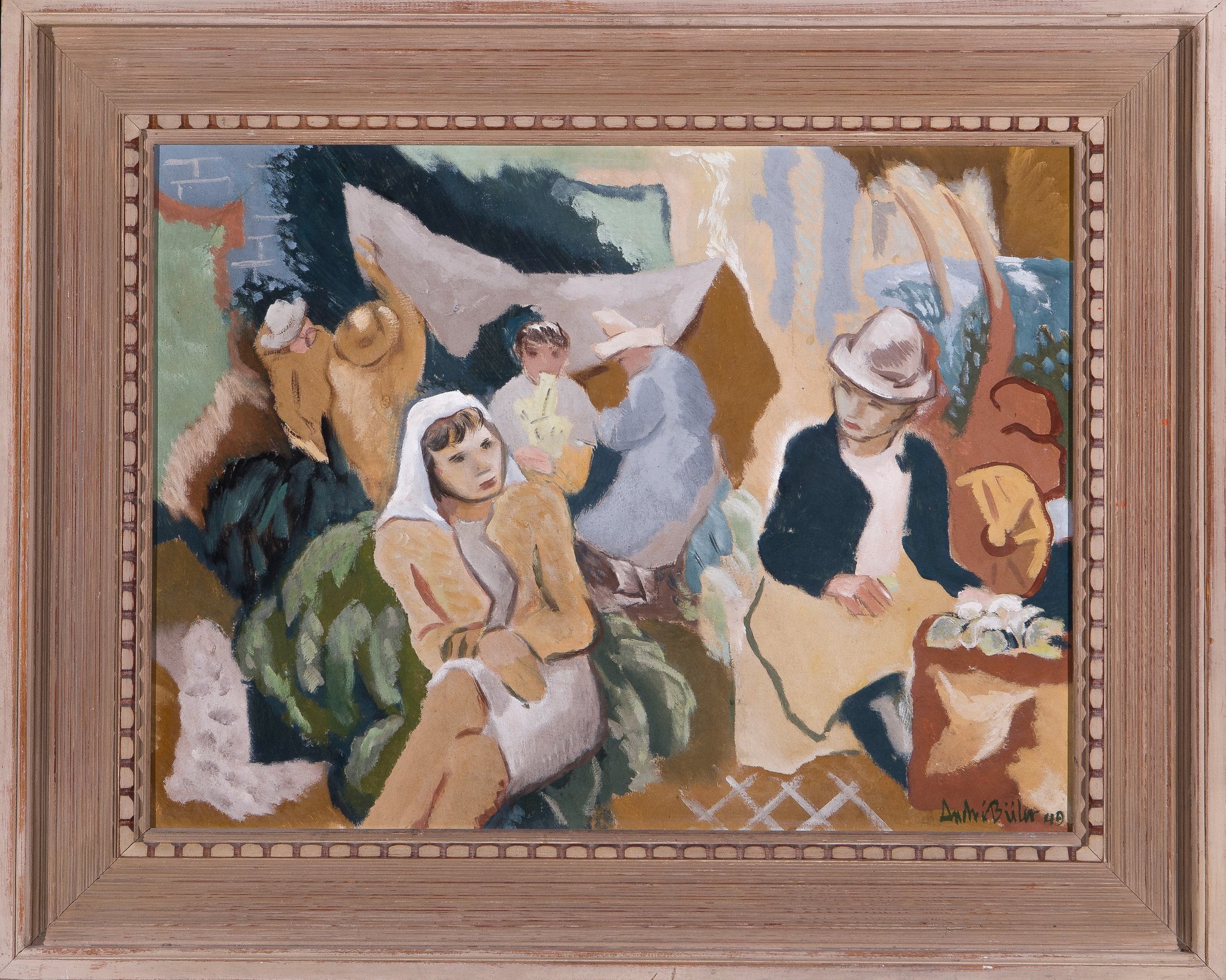
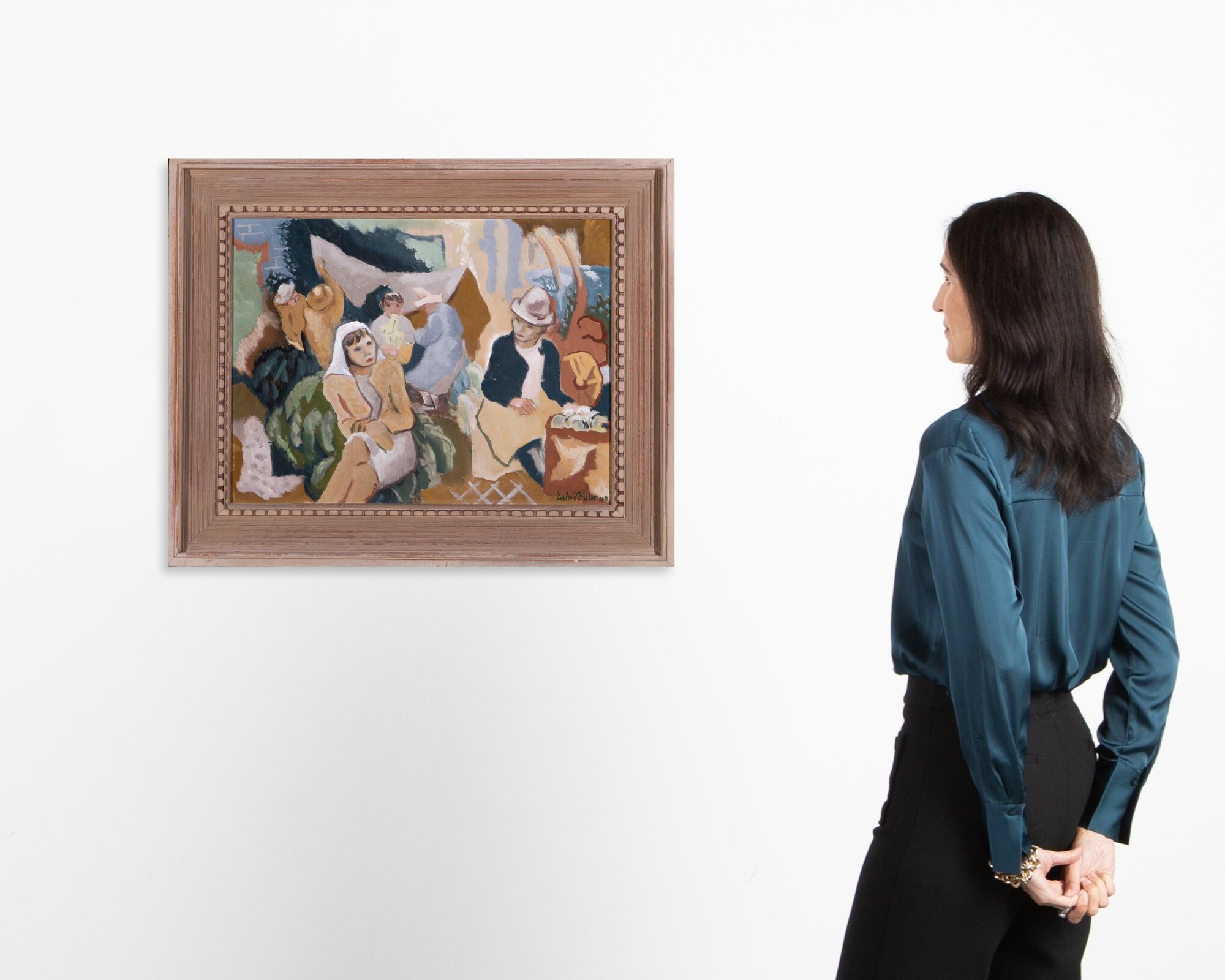
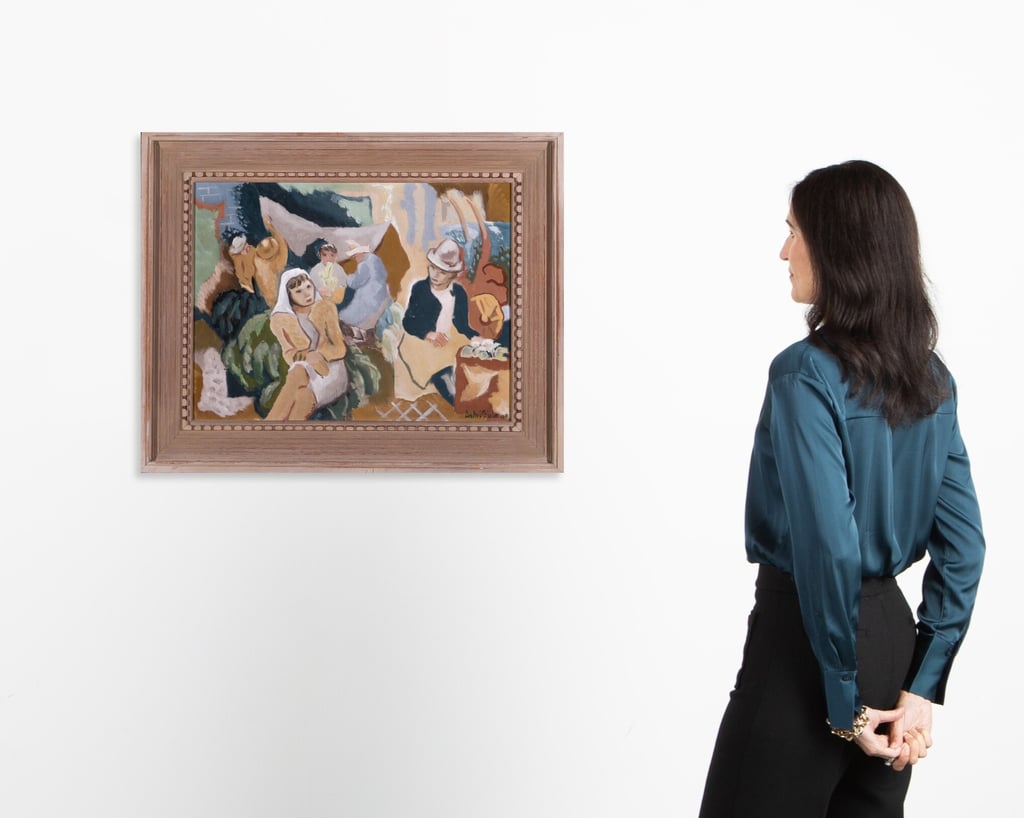
25 x 31 in (63.5 x 78.7 cm) including frame
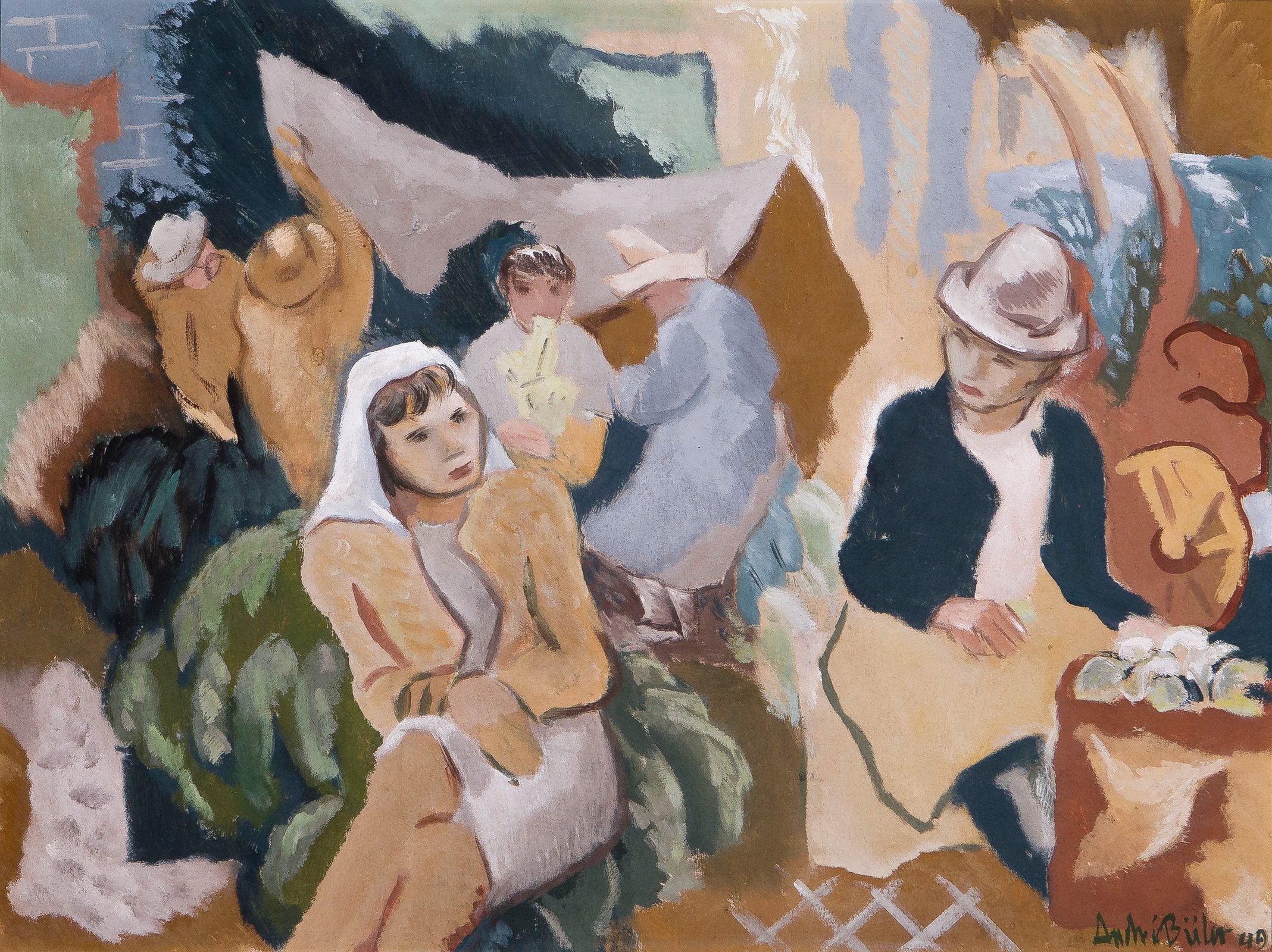
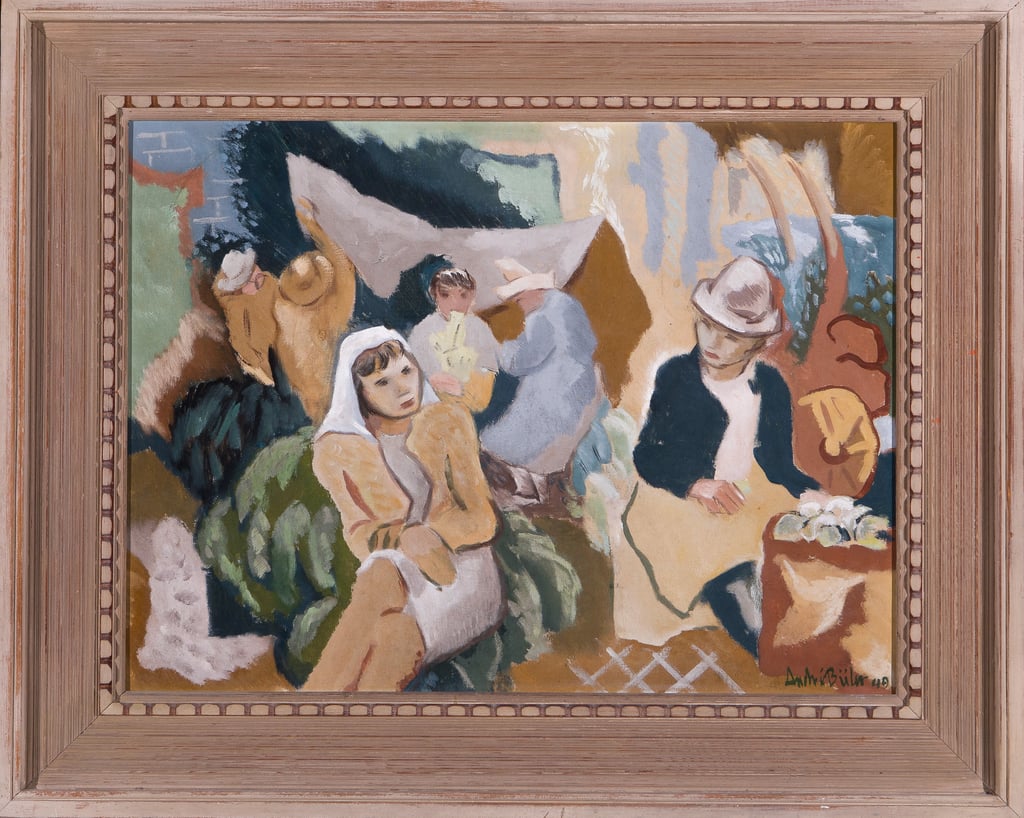
Marche Jacques Cartier (1949) captures the atmospheric bustle of a historic Quebec City market, a subject that remained a central theme throughout André Biéler’s career. The composition is built upon a rhythmic arrangement of figures, where the individual forms of vendors and patrons are simplified into broad, intersecting planes of color. This geometric approach allows Biéler to convey the collective energy of the crowd rather than focusing on specific portraiture.
The work is executed in a palette of earthy ochres, deep forest greens, and muted blues, creating a balanced tonal field that reflects the light of an outdoor public space. Biéler’s application of oil on masonite results in a matte, tactile surface; his brushwork is deliberate, using thick strokes to define the structural weight of the figures and the surrounding market stalls.
By the late 1940s, Biéler had fully integrated his European modernist training with his observation of local Quebecois traditions. In this piece, the "Jacques Cartier" market serves as a stage for exploring human interaction and community labor. The painting stands as a mature example of Biéler’s ability to find modern, abstract patterns within the daily social rituals of Canadian life.
Private Collection, Winnipeg
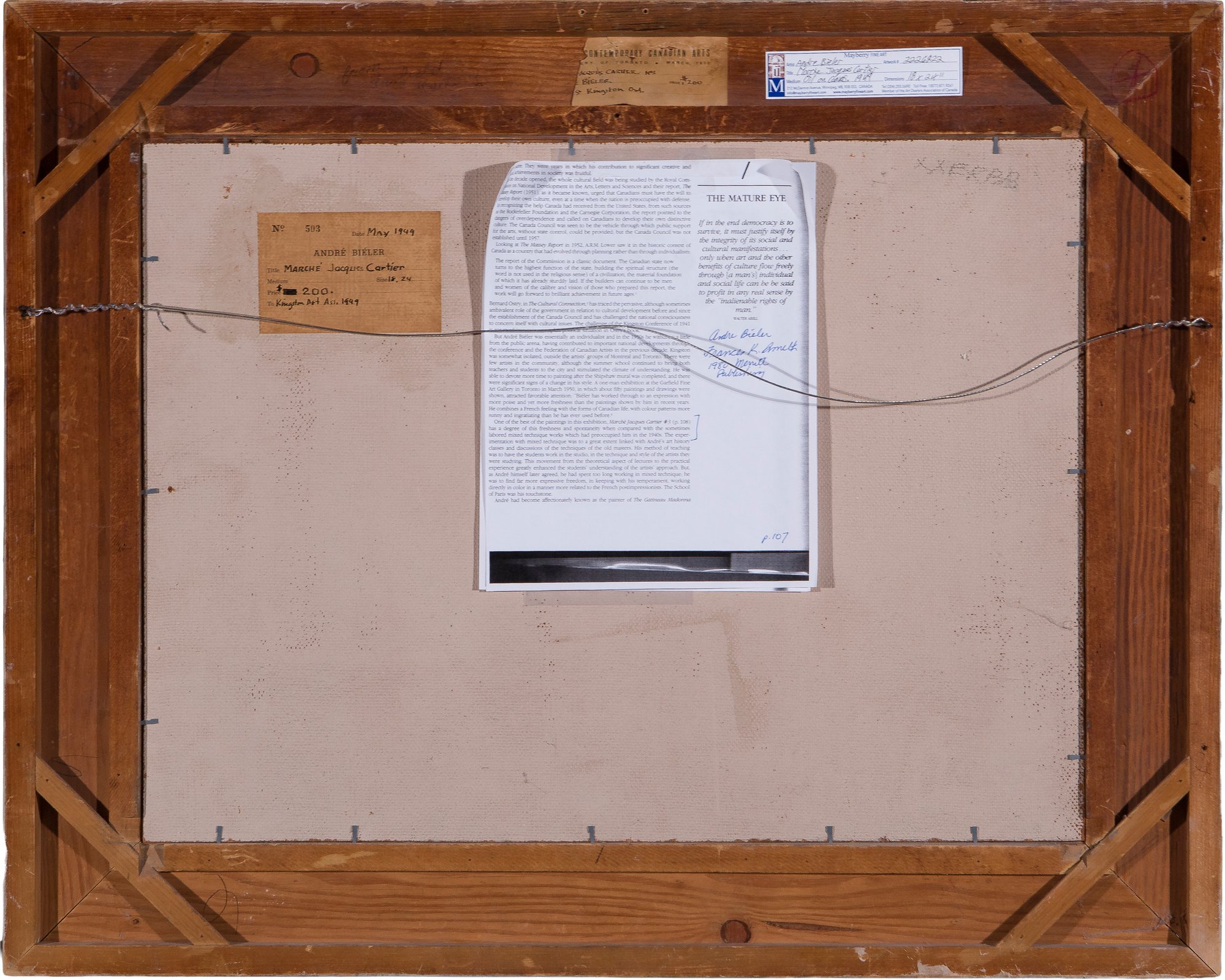
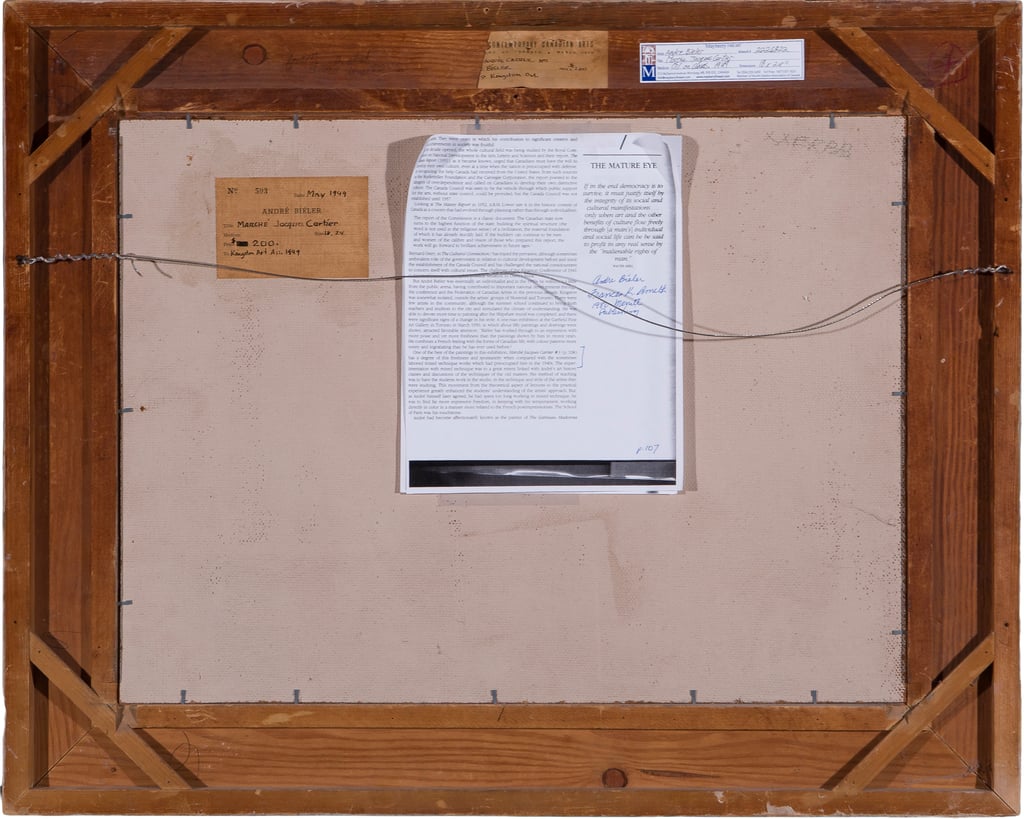
Contemporary Canadian Arts, Toronto 1950
Illustrated on page 108 of Frances Smith, Bieler, An Artist’s Life and Times, first edition (1980), and illustrated on page 220 of the second edition (2006)
(Includes Buyer's Premium)
André Biéler
André Charles Biéler was born on October 8, 1896, in Lausanne, Switzerland, to Charles Biéler, director of the Collège Galliard, and Blanche, daughter of historian Jean-Henri Merle d'Aubigné. The family lived in Paris for twelve years before immigrating to Canada in 1908, settling in Montreal where his father became registrar of Presbyterian College. Biéler studied at Westmount Academy and the Institut Technique de Montreal, intending to pursue architecture. In 1915, he enlisted in the Princess Patricia's Canadian Light Infantry during World War I and was wounded and seriously gassed.
After his release from the army, Biéler studied at the Lycée Carnot in Paris. He returned to Canada in 1919 and went to Florida to recuperate, where Harry Davis Fluhart gave him art lessons. A veteran's grant allowed him to study at the Art Students League of New York in Woodstock under Charles Rosen and Eugene Speicher. From 1922 to 1926, he spent most of his time in Switzerland, studying under his uncle Ernest Biéler, a painter and muralist, and helped with several frescoes in the town hall of Le Locle in Canton Neuchâtel. He also studied in Paris at the Académie Ranson with Maurice Denis and Paul Sérusier. In 1924, he had his first solo exhibition at the Art Association of Montreal.
Biéler lived on the Île d'Orléans in Quebec from 1927 to 1929, where he painted habitants and met A.Y. Jackson. In 1930, he established a studio in Montreal, earning a living through commercial commissions and teaching. He and John Goodwin Lyman founded the Atelier art school, which operated for a short period. In 1931, Biéler married Jeannette Meunier, a young interior decorator and designer, and became involved in designing theater sets, costumes, furniture, interiors, fabrics, and posters. In 1935, they moved to Saint-Adèle in the Laurentian Mountains.
In 1936, Biéler became a professor of art at Queen's University in Kingston, Ontario. In 1941, he organized the first conference of Canadian artists, which led to the foundation of the Federation of Canadian Artists, serving as its first president. He taught at the Banff School of Fine Arts during summers in 1940, 1947, 1949, and 1952. In 1957, Biéler provided impetus for the formation of the Canada Council and was the main organizer of the Agnes Etherington Art Centre in Kingston, serving as its first director until 1963. He retired from Queen's University in 1963.
Biéler's work was modernist, initially emphasizing line and form influenced by his uncle's work in stained glass and mosaic, later showing more interest in light and color. He created genre pictures of rural Quebec life, depicting figures working in groups and gathering around churches. His major commissions included a large mural for the Shipshaw plant of the Aluminum Company of Canada (1945-48), a mural for the Veterans' Affairs Building in Ottawa (1955), seventy-five color woodcuts for the Queen Elizabeth Hotel in Montreal (1957), and mosaic murals for Chalmers United Church and Frontenac Wall & Tile in Kingston. He held more than twenty-five solo exhibitions in locations including Geneva, Montreal, Kingston, Quebec City, and San Miguel de Allende in Mexico. He belonged to the Canadian Group of Painters and the Royal Canadian Academy of Arts, received the J.W.L. Forster Award from the Ontario Society of Artists in 1957, the Canadian Centennial Medal, an honorary doctorate, and was made a member of the Order of Canada in 1987. André Charles Biéler died in Kingston, Ontario, on December 1, 1989, survived by his wife Jeannette and four children.
Major Spring Fine Art Auction
May 7 - May 28, 2026

661 Wall St, Winnipeg MB
(204) 255-5690
mayberryfineart.com
[email protected]
Contact us to make an appointment to preview this item or to sell similar works.
|
Bidding Range
|
Increment
|
|---|---|
| $0.00 - $50.00 | $1.00 |
| $50.00 - $100.00 | $5.00 |
| $100.00 - $500.00 | $10.00 |
| $500.00 - $1,000.00 | $25.00 |
| $1,000.00 - $5,000.00 | $50.00 |
| $5,000.00 - $10,000.00 | $100.00 |
| $10,000.00 - $20,000.00 | $200.00 |
| $20,000.00 - $50,000.00 | $500.00 |
| $50,000.00 - $100,000.00 | $1,000.00 |
| $100,000.00+ | $5,000.00 |
Login or register a BidLots.com account to participate in any auction. Track specific lots and artists with real-time notifications on all bidding activity.
Bidding approval requires three simple steps:
1. Create a Bid Lots account
2. Confirm your email address
3. Create a valid billing profile
Bid Lots and/or the auctioneer may choose to revoke your bidding privileges if your account is not in good standing or your activity is in conflict with our standard terms and conditions of sale.
The buyer’s premium is an additional percentage charged to the winning bidder. The buyer’s premiums may vary from auction to auction, typically ranging from 10% to 20%. Buyer’s premiums will be displayed on detailed lot listings and paddle registration forms.
Bidding begins at the reserve price and advances at set increments based on the bidding range. The specific bidding increments may vary from auction to auction, however the next bid and subsequent increments will always be clearly defined on detailed lot listings. Maximum Bids and Single Bids can only be placed within the pre-defined bidding increments ensuring that no two bidders can place identical bids on an item. View individual lot detail pages to see a complete range of bidding increments for that item.
Requests to cancel a single bid are at the sole descretion of the auctioneer. Maximum bids can be increased but cannot be decreased unless premitted by the auctioneer. Requests to cancel a bid or to alter a maximum bid will be denied if the specific lot is scheduled to close in less than 24 hours or if the lot has significant interest or activity.
To request that a bid be cancelled or to change a maximum bid use the "Ask a question" button on the detailed lot listing.
You will receive an email notification when you have successfully won an auction. You will also see the item listed on your "Bidding Results" page and if you are logged into the site you will see a highlighted message on the auction catalogue pages and auction listings.
Shipping requirements may vary on different items depending on location and size or weight of an item. When registering for a specific auction you will be provided options to clarify your preferred shipping instructions. The auctioneer will also review and provide specific shipping quotes or options following the close of an auction. If you have specific shipping requirements or are unsure of the shipping constraints on a specific item please contact the auctioneer prior to bidding.
Following the close of an auction the auctioneer will provide a detailed invoice for all items you have won. They may contact you before a final invoice is prepared to confirm or review specific shipping instructions. Payment is due once a final invoice is provided and can be submitted online by credit card, or made by EFT (Electronic Fund Transfer), bank draft or international wire transfer. Any outstanding balance will be automatically charged to your registered credit card 5 days following the close of an auction.