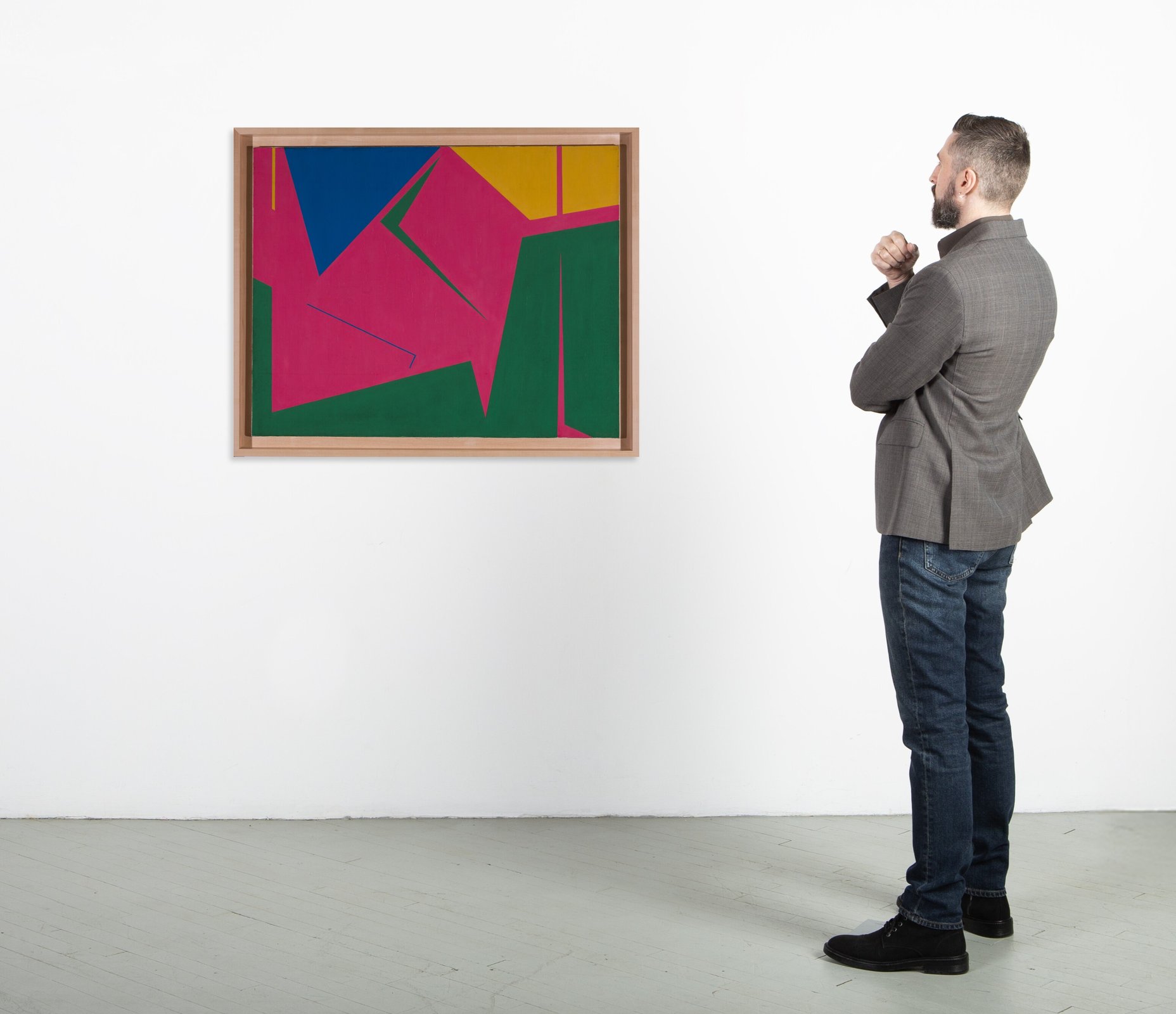
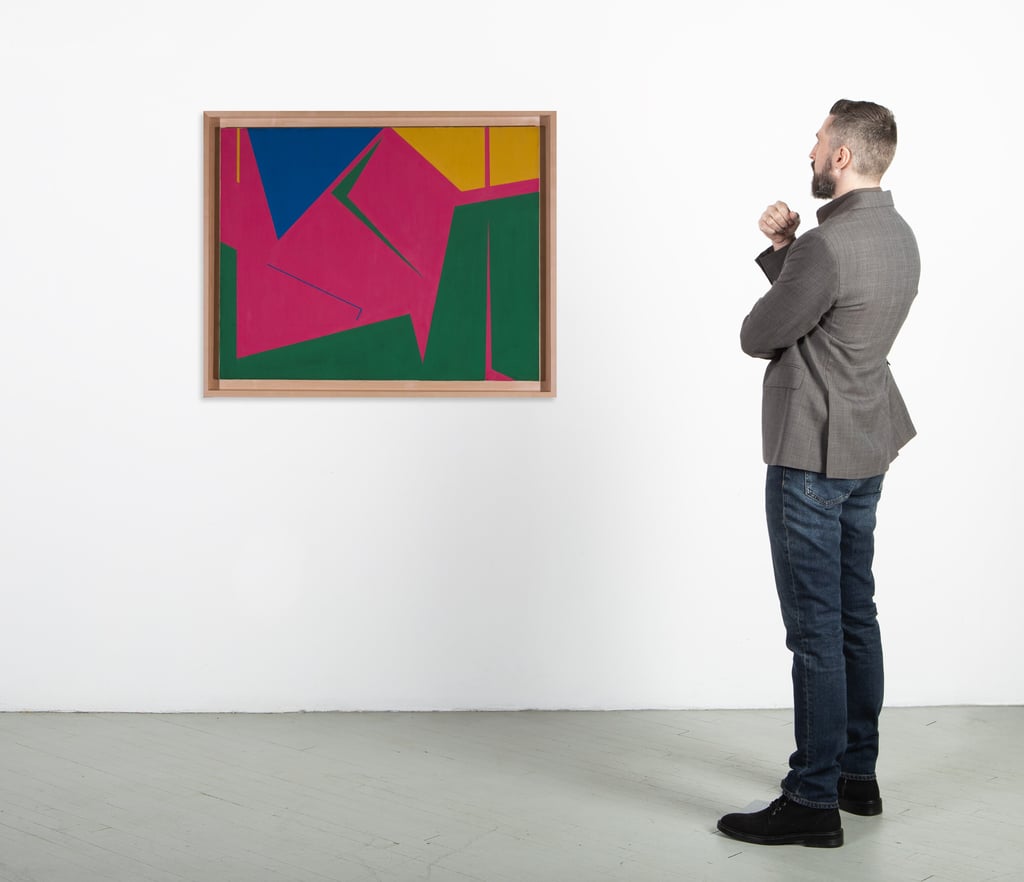
32.5 x 40 x 2 in (82.6 x 101.6 x 5.1 cm) including frame
Fernand Leduc was an influential figure in post-war Quebec abstraction. An early member of Les Automatistes and a signatory of the 1948 Refus global manifesto, Leduc helped shift Montreal’s artistic landscape toward non-objective painting, later co-founding the Non-Figurative Artists' Association of Montreal (NFAAM) in 1956. By the late 1950s and early 1960s, while based in France yet maintaining direct ties to Montreal, Leduc moved away from gestural automatism toward the structural clarity of hard-edge geometric abstraction and color theory.
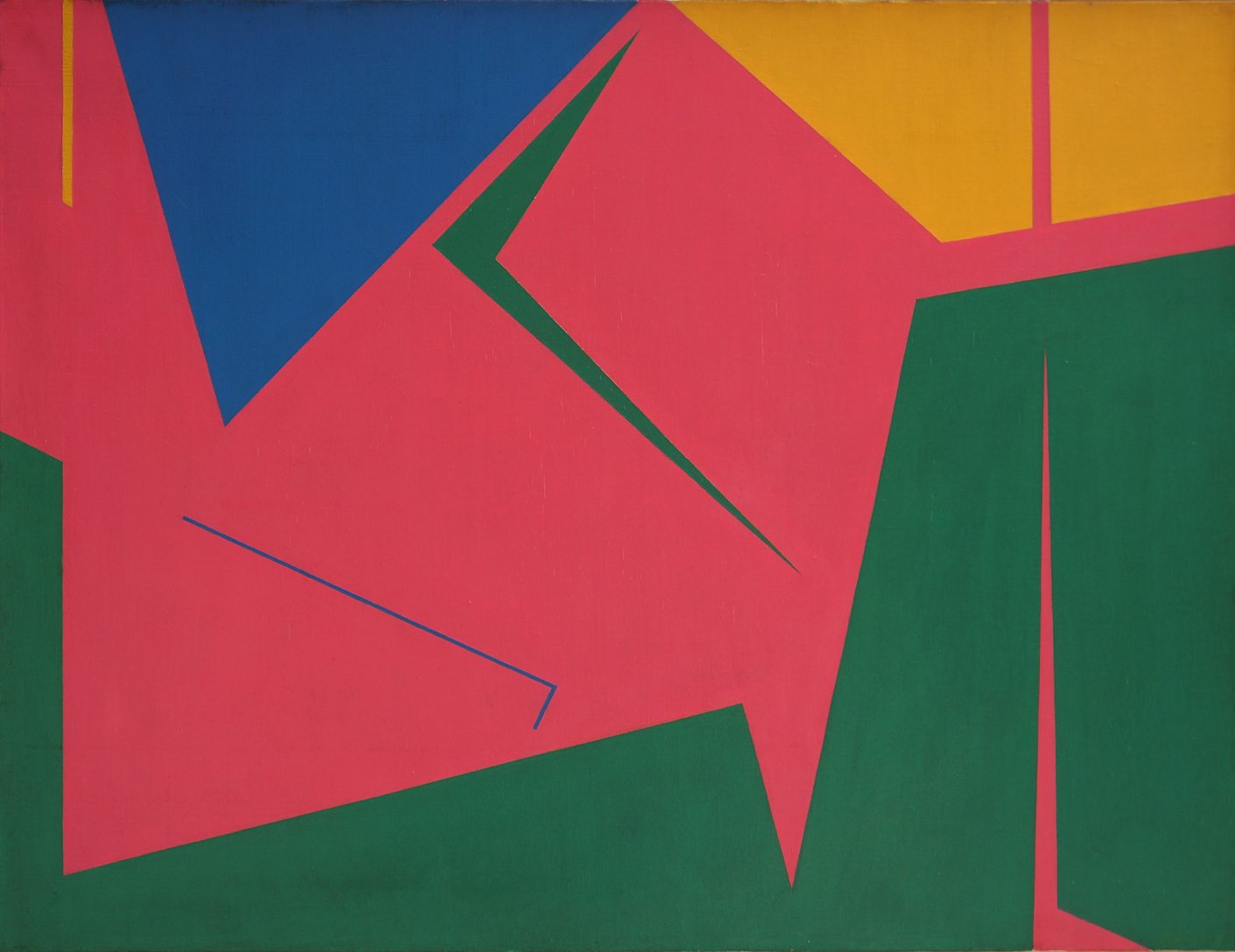
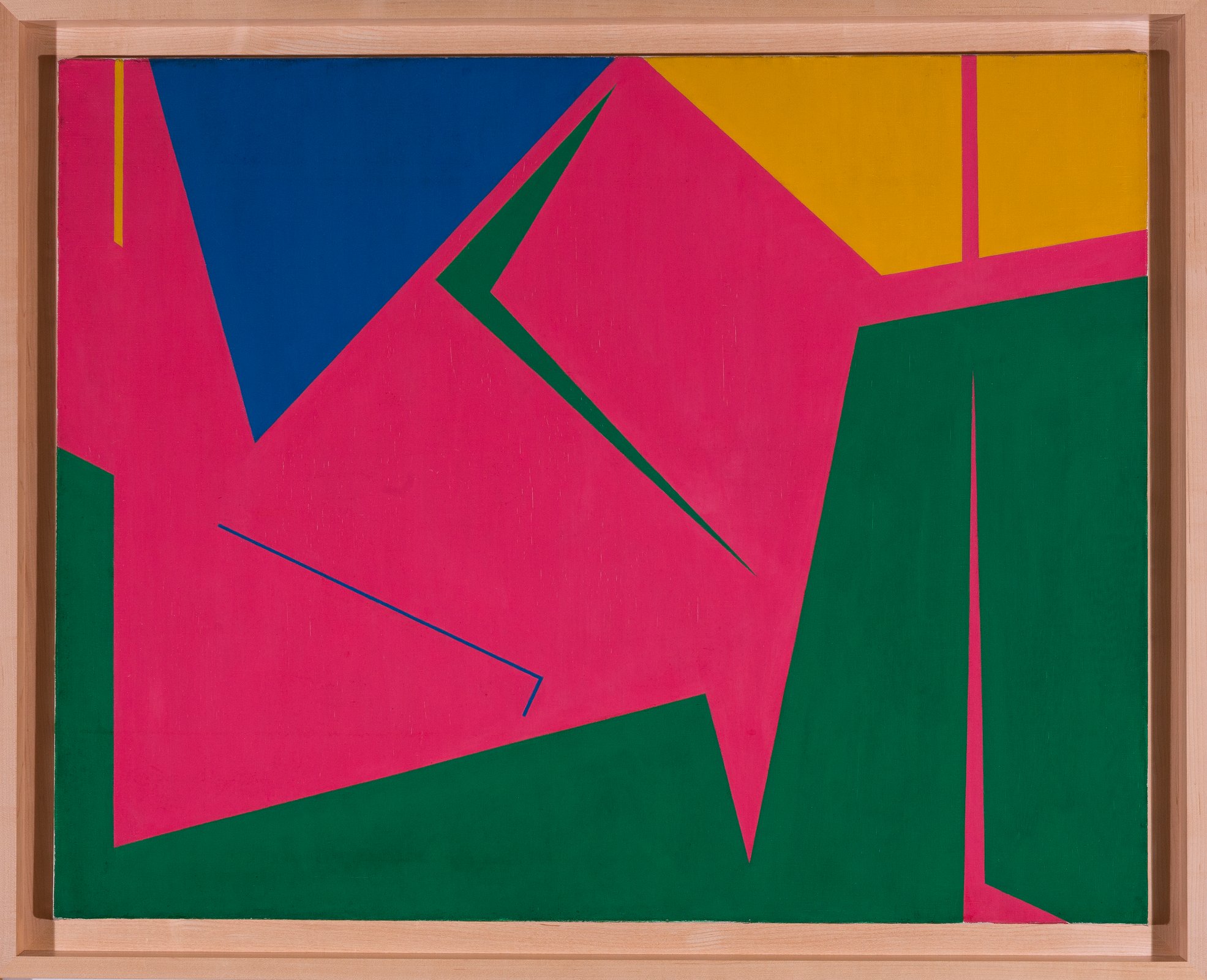
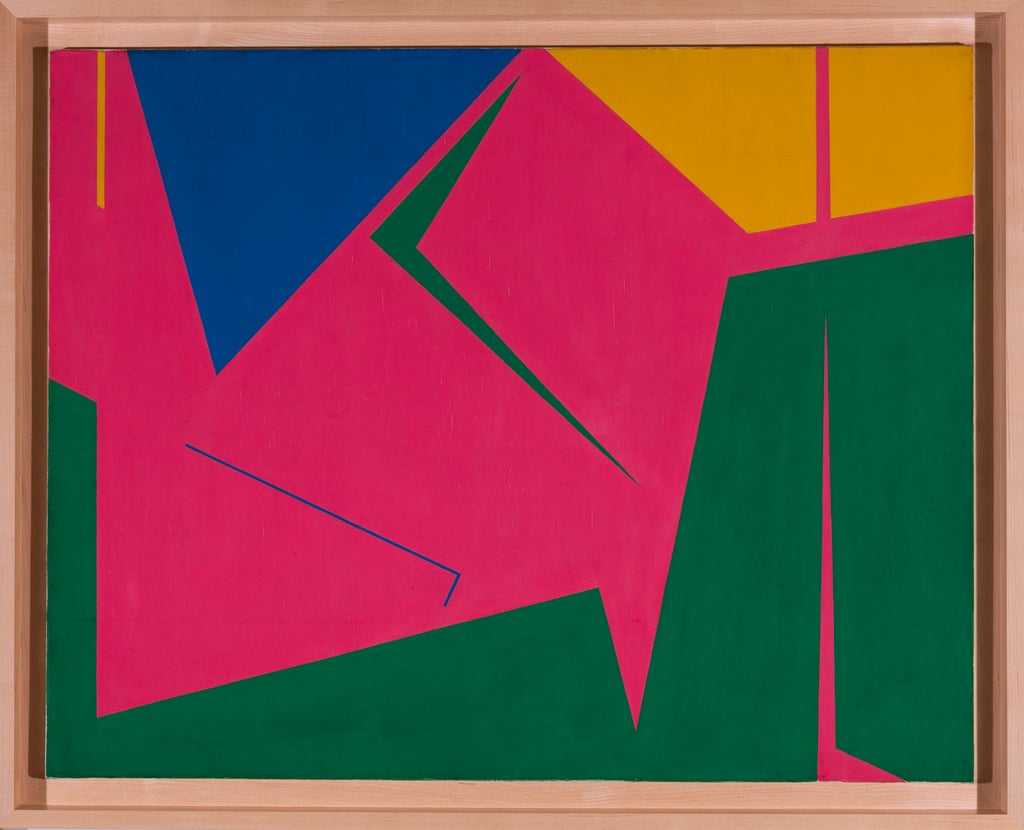
Painted in 1961, Composition J documents this shift in practice. The canvas is arranged into interlocking, hard-edged fields of saturated magenta, forest green, cobalt blue, and warm yellow. Sharp angles govern the division of space, accented by fine linear elements—such as the slender yellow band along the upper-left margin, a blue angled vector in the lower left, and narrow incisions cutting through the color blocks.
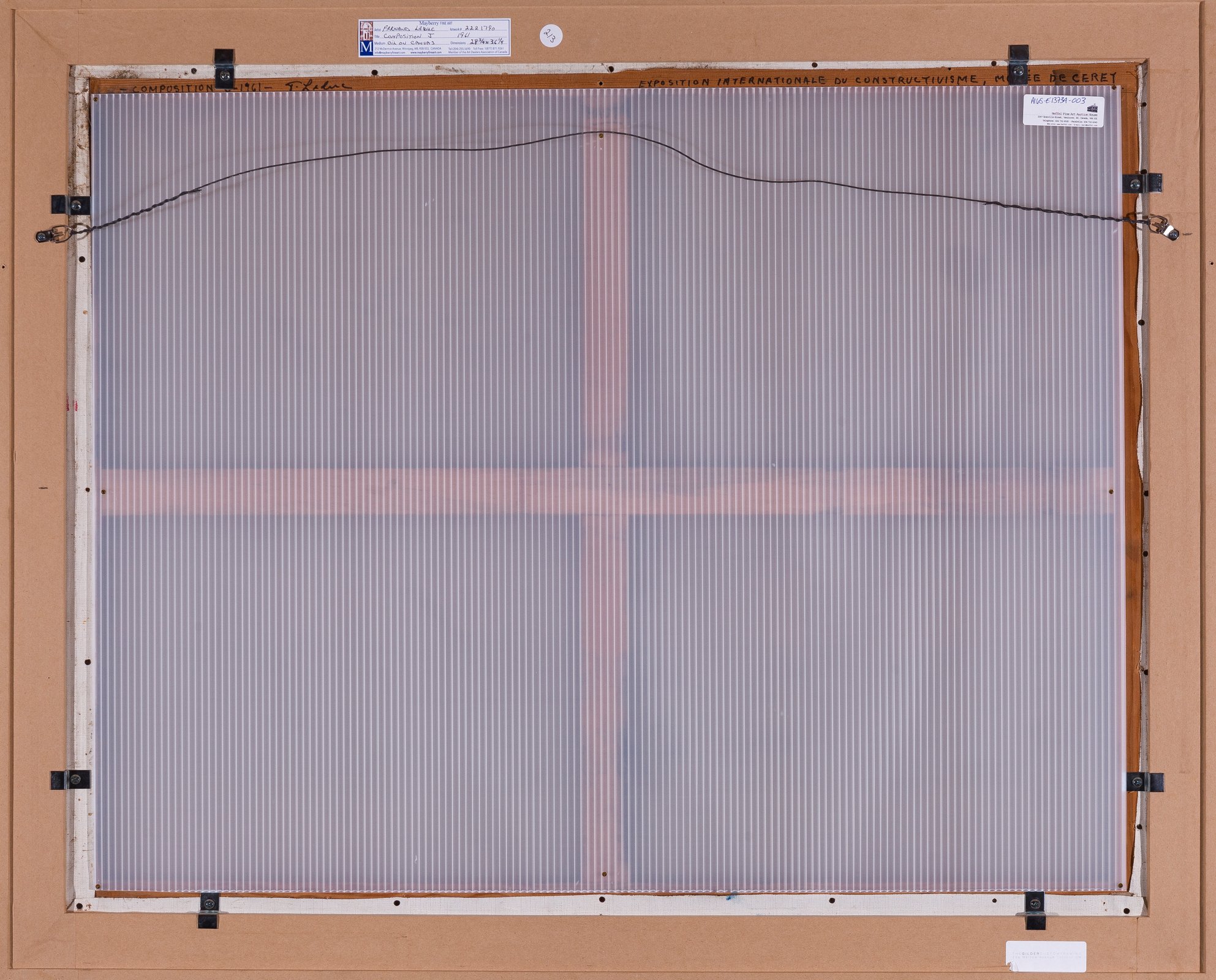
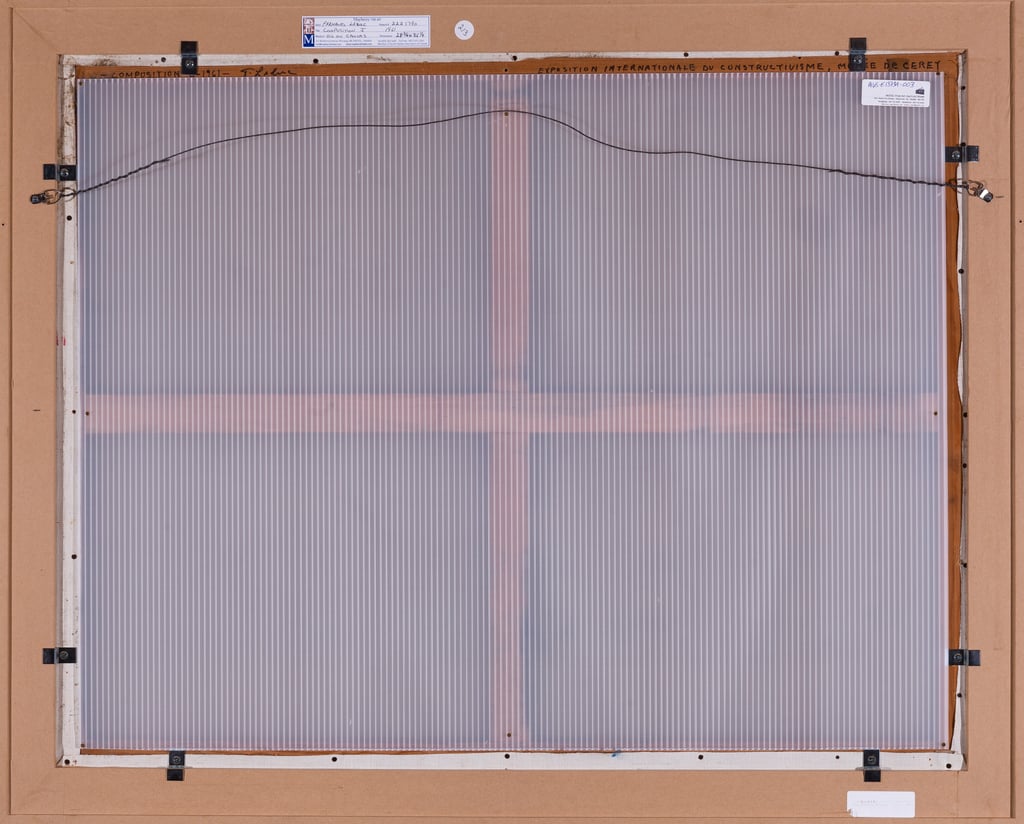
The painting was included in the Exposition Internationale du constructivisme at the Musée d'art moderne de Céret in the autumn of 1962, reflecting Leduc's engagement with European geometric movements of the period. With flat paint application that removes visible gesture, the work investigates edge tension, spatial equilibrium, and the planar relationships of pure color, marking a transitional moment in Leduc's development toward his later chromatic light paintings.
Galerie Callu Mérite, Paris, France.
Private collection, Toronto, Canada.
Canadian Art Group, Toronto
Mayberry Fine Art, Winnipeg
Private Collection, Vancouver
Exposition Internationale du constructivisme, 8 Sept - 8 Oct., 1962,
Musée d'art moderne de Céret, France.
Fernand Leduc
Fernand Leduc (1916-2014) was a Canadian abstract painter born in Montreal, Quebec. He began his artistic education in 1938 at the Ecole des beaux-arts de Montreal, graduating in 1943. During his student years, he grew dissatisfied with the academic curriculum and sought out painter Paul-Emile Borduas, becoming an early participant in the discussions and studio sessions that led to the formation of Les Automatistes. In 1947, he relocated to Paris, France, where he served as an intermediary between the Montreal group and European surrealist circles, facilitating connections with Andre Breton.
In 1948, Leduc contributed to the publication of the Refus global manifesto, signing the document alongside fifteen other members of the Automatiste movement. Although living in France at the time of its release, he sent paintings back to Canada for the movement's defining exhibitions. He returned to Montreal in 1953, where he took on an active organizational role in the local art community. In 1956, he helped establish the Non-Figurative Artists' Association of Montreal (Association des artistes non-figuratifs de Montreal) and served as its first president.
During the mid-1950s, Leduc shifted away from the gestural abstraction of the Automatistes toward the geometric discipline of the Plasticiens. He returned to France in 1959, living and maintaining studios in Paris and later in the commune of Callian in the Var region. Over the following decades, his studio work concentrated on color interactions, leading to his microchromies series of the 1970s, which investigated subtle gradations of light and chromatic relationships on large canvases.
Leduc returned to Canada in 2006, settling once again in Montreal. Throughout his career, his work was featured in major museum exhibitions, including retrospective surveys organized by the Musee d'art contemporain de Montreal in 1970 and 2006. His paintings are preserved in public permanent collections, including the National Gallery of Canada in Ottawa, the Montreal Museum of Fine Arts, the Musee national des beaux-arts du Quebec in Quebec City, and the Art Gallery of Ontario in Toronto. In 1977, he received the Prix Louis-Philippe-Hebert from the Societe Saint-Jean-Baptiste de Montreal, followed by the Prix Paul-Emile-Borduas from the Government of Quebec in 1988 and the Governor General's Award in Visual and Media Arts in 2007. Leduc died in Montreal on January 28, 2014, at the age of ninety-seven.
Major Fall Fine Art Auction
November 12 - December 3, 2026
661 Wall St, Winnipeg MB
(204) 255-5690
mayberryfineart.com
[email protected]
Contact us to make an appointment to preview this item or to sell similar works.
|
Bidding Range
|
Increment
|
|---|---|
| $0.00 - $50.00 | $1.00 |
| $50.00 - $100.00 | $5.00 |
| $100.00 - $500.00 | $10.00 |
| $500.00 - $1,000.00 | $25.00 |
| $1,000.00 - $2,500.00 | $50.00 |
| $2,500.00 - $10,000.00 | $100.00 |
| $10,000.00 - $20,000.00 | $200.00 |
| $20,000.00 - $50,000.00 | $500.00 |
| $50,000.00 - $100,000.00 | $1,000.00 |
| $100,000.00 - $300,000.00 | $5,000.00 |
| $300,000.00 - $1,000,000.00 | $10,000.00 |
| $1,000,000.00 - $2,000,000.00 | $25,000.00 |
| $2,000,000.00+ | $50,000.00 |
Login or register a BidLots.com account to participate in any auction. Track specific lots and artists with real-time notifications on all bidding activity.
Bidding approval requires three simple steps:
1. Create a Bid Lots account
2. Confirm your email address
3. Create a valid billing profile
Bid Lots and/or the auctioneer may choose to revoke your bidding privileges if your account is not in good standing or your activity is in conflict with our standard terms and conditions of sale.
The buyer’s premium is an additional percentage charged to the winning bidder. The buyer’s premiums may vary from auction to auction, typically ranging from 10% to 20%. Buyer’s premiums will be displayed on detailed lot listings and paddle registration forms.
Bidding begins at the reserve price and advances at set increments based on the bidding range. The specific bidding increments may vary from auction to auction, however the next bid and subsequent increments will always be clearly defined on detailed lot listings. Maximum Bids and Single Bids can only be placed within the pre-defined bidding increments ensuring that no two bidders can place identical bids on an item. View individual lot detail pages to see a complete range of bidding increments for that item.
Requests to cancel a single bid are at the sole descretion of the auctioneer. Maximum bids can be increased but cannot be decreased unless premitted by the auctioneer. Requests to cancel a bid or to alter a maximum bid will be denied if the specific lot is scheduled to close in less than 24 hours or if the lot has significant interest or activity.
To request that a bid be cancelled or to change a maximum bid use the "Ask a question" button on the detailed lot listing.
You will receive an email notification when you have successfully won an auction. You will also see the item listed on your "Bidding Results" page and if you are logged into the site you will see a highlighted message on the auction catalogue pages and auction listings.
Shipping requirements may vary on different items depending on location and size or weight of an item. When registering for a specific auction you will be provided options to clarify your preferred shipping instructions. The auctioneer will also review and provide specific shipping quotes or options following the close of an auction. If you have specific shipping requirements or are unsure of the shipping constraints on a specific item please contact the auctioneer prior to bidding.
Following the close of an auction the auctioneer will provide a detailed invoice for all items you have won. They may contact you before a final invoice is prepared to confirm or review specific shipping instructions. Payment is due once a final invoice is provided and can be submitted online by credit card, or made by EFT (Electronic Fund Transfer), bank draft or international wire transfer. Any outstanding balance will be automatically charged to your registered credit card 5 days following the close of an auction.