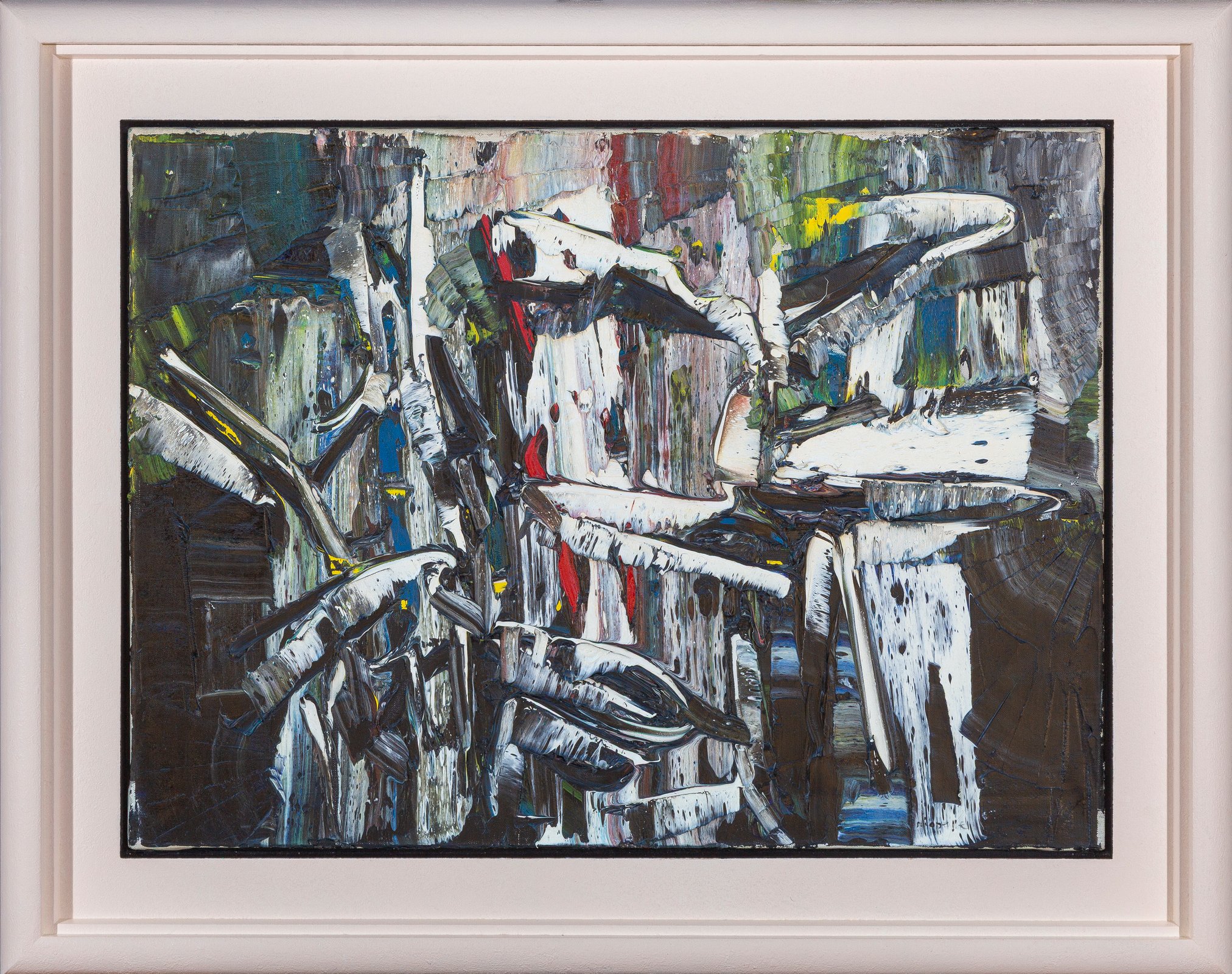
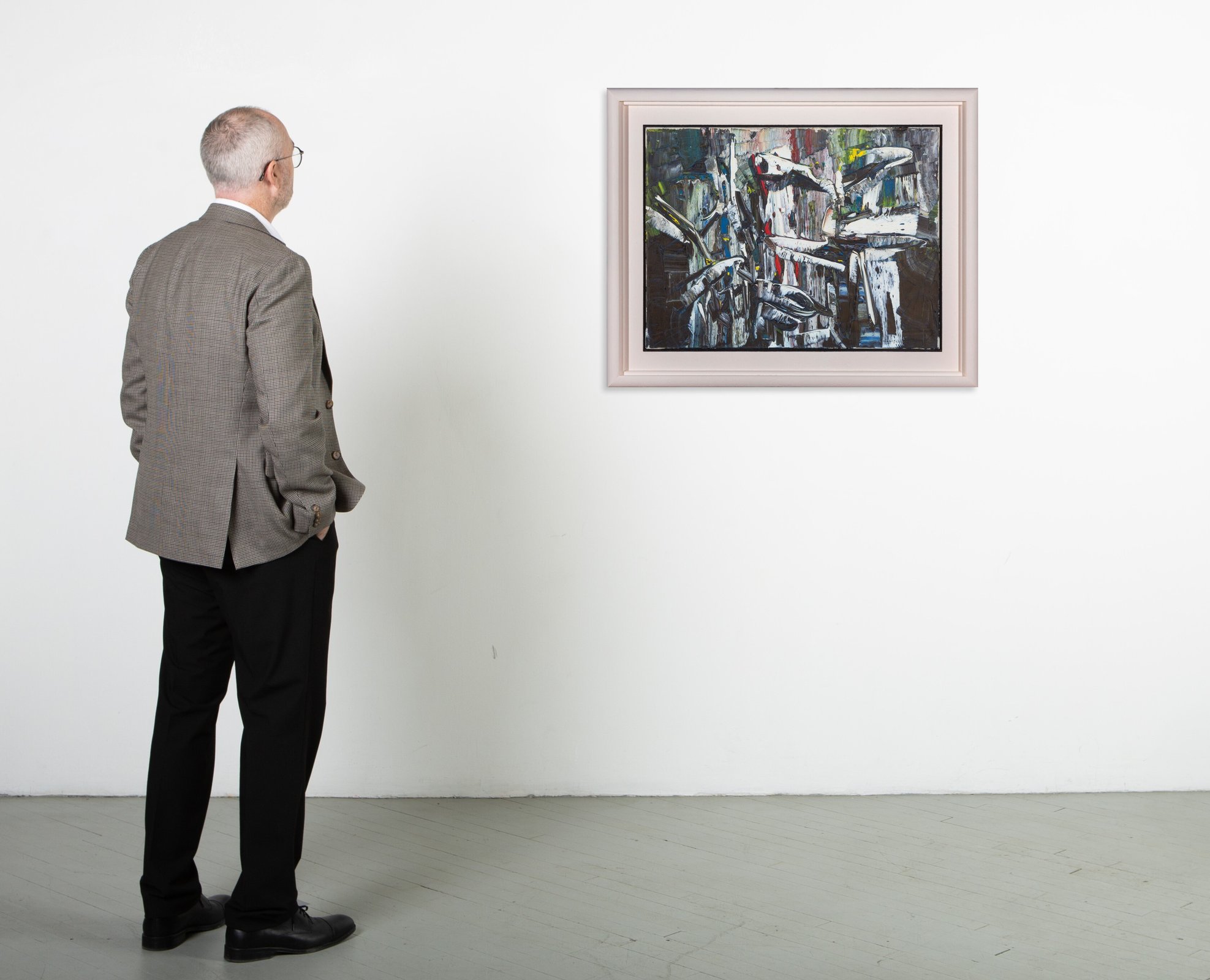
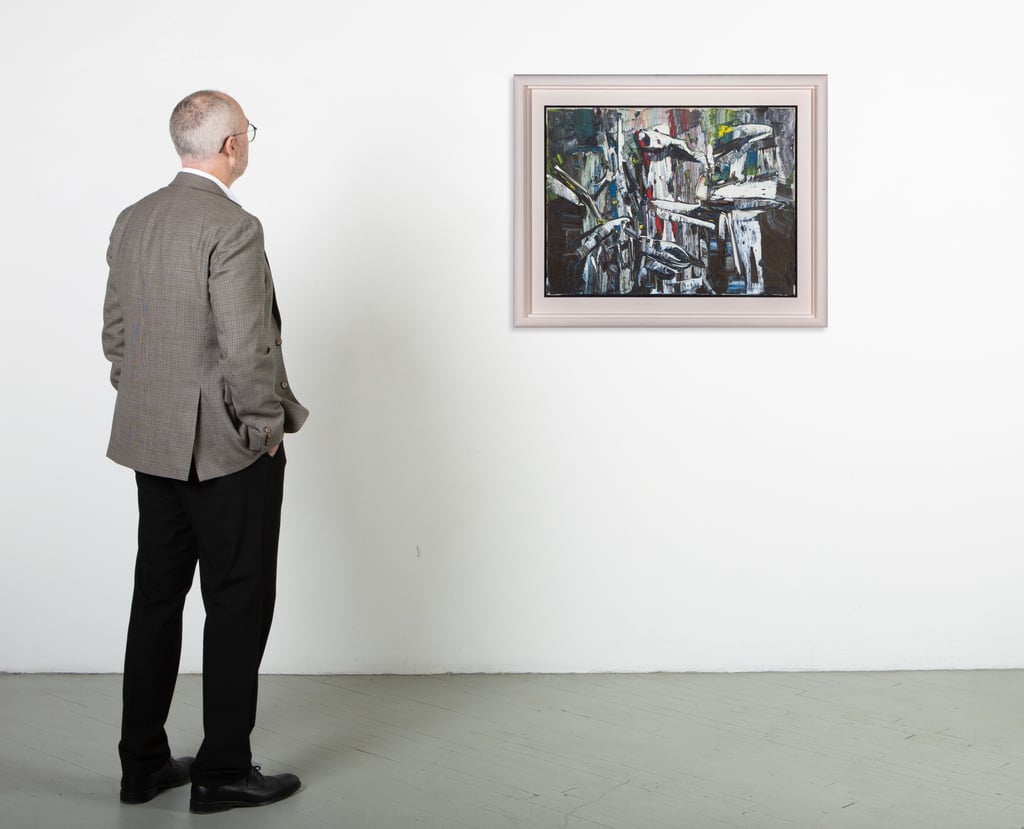
29 x 36 in (73.7 x 91.4 cm) including frame
Jean Paul Riopelle stands as one of the few twentieth-century Canadian painters to achieve widespread international critical acclaim. Emerging from Montreal’s Automatiste movement and co-signing the 1948 Refus global manifesto, Riopelle established his studio in Paris, where his work aligned with European Tachisme and Lyrical Abstraction while developing in dialogue with American Abstract Expressionism. By the mid-1950s, Riopelle was exhibiting extensively on both sides of the Atlantic, represented by major dealers such as Pierre Loeb in Paris and Pierre Matisse in New York, and included in international surveys at the Venice Biennale, the São Paulo Biennial, and the Guggenheim Museum.
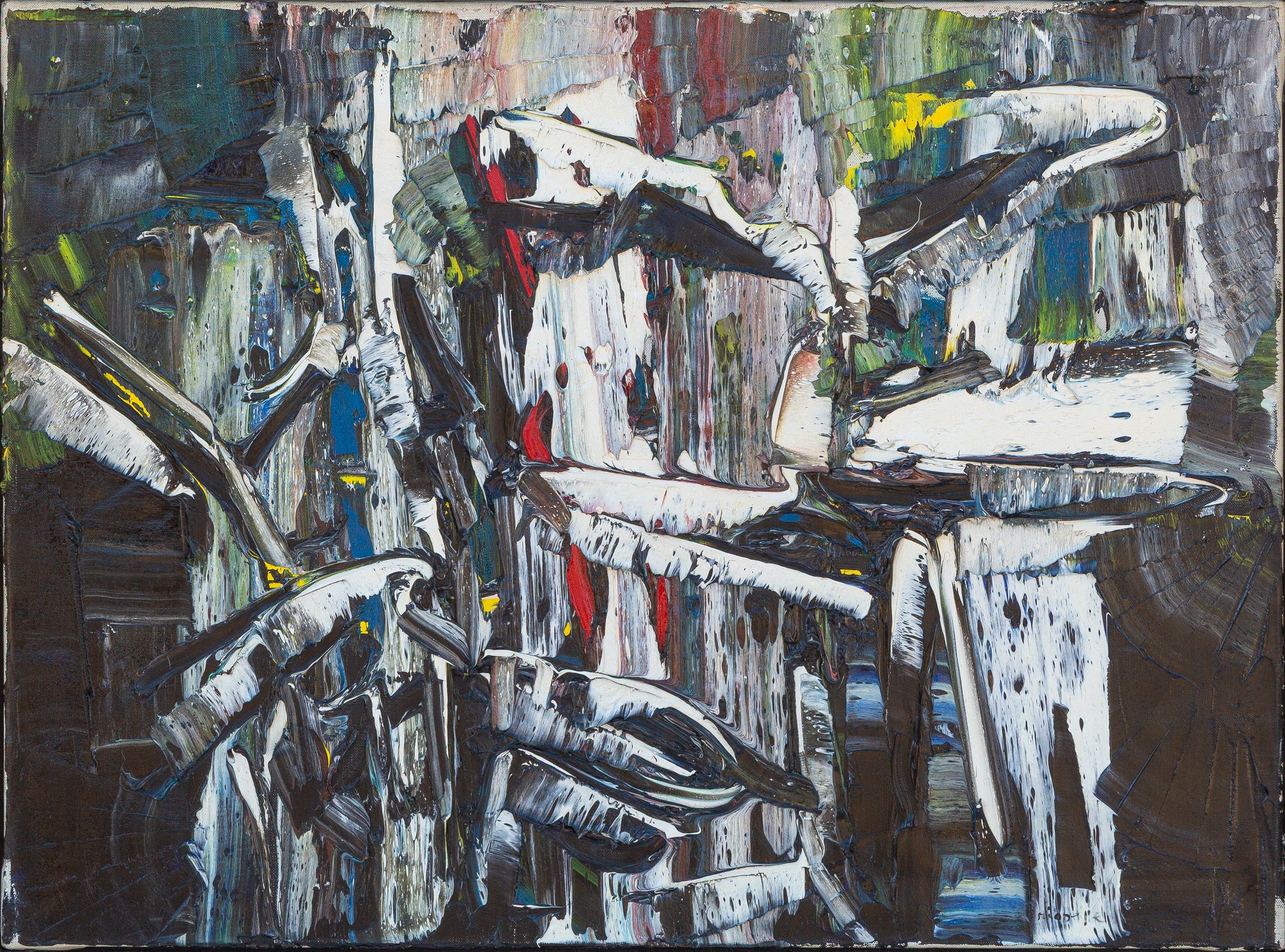
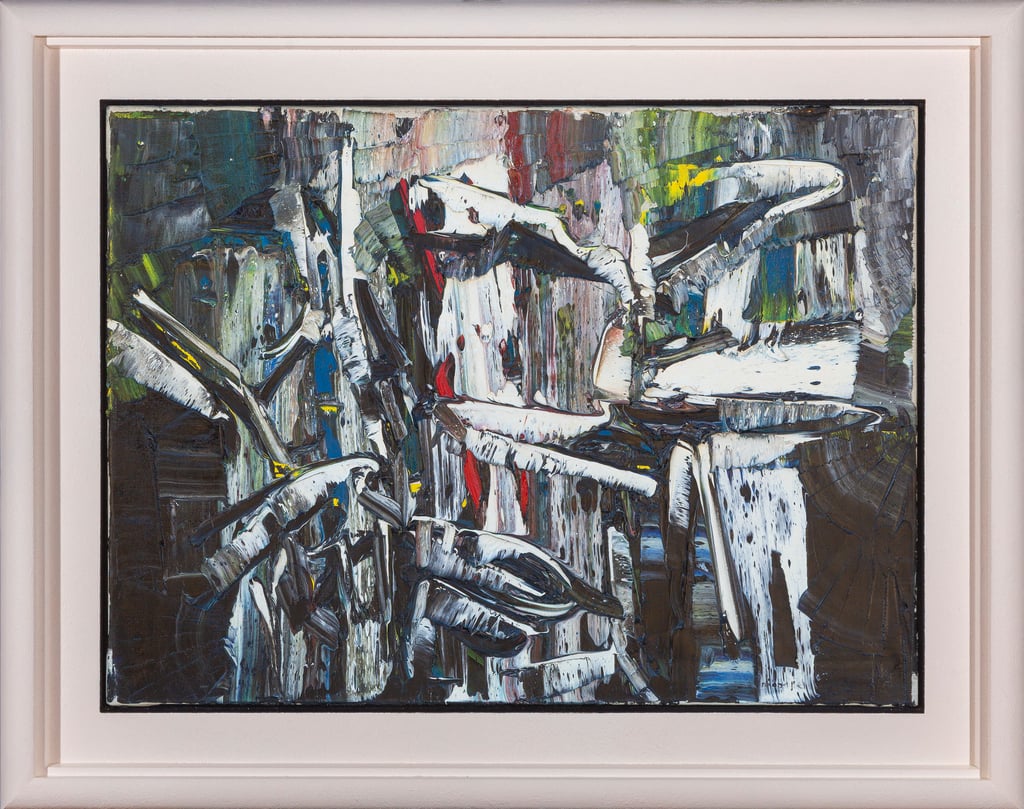
Painted in 1957, Antique belongs to a transformative phase in Riopelle’s painterly evolution. While his celebrated canvases of the early to mid-1950s were defined by uniform, all-over mosaics of pure prismatic color, his late-1950s output shifted toward greater structural dynamism, broader gestural planes, and a more focused tonal palette.
In Antique, Riopelle builds an active relief surface using his signature palette knife technique, applying heavy impasto in sweeping, decisive strokes. Bold bands of opaque white and deep earth tones dominate the composition, anchored by dark brown and charcoal grounds. Beneath and between these textured slabs of paint, flashes of primary red, cobalt blue, and bright yellow emerge, providing optical vibration and spatial depth across the picture plane. The faceted, directional marks intersect in dynamic diagonal and horizontal thrusts, balancing energetic movement with compositional stability. Documented in the artist's catalogue raisonné, Antique provides a resolved example of Riopelle’s mature gestural abstraction during the height of his international recognition.
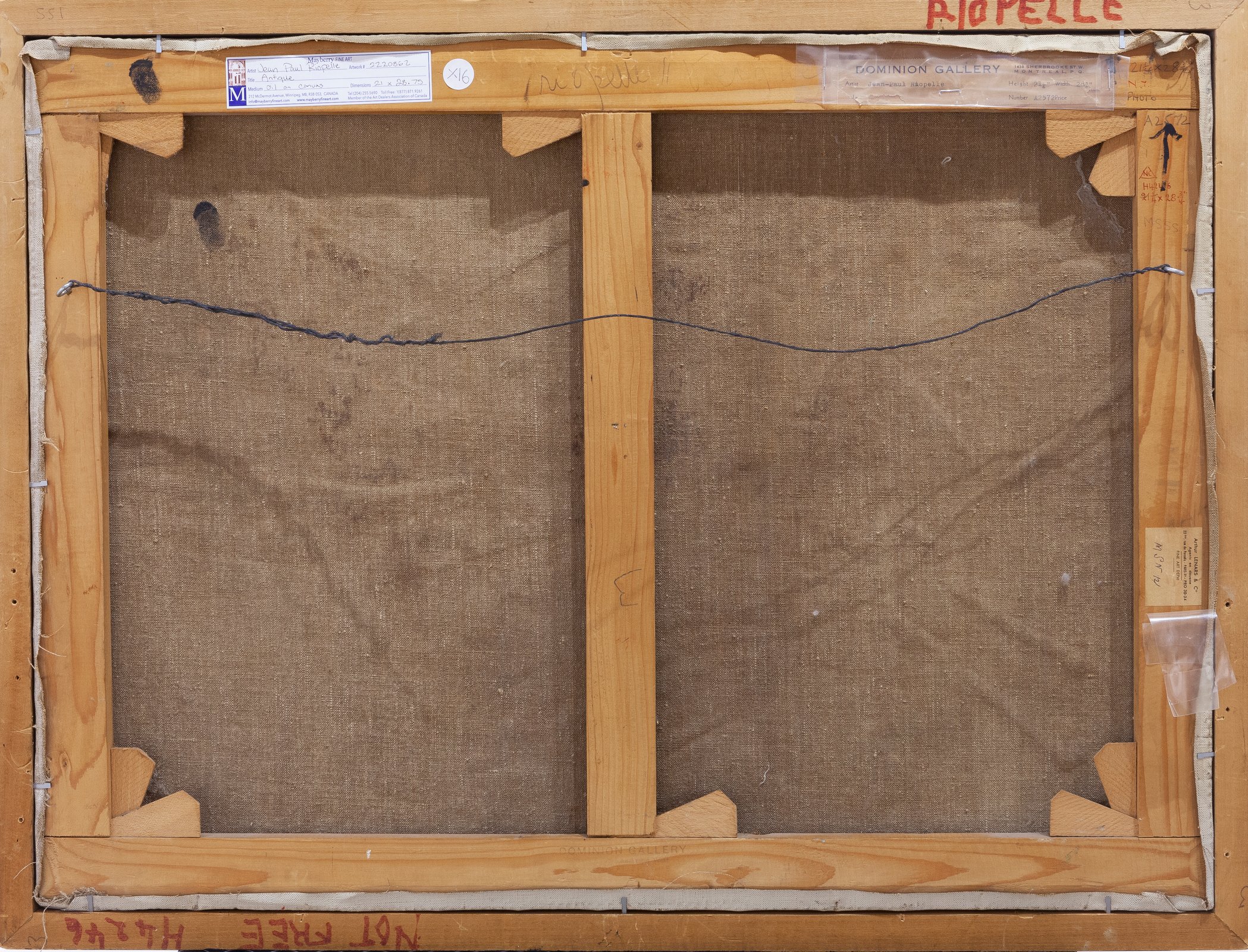
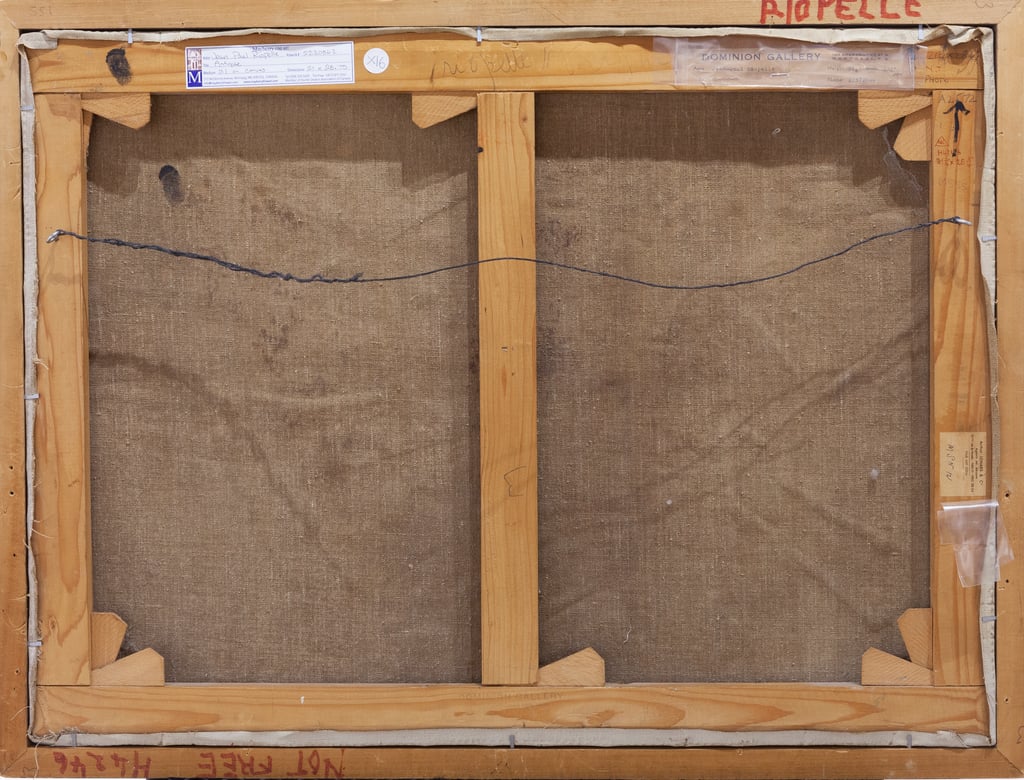
Dominion Gallery, Montreal
Private Collection, Edmonton
Mayberry Fine Art, Winnipeg
Private Collection, Winnipeg
Yseult Riopelle, Jean Paul Riopelle: Catalogue Raisonné, Tome 2, 1954–1959, Montreal: Hibou Éditeurs, 2004, reproduced p. 278, no. 1957.129H.1957.
Jean Paul Riopelle
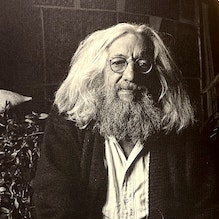
Jean-Paul Riopelle had an avid interest in art growing up. When his parents noticed this, his family enrolled him in art classes, but they would go on to discourage his work in favor of a more reliable education. He grew up in a bourgeois household in Montreal as the son of a carpenter. His mother, Anna, had inherited properties from her father. Riopelle failed at the polytechnic that his parents wanted him to attend and moved on to the École des Beaux-Arts in Montreal. Shortly thereafter, he enrolled in the École du Meuble and took classes under Paul-Émile Borduas. Borduas pushed the young instructor to forge his own visual language and disregard the artistic conventions of Quebec at the time. Riopelle would go on to sign the ‘Refus Global’ manifesto written by Borduas in 1948, once again critiquing the stagnation of society in Quebec. It placed emphasis on passion rather than reason, which is a major theme in Riopelle’s work.
It was suggested by Hélène de Billy that the painter’s reluctance to use white was influenced by the death of his brother, Pierre, at a young age. The Catholic burial rites dictated that the clothes and objects buried with the deceased must be white, thus the color went on to remind Riopelle of his late brother. As Riopelle got older, white re-emerged in his work (for example in Untitled Abstract in White and Gray (1959), Sans Titre (1978) and L’heure feu follet (1956)). His colossal Hommage à Rosa Luxemburg (1992) paid tribute to his late companion, Joan Mitchell. The 30 panels were completed using spray paint, a medium Riopelle favored later in life.
Riopelle was criticized in university for confining himself to an academic approach in his art. This may be surprising, given the abstract style he later developed that went on to make him an icon in Canadian and Abstract art. Riopelle’s recognizable style was honed under Borduas and grew from his relationship with European surrealists. Wielding a palette knife, Riopelle applies the paint quickly with the acute precision of a master fencer. His application is angular and creates explosions of supreme color. While his style evolved throughout his career, his affinity for color never wavered. Bright pigments dominate his provincial compositions in the early 40s until the mid-1970s, where he began to experiment with a monochrome palette and bronze sculpture. His mature work towards the end of his life combined everything he had learned and paid homage to the artistic giants he had learned from in his youth. His mixed media pieces are imbued with mysticism and an austere reverence for life held by those towards the end of theirs.
Major Fall Fine Art Auction
November 12 - December 3, 2026

661 Wall St, Winnipeg MB
(204) 255-5690
mayberryfineart.com
[email protected]
Contact us to make an appointment to preview this item or to sell similar works.
|
Bidding Range
|
Increment
|
|---|---|
| $0.00 - $50.00 | $1.00 |
| $50.00 - $100.00 | $5.00 |
| $100.00 - $500.00 | $10.00 |
| $500.00 - $1,000.00 | $25.00 |
| $1,000.00 - $2,500.00 | $50.00 |
| $2,500.00 - $10,000.00 | $100.00 |
| $10,000.00 - $20,000.00 | $200.00 |
| $20,000.00 - $50,000.00 | $500.00 |
| $50,000.00 - $100,000.00 | $1,000.00 |
| $100,000.00 - $300,000.00 | $5,000.00 |
| $300,000.00 - $1,000,000.00 | $10,000.00 |
| $1,000,000.00 - $2,000,000.00 | $25,000.00 |
| $2,000,000.00+ | $50,000.00 |
Login or register a BidLots.com account to participate in any auction. Track specific lots and artists with real-time notifications on all bidding activity.
Bidding approval requires three simple steps:
1. Create a Bid Lots account
2. Confirm your email address
3. Create a valid billing profile
Bid Lots and/or the auctioneer may choose to revoke your bidding privileges if your account is not in good standing or your activity is in conflict with our standard terms and conditions of sale.
The buyer’s premium is an additional percentage charged to the winning bidder. The buyer’s premiums may vary from auction to auction, typically ranging from 10% to 20%. Buyer’s premiums will be displayed on detailed lot listings and paddle registration forms.
Bidding begins at the reserve price and advances at set increments based on the bidding range. The specific bidding increments may vary from auction to auction, however the next bid and subsequent increments will always be clearly defined on detailed lot listings. Maximum Bids and Single Bids can only be placed within the pre-defined bidding increments ensuring that no two bidders can place identical bids on an item. View individual lot detail pages to see a complete range of bidding increments for that item.
Requests to cancel a single bid are at the sole descretion of the auctioneer. Maximum bids can be increased but cannot be decreased unless premitted by the auctioneer. Requests to cancel a bid or to alter a maximum bid will be denied if the specific lot is scheduled to close in less than 24 hours or if the lot has significant interest or activity.
To request that a bid be cancelled or to change a maximum bid use the "Ask a question" button on the detailed lot listing.
You will receive an email notification when you have successfully won an auction. You will also see the item listed on your "Bidding Results" page and if you are logged into the site you will see a highlighted message on the auction catalogue pages and auction listings.
Shipping requirements may vary on different items depending on location and size or weight of an item. When registering for a specific auction you will be provided options to clarify your preferred shipping instructions. The auctioneer will also review and provide specific shipping quotes or options following the close of an auction. If you have specific shipping requirements or are unsure of the shipping constraints on a specific item please contact the auctioneer prior to bidding.
Following the close of an auction the auctioneer will provide a detailed invoice for all items you have won. They may contact you before a final invoice is prepared to confirm or review specific shipping instructions. Payment is due once a final invoice is provided and can be submitted online by credit card, or made by EFT (Electronic Fund Transfer), bank draft or international wire transfer. Any outstanding balance will be automatically charged to your registered credit card 5 days following the close of an auction.