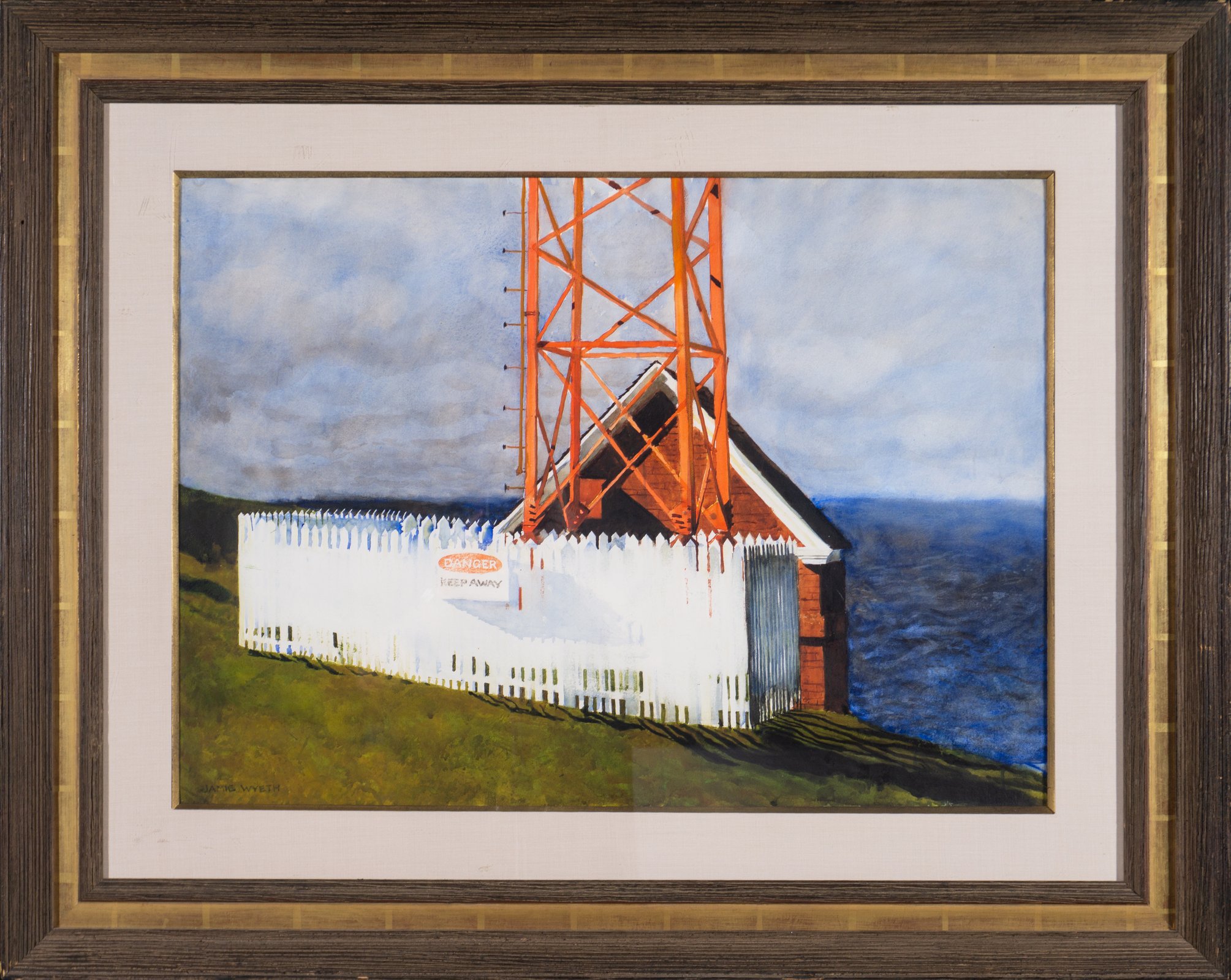
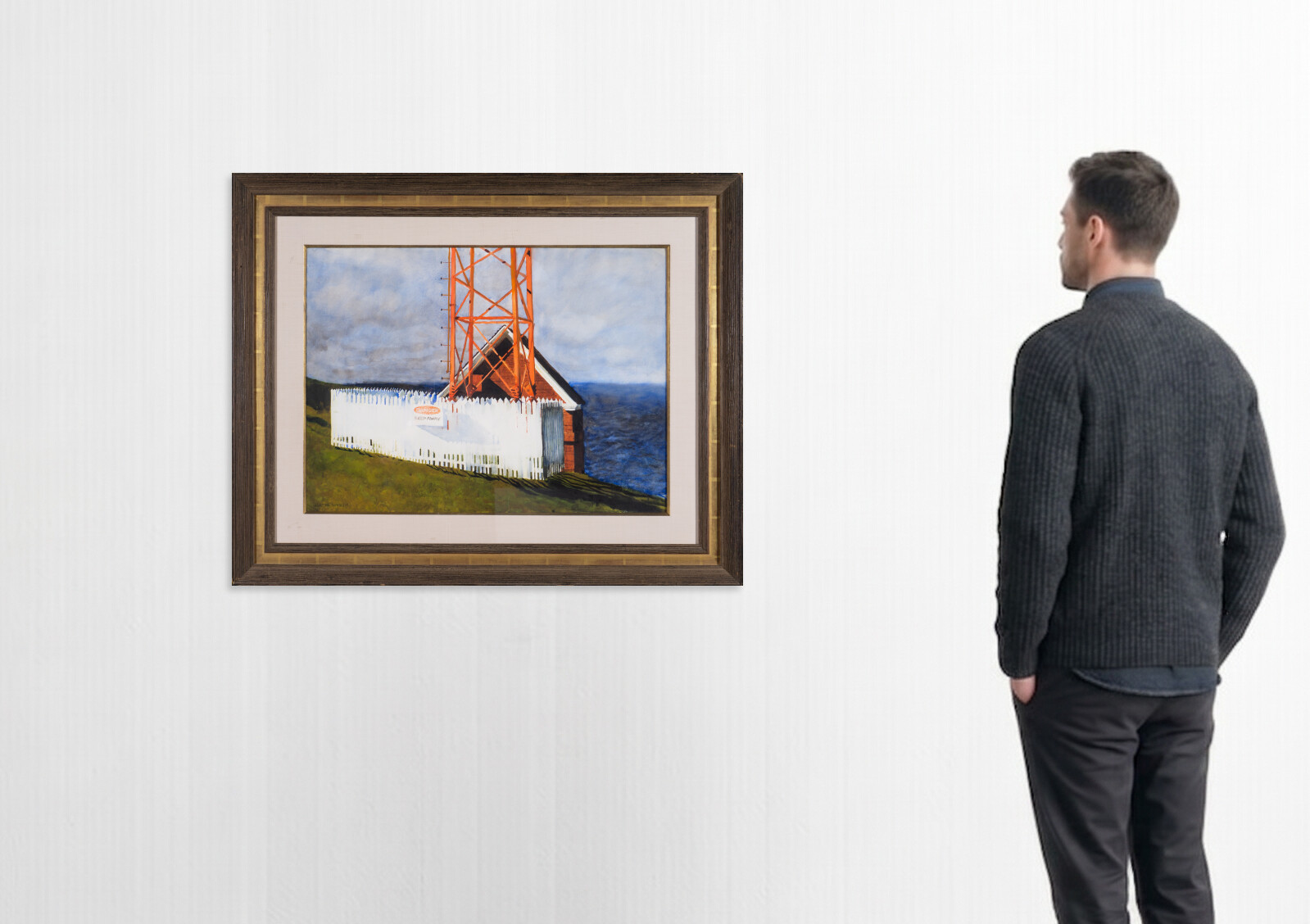
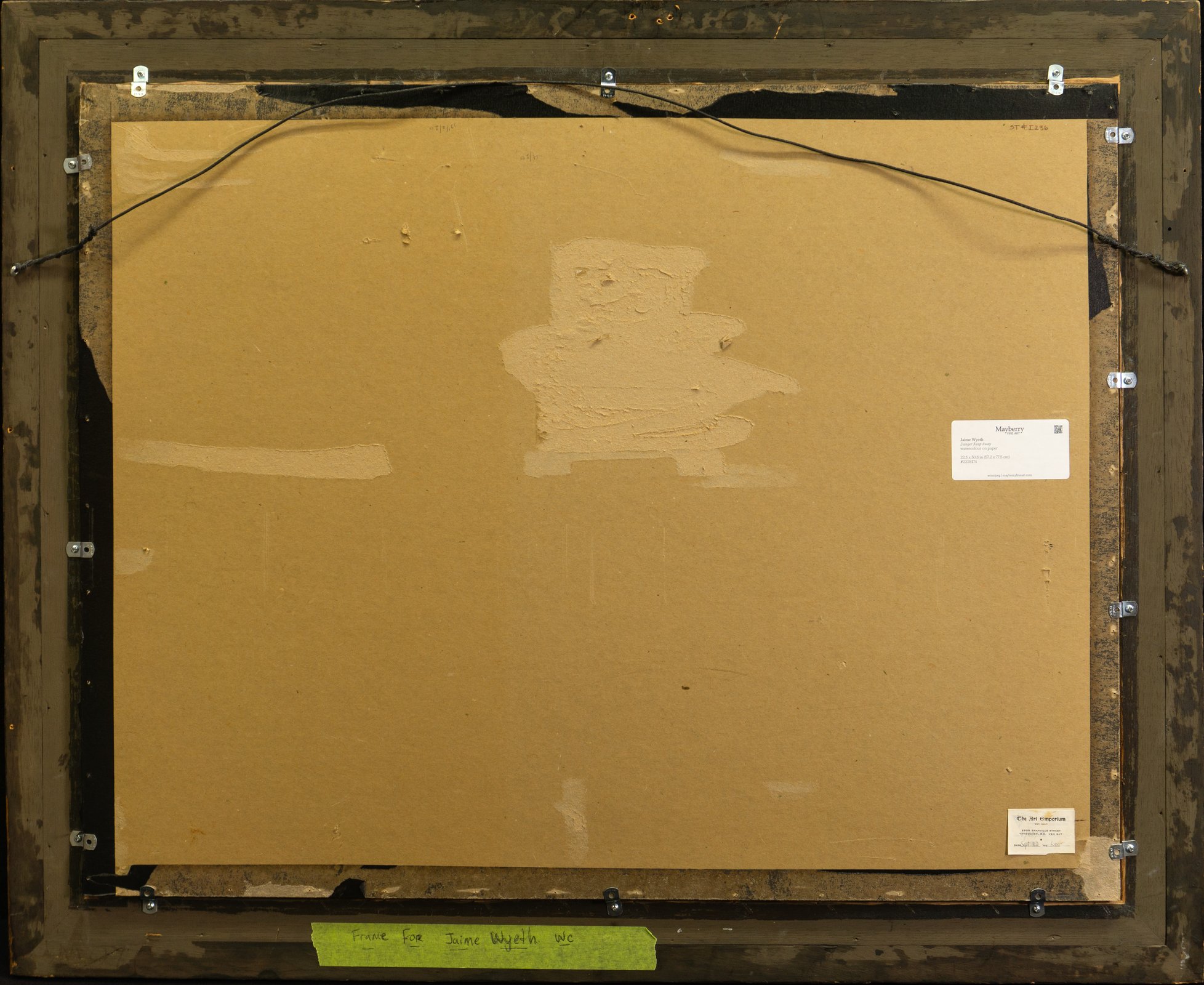
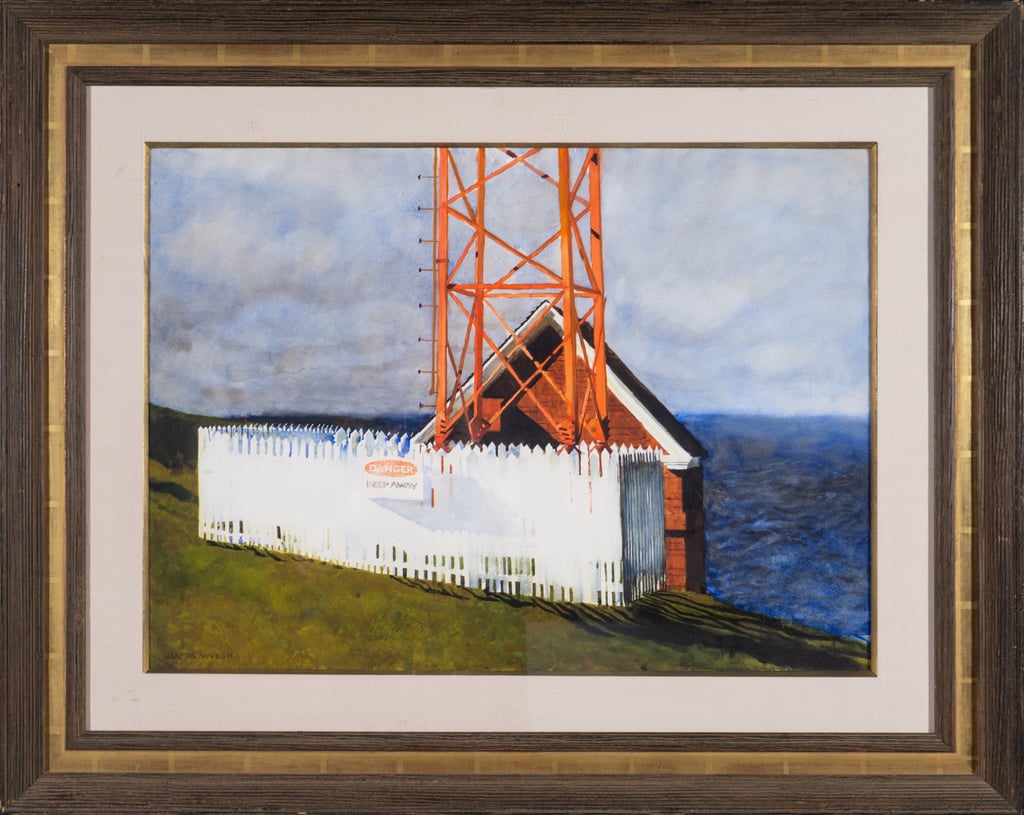
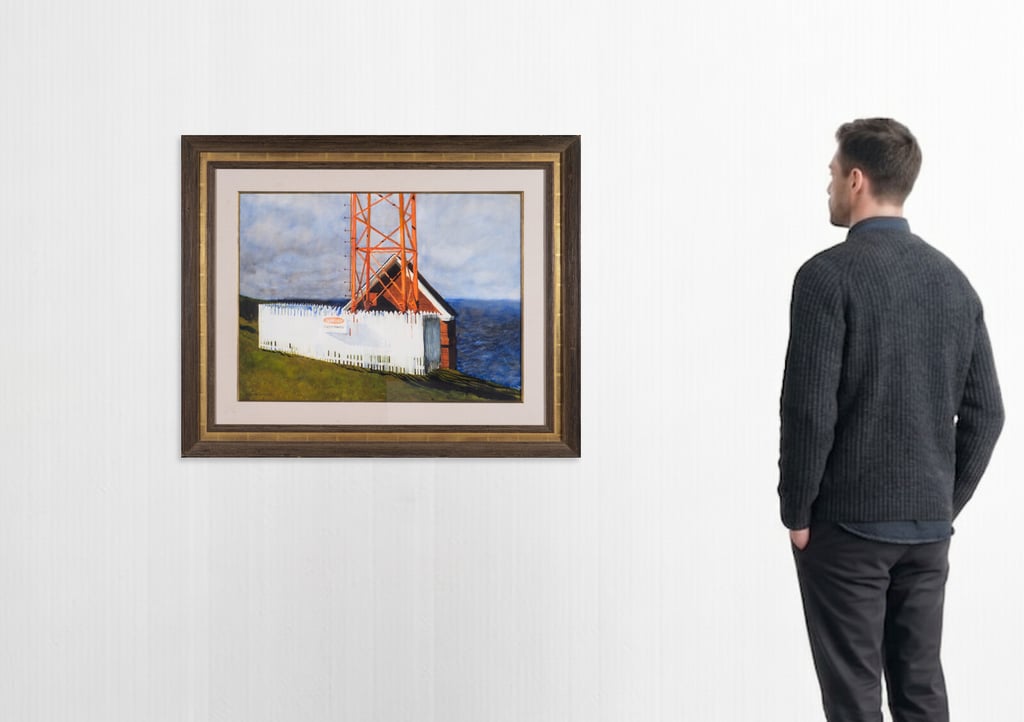
33.5 x 41.5 in (85.1 x 105.4 cm) including frame
Along with the Brandywine Valley of Pennsylvania, the mid-coast region of Maine has remained central to the Wyeth family's artistic identity. Jamie Wyeth first arrived on Monhegan Island in the late 1960s, later acquiring Rockwell Kent’s former home and studio, and eventually purchasing the light station and keeper's buildings across the harbor on Manana Island. Unpopulated, windswept, and exposed directly to the North Atlantic, Manana provided an austere counterpoint to the busy seasonal artist colony on Monhegan. While generations of New England landscape painters gravitated toward picturesque marine subjects—quaint fishing dories, scenic harbors, and dramatic surf breaking on headlands—Wyeth deliberately avoided regionalist nostalgia. His focus on Manana turned instead to the stark, utilitarian realities of maritime survival, confronting the underlying isolation and vulnerability inherent to offshore life.
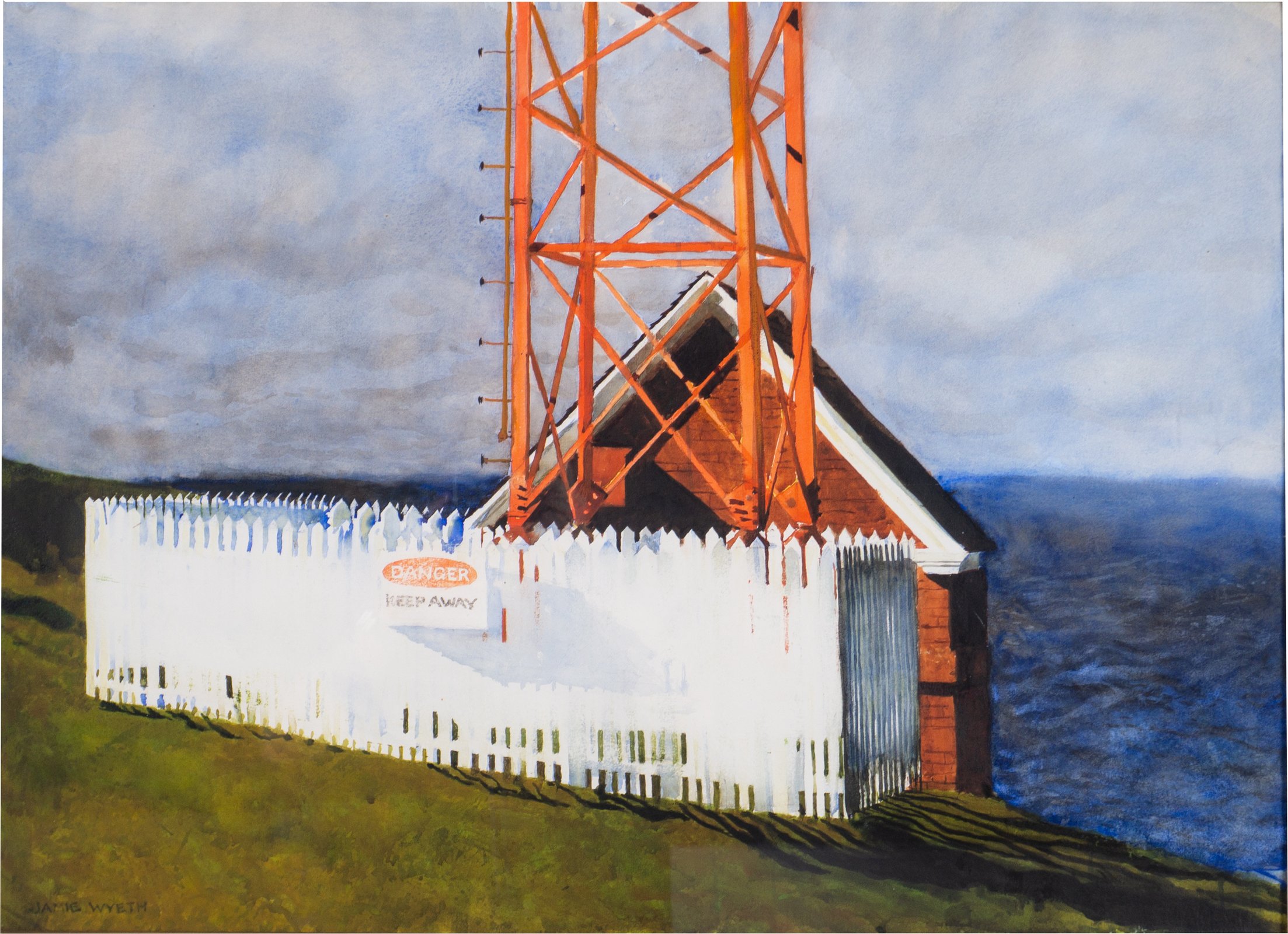
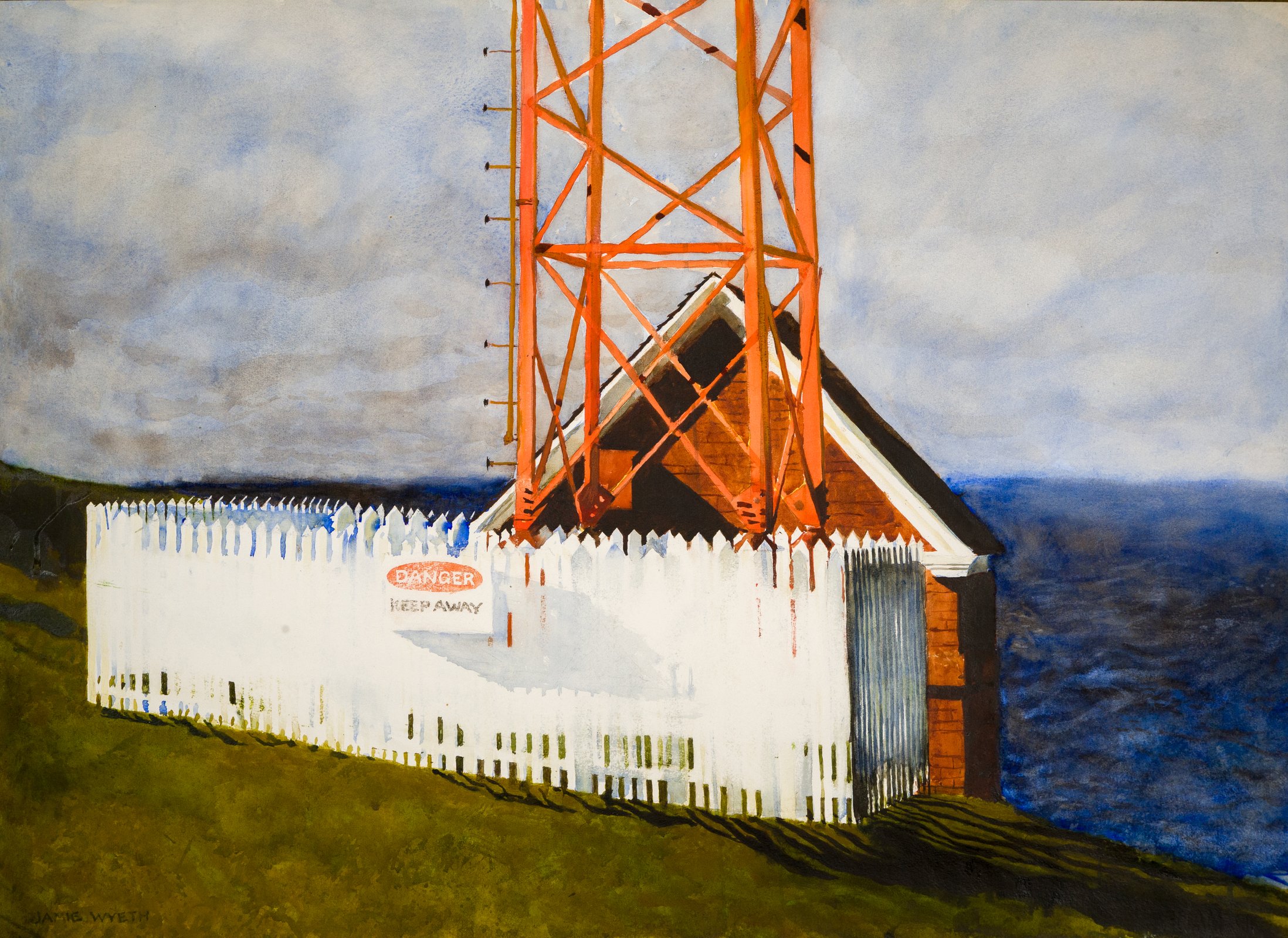
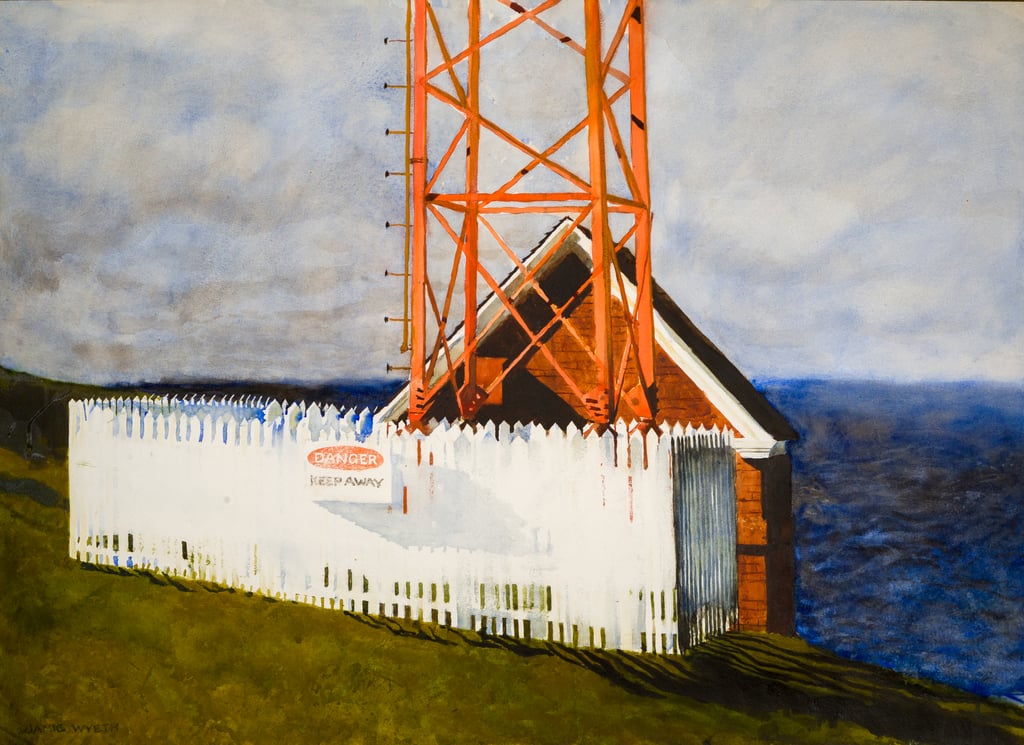
Executed in 1977, Danger Keep Away depicts the United States Coast Guard fog signal station on Manana Island, an outpost established in the nineteenth century to guide vessels through treacherous Gulf of Maine fog banks into Monhegan Harbor. Rather than presenting a broad maritime view, Wyeth tightly frames the station's warning infrastructure: the vivid orange steel framework of the radio beacon tower straddling a brick equipment shed, enclosed within a white picket enclosure marked with an explicit caution sign. The work relates closely to other pivotal Manana compositions of the mid-1970s, including Fog Bell (1974), in which navigational signals and alarms are isolated as psychological talismans against natural disaster. By shifting emphasis from the ocean itself to the manufactured systems designed to repel it, Wyeth departs sharply from contemporaries who romanticized island life, treating the coastal setting as a psychological space defined by perpetual caution and vigilance.
The composition relies on severe geometric structure and sharp shifts in light to reinforce this unease. Low, late-day sunlight rakes across the headland, throwing elongated shadows from the fence pickets across the foreground turf. The brilliant white barrier and orange tower cut an abrupt silhouette against the darkened water and the muted wall of fog moving in from the horizon. Utilizing drybrush and controlled watercolour washes, Wyeth captures both the tactile surfaces of wood, brick, and steel, and the heavy atmospheric dampness characteristic of the outer islands, balancing precision draughtsmanship with a quiet sense of foreboding. In uniting industrial utility, psychological restraint, and the stark geography of Manana Island, Danger Keep Away exemplifies Wyeth’s singular ability to transform an everyday maritime outpost into an enduring monument to human resilience against an indifferent sea.
Art Emporium, Vancouver
Private Collection, Winnipeg
Jaime Wyeth
James Browning Wyeth was born on July 6, 1946, in Wilmington, Delaware, and was raised in Chadds Ford, Pennsylvania. In 1966, he enlisted in the Delaware Air National Guard, serving until 1971. During this period, he received a commission from the Eyewitness to Space program run jointly by NASA and the National Gallery of Art in Washington, D.C., to record launch activities at Cape Kennedy. In 1967, he completed an official posthumous portrait of President John F. Kennedy, commissioned by the Kennedy family.
In 1968, Wyeth married Phyllis Mills, an equestrian and disability advocate. During the early 1970s, he split his time between Pennsylvania and New York City, working alongside Andy Warhol at The Factory to complete a mutual series of painted portraits and sketches. In 1972, he was appointed to the board of directors of the Brandywine River Museum of Art in Chadds Ford, and in 1975, he was appointed by President Gerald Ford to the board of trustees of the John F. Kennedy Center for the Performing Arts. He was inducted into the American Academy of Arts and Letters in 1976.
Wyeth participated as an official artist during the 1976 United States Senate Watergate hearings, producing courtroom drawings for regional and national press distribution. In 1987, he traveled to the Soviet Union as part of an official cultural exchange sponsored by the United States Information Agency, accompanying a touring exhibition alongside Soviet artist Tonya Shirokova. His paintings have been acquired into the permanent collections of major public institutions, including the National Gallery of Art, the Smithsonian American Art Museum, the Museum of Fine Arts, Boston, and the Whitney Museum of American Art.
Major Fall Fine Art Auction
November 12 - December 3, 2026
661 Wall St, Winnipeg MB
(204) 255-5690
mayberryfineart.com
[email protected]
Contact us to make an appointment to preview this item or to sell similar works.
|
Bidding Range
|
Increment
|
|---|---|
| $0.00 - $50.00 | $1.00 |
| $50.00 - $100.00 | $5.00 |
| $100.00 - $500.00 | $10.00 |
| $500.00 - $1,000.00 | $25.00 |
| $1,000.00 - $2,500.00 | $50.00 |
| $2,500.00 - $10,000.00 | $100.00 |
| $10,000.00 - $20,000.00 | $200.00 |
| $20,000.00 - $50,000.00 | $500.00 |
| $50,000.00 - $100,000.00 | $1,000.00 |
| $100,000.00 - $300,000.00 | $5,000.00 |
| $300,000.00 - $1,000,000.00 | $10,000.00 |
| $1,000,000.00 - $2,000,000.00 | $25,000.00 |
| $2,000,000.00+ | $50,000.00 |
Login or register a BidLots.com account to participate in any auction. Track specific lots and artists with real-time notifications on all bidding activity.
Bidding approval requires three simple steps:
1. Create a Bid Lots account
2. Confirm your email address
3. Create a valid billing profile
Bid Lots and/or the auctioneer may choose to revoke your bidding privileges if your account is not in good standing or your activity is in conflict with our standard terms and conditions of sale.
The buyer’s premium is an additional percentage charged to the winning bidder. The buyer’s premiums may vary from auction to auction, typically ranging from 10% to 20%. Buyer’s premiums will be displayed on detailed lot listings and paddle registration forms.
Bidding begins at the reserve price and advances at set increments based on the bidding range. The specific bidding increments may vary from auction to auction, however the next bid and subsequent increments will always be clearly defined on detailed lot listings. Maximum Bids and Single Bids can only be placed within the pre-defined bidding increments ensuring that no two bidders can place identical bids on an item. View individual lot detail pages to see a complete range of bidding increments for that item.
Requests to cancel a single bid are at the sole descretion of the auctioneer. Maximum bids can be increased but cannot be decreased unless premitted by the auctioneer. Requests to cancel a bid or to alter a maximum bid will be denied if the specific lot is scheduled to close in less than 24 hours or if the lot has significant interest or activity.
To request that a bid be cancelled or to change a maximum bid use the "Ask a question" button on the detailed lot listing.
You will receive an email notification when you have successfully won an auction. You will also see the item listed on your "Bidding Results" page and if you are logged into the site you will see a highlighted message on the auction catalogue pages and auction listings.
Shipping requirements may vary on different items depending on location and size or weight of an item. When registering for a specific auction you will be provided options to clarify your preferred shipping instructions. The auctioneer will also review and provide specific shipping quotes or options following the close of an auction. If you have specific shipping requirements or are unsure of the shipping constraints on a specific item please contact the auctioneer prior to bidding.
Following the close of an auction the auctioneer will provide a detailed invoice for all items you have won. They may contact you before a final invoice is prepared to confirm or review specific shipping instructions. Payment is due once a final invoice is provided and can be submitted online by credit card, or made by EFT (Electronic Fund Transfer), bank draft or international wire transfer. Any outstanding balance will be automatically charged to your registered credit card 5 days following the close of an auction.