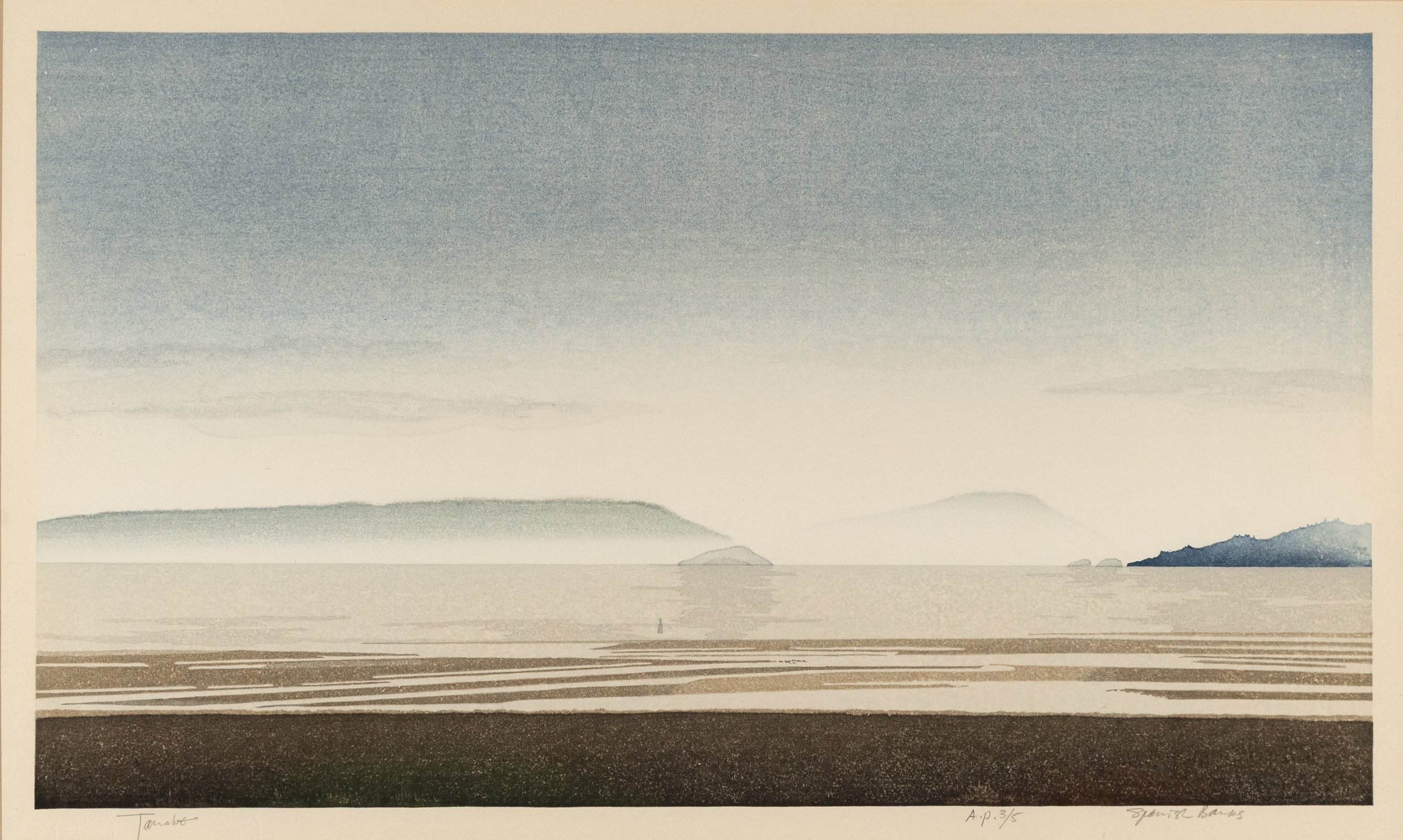
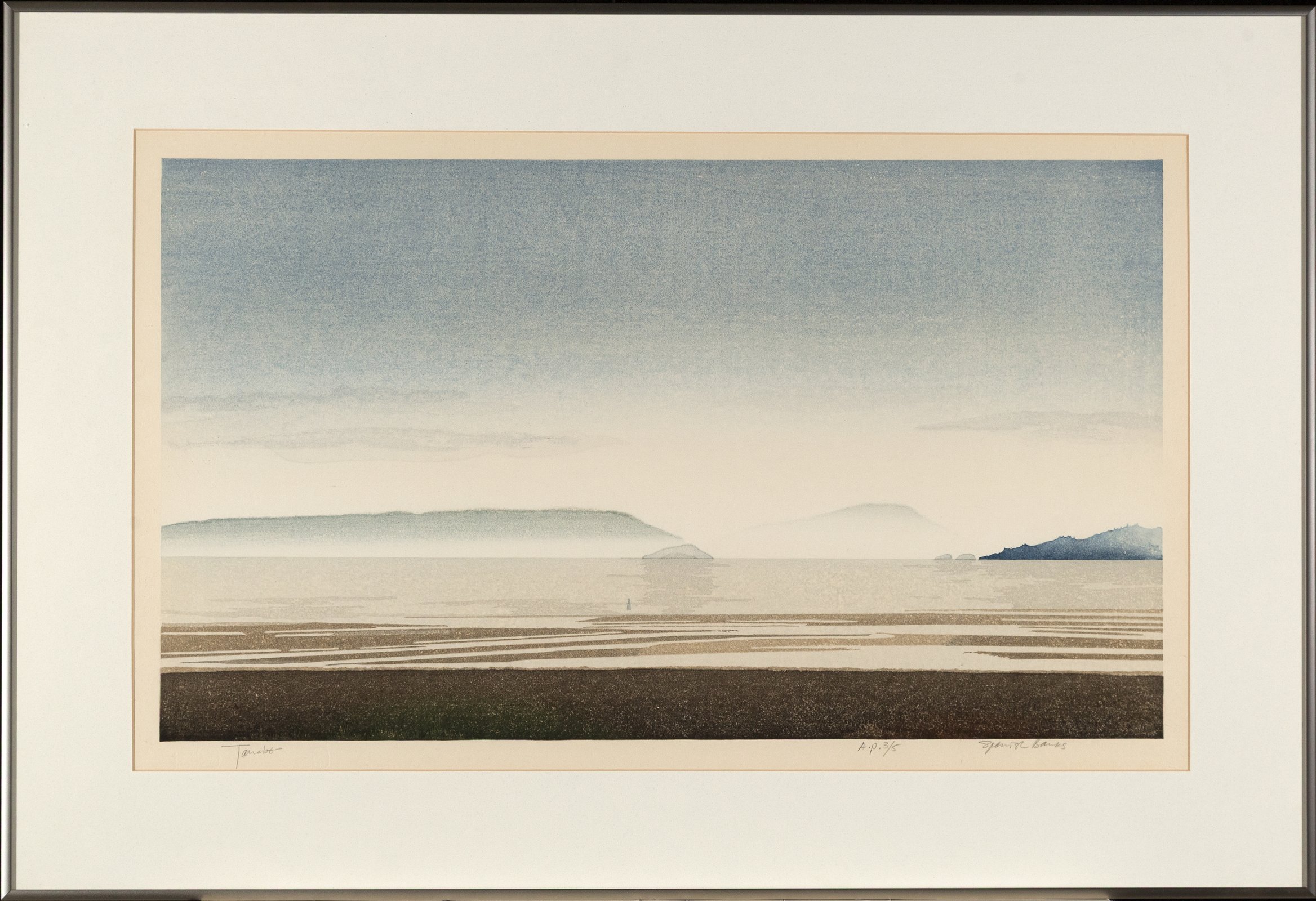
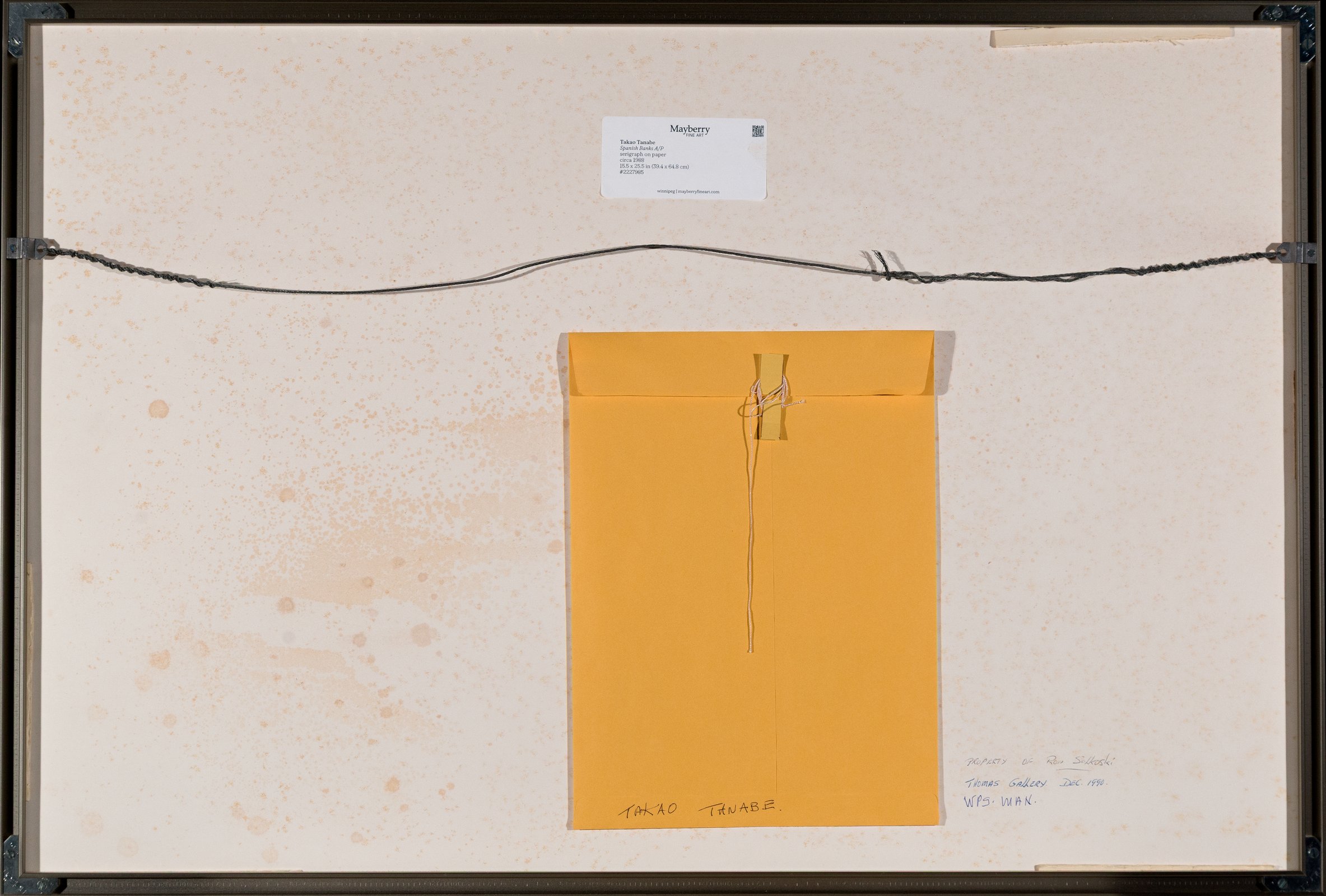
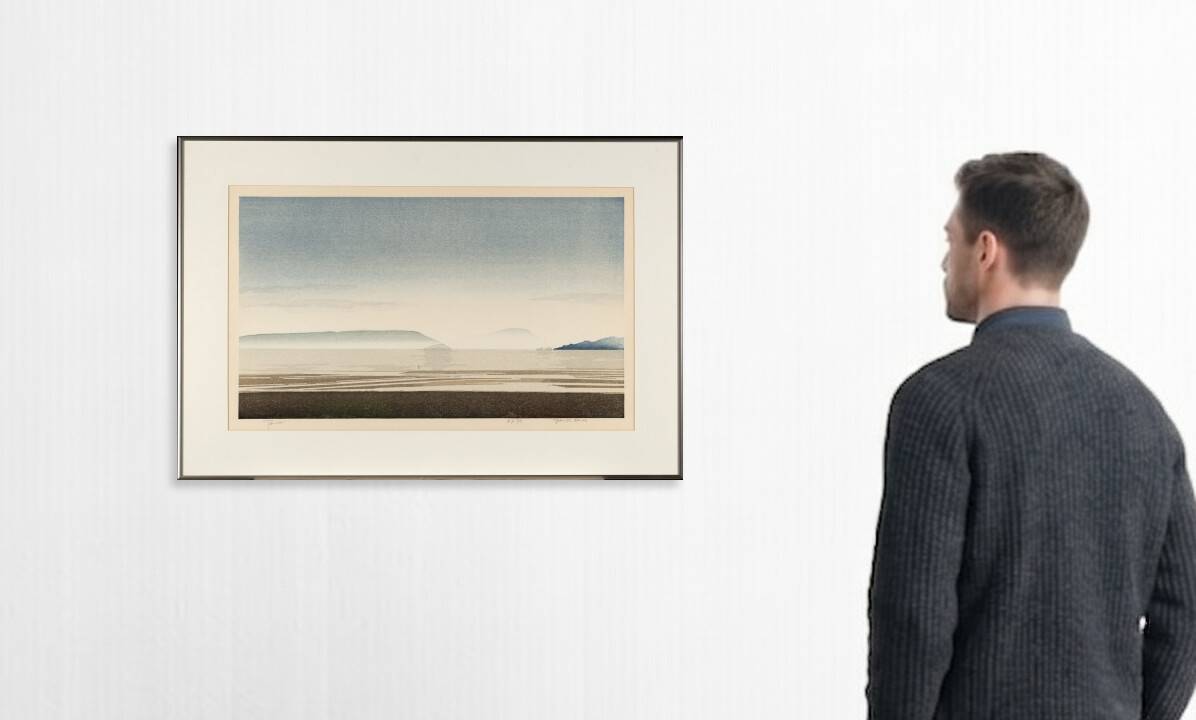
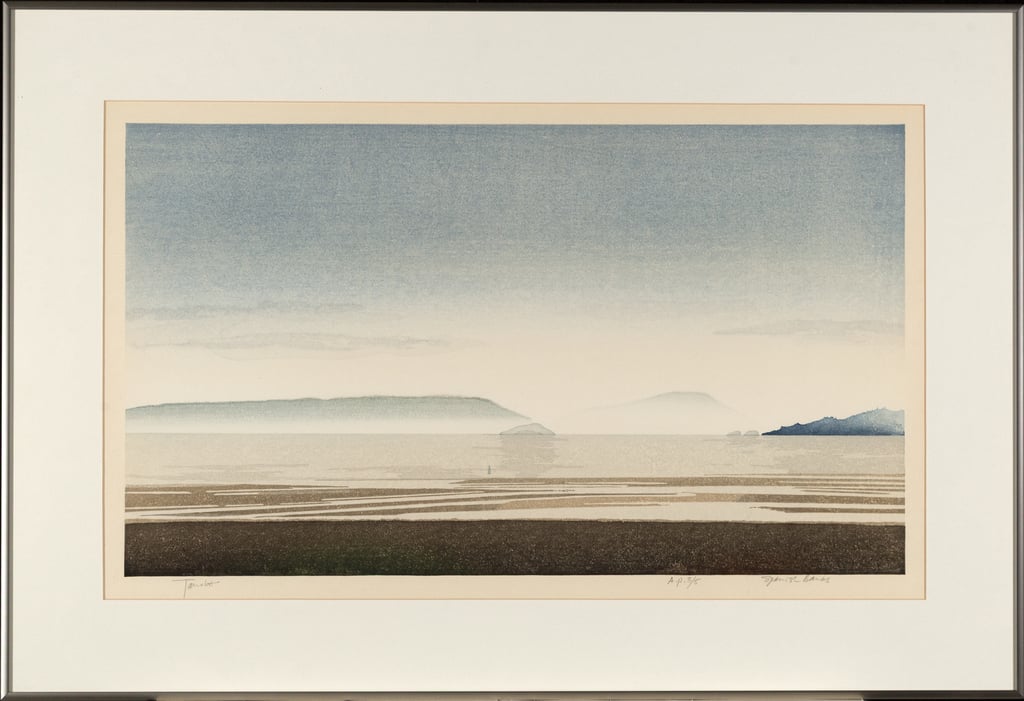
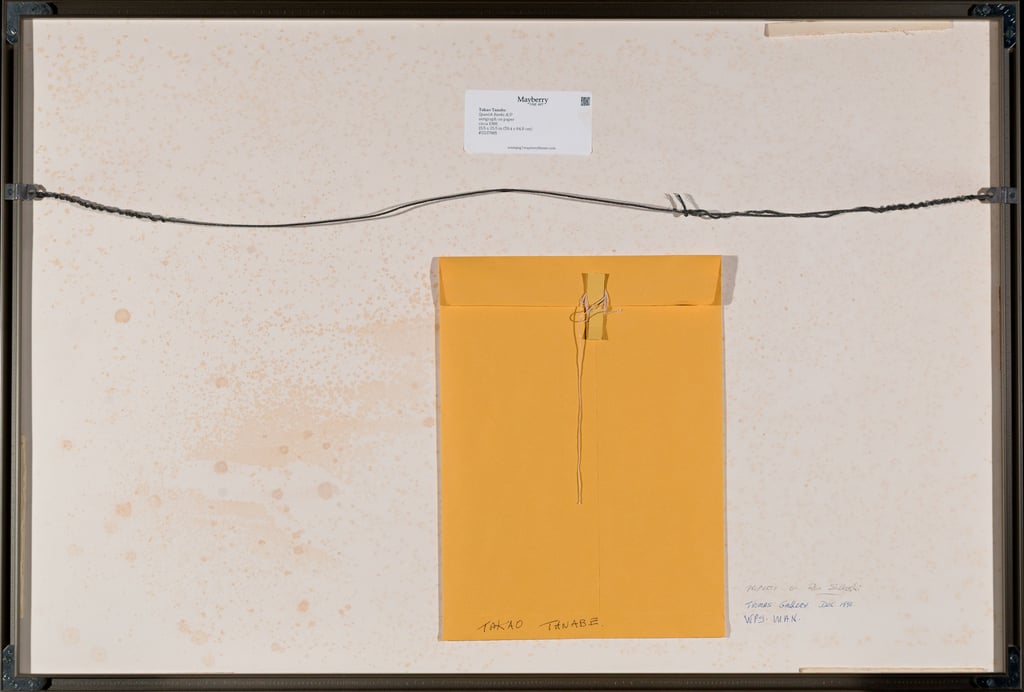
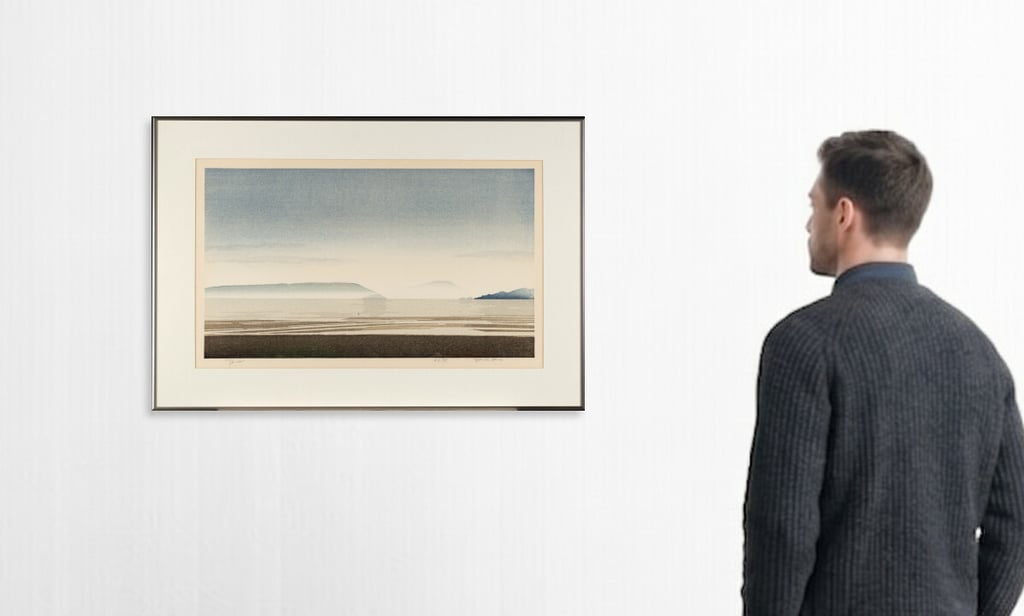
21.75 x 32 x 0.75 in (55.2 x 81.3 x 1.9 cm) including frame
Depicting the low-tide flats and sweeping horizons of Vancouver’s outer shores, Spanish Banks exemplifies Takao Tanabe’s mastery of coastal atmospheric perspective. Through thinly layered planes of muted tone, Tanabe strips the view of temporal detail, balancing modernist formal restraint with a quiet, contemplative evocation of the Pacific coastline.
Ian Thom, Takao Tanabe: New Prints, 1994, unpaginated
Ian Thom and Christine May, Takao Tanabe: Printmaker, Kelowna Art Gallery, 2023, same image reproduced page 61
Ian Thom, Takao Tanabe: Life & Work, Art Canada Institute, 2024, same image reproduced pages 72 and 73
West Vancouver Art Museum, A Modern Landscape: Takao Tanabe, May 26 — July 17, 2021, same image
Kelowna Art Gallery, Takao Tanabe: Printmaker, July 1 - October 1, 2023, same image, catalogue #69
Takao Tanabe
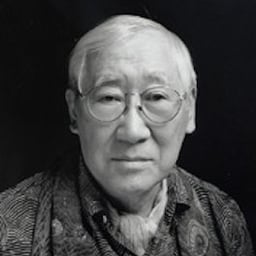
Takao Tanabe, CM, OBC, RCA (born 1926), was born in Seal Cove, British Columbia, to Japanese immigrant parents. In 1937, his family relocated to Vancouver. Following the invocation of the War Measures Act in 1941, Tanabe and his family were forcibly displaced in 1942 and interned at Lemon Creek in southeastern British Columbia. In 1944, restricted from returning to the Pacific coast, he moved to Winnipeg to work as a farm laborer, foundry worker, and warehouse clerk. Seeking technical employment training, he enrolled in evening classes at the Winnipeg School of Art in 1946, progressing to full-time study from 1946 to 1949 under the mentorship of artist Joseph Plaskett. Tanabe continued his formal training at the Brooklyn Museum Art School in New York from 1951 to 1952 with Hans Hofmann and Reuben Tam, followed by studies at the Central School of Arts and Crafts in London from 1953 to 1954 on an Emily Carr Scholarship. Between 1959 and 1961, a Canada Council grant supported his studies in traditional sumi-e ink painting and single-stroke Zen calligraphy under Ikuo Hirayama and Yanagida Taiun at the Tokyo University of the Arts.
From 1961 to 1968, Tanabe taught at the Vancouver School of Art, serving as head of the commercial art department while completing large-scale public mural commissions across Canada. In 1968, he relocated to the United States, working in Philadelphia before establishing a studio in New York City from 1969 to 1972, where his practice centered on hard-edge geometric abstraction. In 1973, Tanabe returned to Canada to become head of the art department and artist-in-residence at the Banff Centre for the Arts in Alberta, a position he held until 1980. That year, he relocated permanently to Vancouver Island, British Columbia, to dedicate himself exclusively to studio painting.
Tanabe's painting style evolved from calligraphic gestural abstraction and hard-edge geometric canvases into minimalist landscape representations. During his tenure at Banff, he initiated his influential prairie series, applying the disciplined spatial economy of color-field abstraction to the Western Canadian terrain. Working without primer to seal his supports, he applied thin acrylic washes directly onto raw canvas, requiring immediate, precise brushwork akin to traditional ink techniques. These compositions dismantled conventional regionalist landscape conventions by paring vistas down into flat, horizontal bands of color and light while omitting man-made markers such as roads, telephone lines, and grain elevators. Following his return to the West Coast, he carried this spare aesthetic into coastal seascapes characterized by low horizons, expanses of water and sky, and subdued atmospheric conditions.
Tanabe was elected to the Royal Canadian Academy of Arts and appointed a Member of the Order of British Columbia in 1993, followed by appointment as a Member of the Order of Canada in 1999. He received the Governor General's Award in Visual and Media Arts in 2003 and the Audain Prize for Lifetime Achievement in the Visual Arts in 2013. In 2005, a major retrospective of his work organized by the Vancouver Art Gallery and the Art Gallery of Greater Victoria toured nationally to institutions including the McMichael Canadian Art Collection in Kleinburg and the Art Gallery of Nova Scotia in Halifax. His paintings and prints are held in permanent public collections, including the National Gallery of Canada in Ottawa, the Vancouver Art Gallery, the Art Gallery of Ontario in Toronto, the Glenbow Museum in Calgary, and the Tate Collection in the United Kingdom.
Major Fall Fine Art Auction
November 12 - December 3, 2026

661 Wall St, Winnipeg MB
(204) 255-5690
mayberryfineart.com
[email protected]
Contact us to make an appointment to preview this item or to sell similar works.
|
Bidding Range
|
Increment
|
|---|---|
| $0.00 - $50.00 | $1.00 |
| $50.00 - $100.00 | $5.00 |
| $100.00 - $500.00 | $10.00 |
| $500.00 - $1,000.00 | $25.00 |
| $1,000.00 - $2,500.00 | $50.00 |
| $2,500.00 - $10,000.00 | $100.00 |
| $10,000.00 - $20,000.00 | $200.00 |
| $20,000.00 - $50,000.00 | $500.00 |
| $50,000.00 - $100,000.00 | $1,000.00 |
| $100,000.00 - $300,000.00 | $5,000.00 |
| $300,000.00 - $1,000,000.00 | $10,000.00 |
| $1,000,000.00 - $2,000,000.00 | $25,000.00 |
| $2,000,000.00+ | $50,000.00 |
Login or register a BidLots.com account to participate in any auction. Track specific lots and artists with real-time notifications on all bidding activity.
Bidding approval requires three simple steps:
1. Create a Bid Lots account
2. Confirm your email address
3. Create a valid billing profile
Bid Lots and/or the auctioneer may choose to revoke your bidding privileges if your account is not in good standing or your activity is in conflict with our standard terms and conditions of sale.
The buyer’s premium is an additional percentage charged to the winning bidder. The buyer’s premiums may vary from auction to auction, typically ranging from 10% to 20%. Buyer’s premiums will be displayed on detailed lot listings and paddle registration forms.
Bidding begins at the reserve price and advances at set increments based on the bidding range. The specific bidding increments may vary from auction to auction, however the next bid and subsequent increments will always be clearly defined on detailed lot listings. Maximum Bids and Single Bids can only be placed within the pre-defined bidding increments ensuring that no two bidders can place identical bids on an item. View individual lot detail pages to see a complete range of bidding increments for that item.
Requests to cancel a single bid are at the sole descretion of the auctioneer. Maximum bids can be increased but cannot be decreased unless premitted by the auctioneer. Requests to cancel a bid or to alter a maximum bid will be denied if the specific lot is scheduled to close in less than 24 hours or if the lot has significant interest or activity.
To request that a bid be cancelled or to change a maximum bid use the "Ask a question" button on the detailed lot listing.
You will receive an email notification when you have successfully won an auction. You will also see the item listed on your "Bidding Results" page and if you are logged into the site you will see a highlighted message on the auction catalogue pages and auction listings.
Shipping requirements may vary on different items depending on location and size or weight of an item. When registering for a specific auction you will be provided options to clarify your preferred shipping instructions. The auctioneer will also review and provide specific shipping quotes or options following the close of an auction. If you have specific shipping requirements or are unsure of the shipping constraints on a specific item please contact the auctioneer prior to bidding.
Following the close of an auction the auctioneer will provide a detailed invoice for all items you have won. They may contact you before a final invoice is prepared to confirm or review specific shipping instructions. Payment is due once a final invoice is provided and can be submitted online by credit card, or made by EFT (Electronic Fund Transfer), bank draft or international wire transfer. Any outstanding balance will be automatically charged to your registered credit card 5 days following the close of an auction.