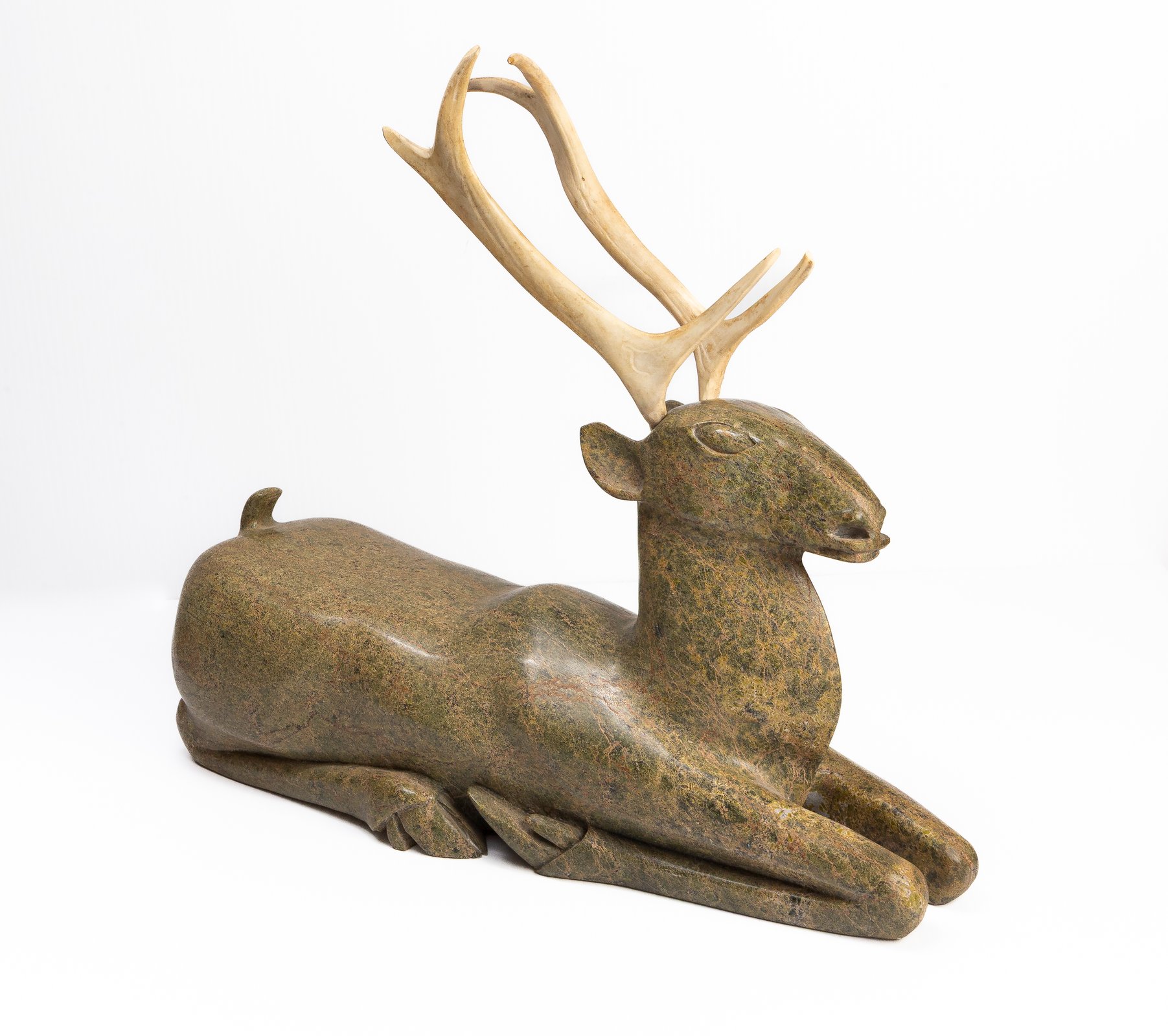
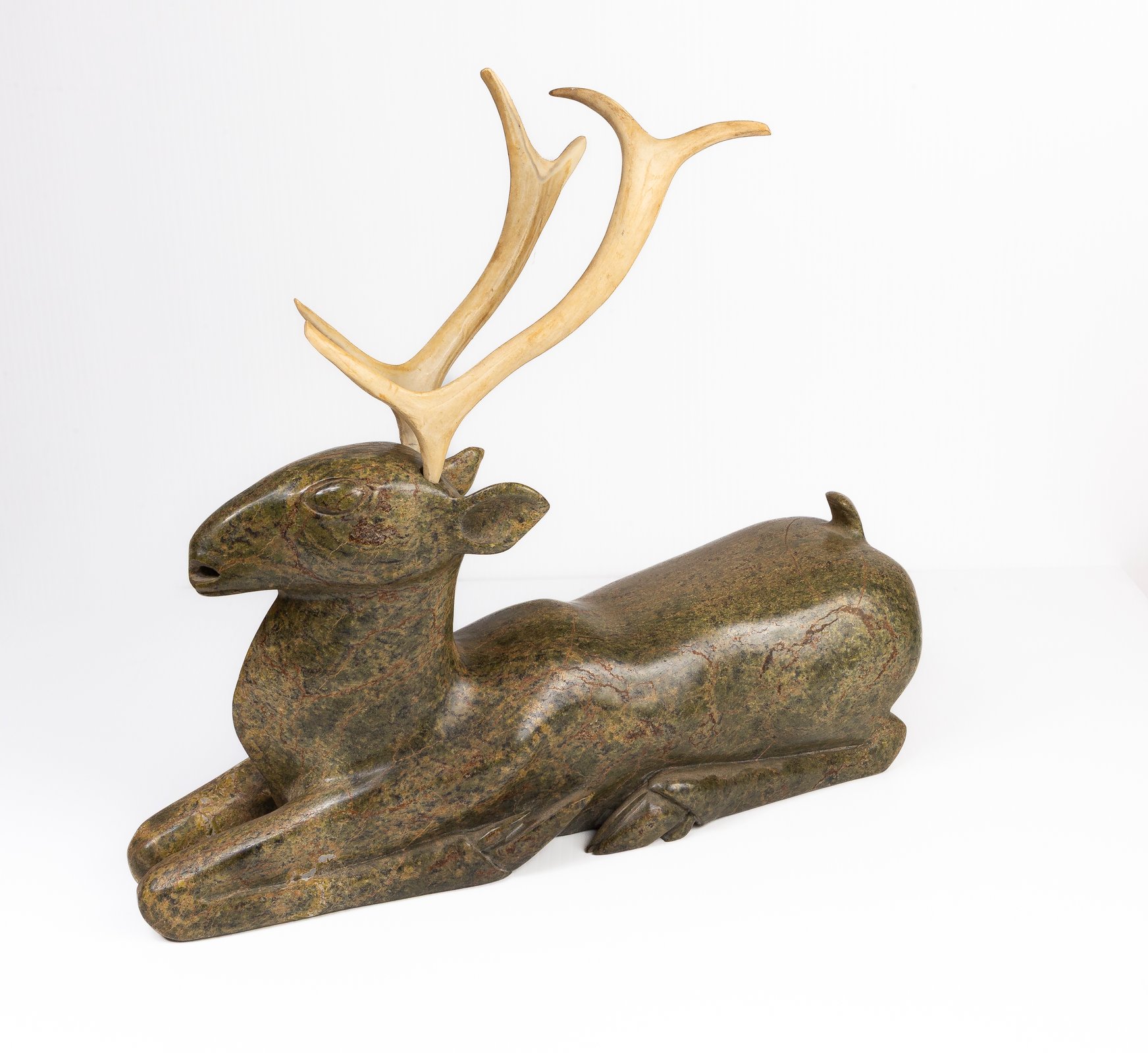
“When I’m doing a caribou, I first make the outline of the animal starting with the muzzle, the nose, and then I work my way down to the body. Then I work on the leg areas. The standing caribou are more difficult than the kneeling ones. I work with files when I am doing the legs and ears. The ears are the last thing I do because they tend to break off. So I finish with those.
I don’t use the grinder to make the form because sometimes there are areas that you tend to cut into too deeply, something you’re not supposed to do. I prefer to use an axe and a saw. Also I use files that you use for steel (rasps) and then I switch to files for the finer work.
For balancing I make sure the base is smooth and flat so that the caribou doesn’t tip to the front or side.
I just make sure that the bottom of the hooves is perfectly level. I use a level like carpenters use in construction work. I make sure the base is a little bit thick before I start to get it level."
Susan Gustavison, Northern Rock Contemporary Inuit Stone Sculpture (exhibition catalogue), McMichael Canadian Art Collection, Kleinburg, Ontario, 1999, page 64.
Private Collection, Winnipeg
(Includes Buyer's Premium)
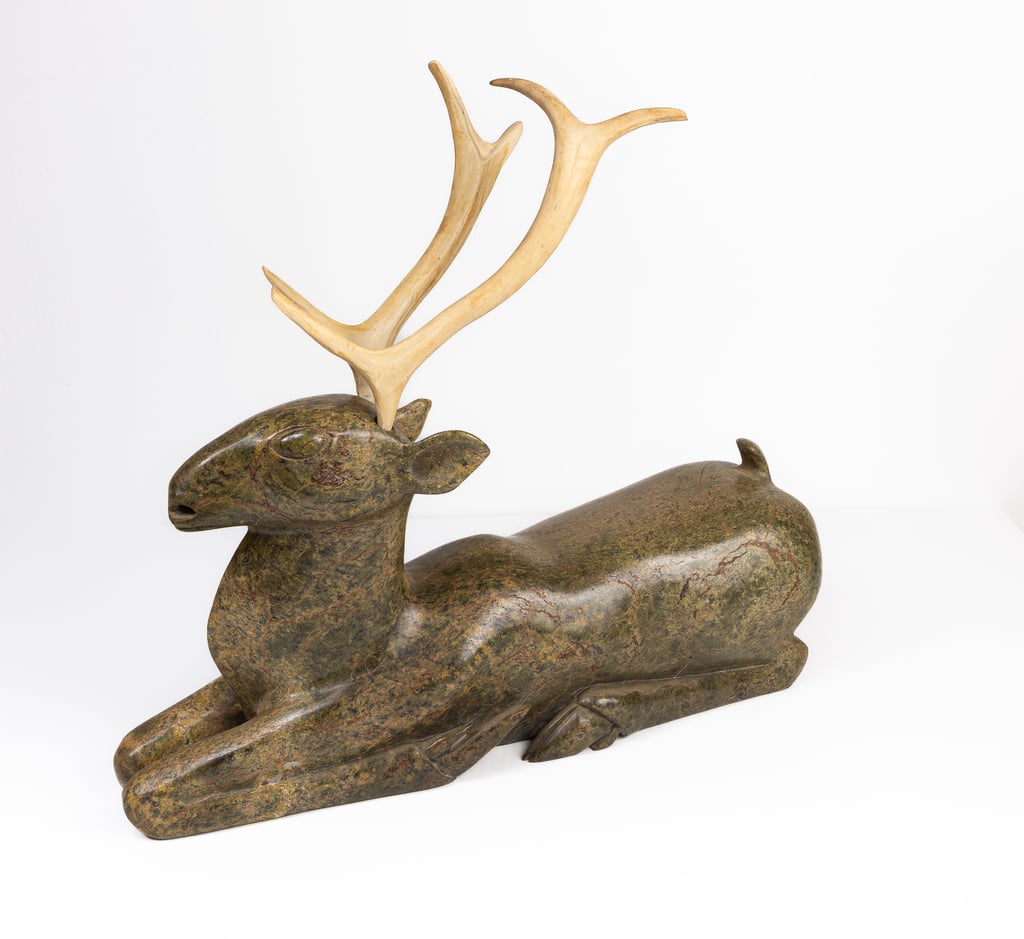
Osuitok Ipeelee
Osuitok Ipeelee was a master carver and a foundational figure in the development of contemporary Inuit art in Kinngait (Cape Dorset). Born in 1923 in the Neeouleeutalik camp, he learned to carve from his father, Ohotok Ipeelee. During his youth, he developed his skills by creating ivory miniatures of hunting equipment and small figures, which he traded with local missionaries and traders. His early practice was rooted in traditional Inuit survival skills and material culture, establishing a deep technical foundation that would later define his mastery of stone.
In the 1950s, Ipeelee became a central figure in the nascent art movement in Kinngait. He was a key collaborator with James Houston, helping to establish the West Baffin Eskimo Co-operative and assisting in the development of local printmaking and sculpture programs. During this period, he was credited as Oshaweetok B in early institutional catalogues. His work gained national recognition quickly, appearing in significant exhibitions such as the 1952 and 1955 Eskimo Art exhibitions held at the National Gallery of Canada.
Throughout his long career, Ipeelee received numerous prestigious commissions that underscored his status as a premier sculptor. In 1955, he directed a team of craftsmen in the creation of an official mace for the Council of the Northwest Territories. In 1959, he was commissioned to carve a sculpture of Queen Elizabeth II to be presented to the monarch during her visit to Canada. He continued to create works of exceptional balance and precision, often depicting Arctic wildlife such as caribou and birds, as well as mythological subjects.
Ipeelee was recognized widely for his contributions to the arts. He was elected a member of the Royal Canadian Academy of Arts (RCA) in 1973, marking a significant milestone for Inuit artists in Canadian institutions. In 2004, he received the Lifetime Aboriginal Art Achievement Award, now known as the Indspire Award. Ipeelee passed away in 2005 in Cape Dorset. His work remains an essential part of the permanent collections of major public institutions, including the National Gallery of Canada, the Winnipeg Art Gallery, and the Art Gallery of Ontario.
Major Spring Fine Art Auction
May 7 - May 28, 2026

661 Wall St, Winnipeg MB
(204) 255-5690
mayberryfineart.com
[email protected]
Contact us to make an appointment to preview this item or to sell similar works.
|
Bidding Range
|
Increment
|
|---|---|
| $0.00 - $50.00 | $1.00 |
| $50.00 - $100.00 | $5.00 |
| $100.00 - $500.00 | $10.00 |
| $500.00 - $1,000.00 | $25.00 |
| $1,000.00 - $5,000.00 | $50.00 |
| $5,000.00 - $10,000.00 | $100.00 |
| $10,000.00 - $20,000.00 | $200.00 |
| $20,000.00 - $50,000.00 | $500.00 |
| $50,000.00 - $100,000.00 | $1,000.00 |
| $100,000.00+ | $5,000.00 |
Login or register a BidLots.com account to participate in any auction. Track specific lots and artists with real-time notifications on all bidding activity.
Bidding approval requires three simple steps:
1. Create a Bid Lots account
2. Confirm your email address
3. Create a valid billing profile
Bid Lots and/or the auctioneer may choose to revoke your bidding privileges if your account is not in good standing or your activity is in conflict with our standard terms and conditions of sale.
The buyer’s premium is an additional percentage charged to the winning bidder. The buyer’s premiums may vary from auction to auction, typically ranging from 10% to 20%. Buyer’s premiums will be displayed on detailed lot listings and paddle registration forms.
Bidding begins at the reserve price and advances at set increments based on the bidding range. The specific bidding increments may vary from auction to auction, however the next bid and subsequent increments will always be clearly defined on detailed lot listings. Maximum Bids and Single Bids can only be placed within the pre-defined bidding increments ensuring that no two bidders can place identical bids on an item. View individual lot detail pages to see a complete range of bidding increments for that item.
Requests to cancel a single bid are at the sole descretion of the auctioneer. Maximum bids can be increased but cannot be decreased unless premitted by the auctioneer. Requests to cancel a bid or to alter a maximum bid will be denied if the specific lot is scheduled to close in less than 24 hours or if the lot has significant interest or activity.
To request that a bid be cancelled or to change a maximum bid use the "Ask a question" button on the detailed lot listing.
You will receive an email notification when you have successfully won an auction. You will also see the item listed on your "Bidding Results" page and if you are logged into the site you will see a highlighted message on the auction catalogue pages and auction listings.
Shipping requirements may vary on different items depending on location and size or weight of an item. When registering for a specific auction you will be provided options to clarify your preferred shipping instructions. The auctioneer will also review and provide specific shipping quotes or options following the close of an auction. If you have specific shipping requirements or are unsure of the shipping constraints on a specific item please contact the auctioneer prior to bidding.
Following the close of an auction the auctioneer will provide a detailed invoice for all items you have won. They may contact you before a final invoice is prepared to confirm or review specific shipping instructions. Payment is due once a final invoice is provided and can be submitted online by credit card, or made by EFT (Electronic Fund Transfer), bank draft or international wire transfer. Any outstanding balance will be automatically charged to your registered credit card 5 days following the close of an auction.