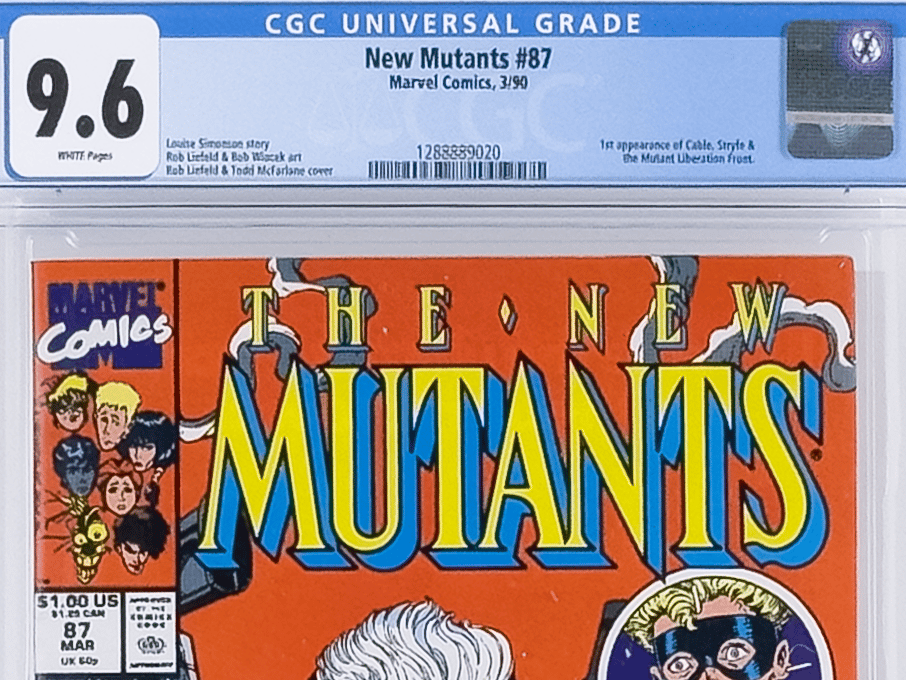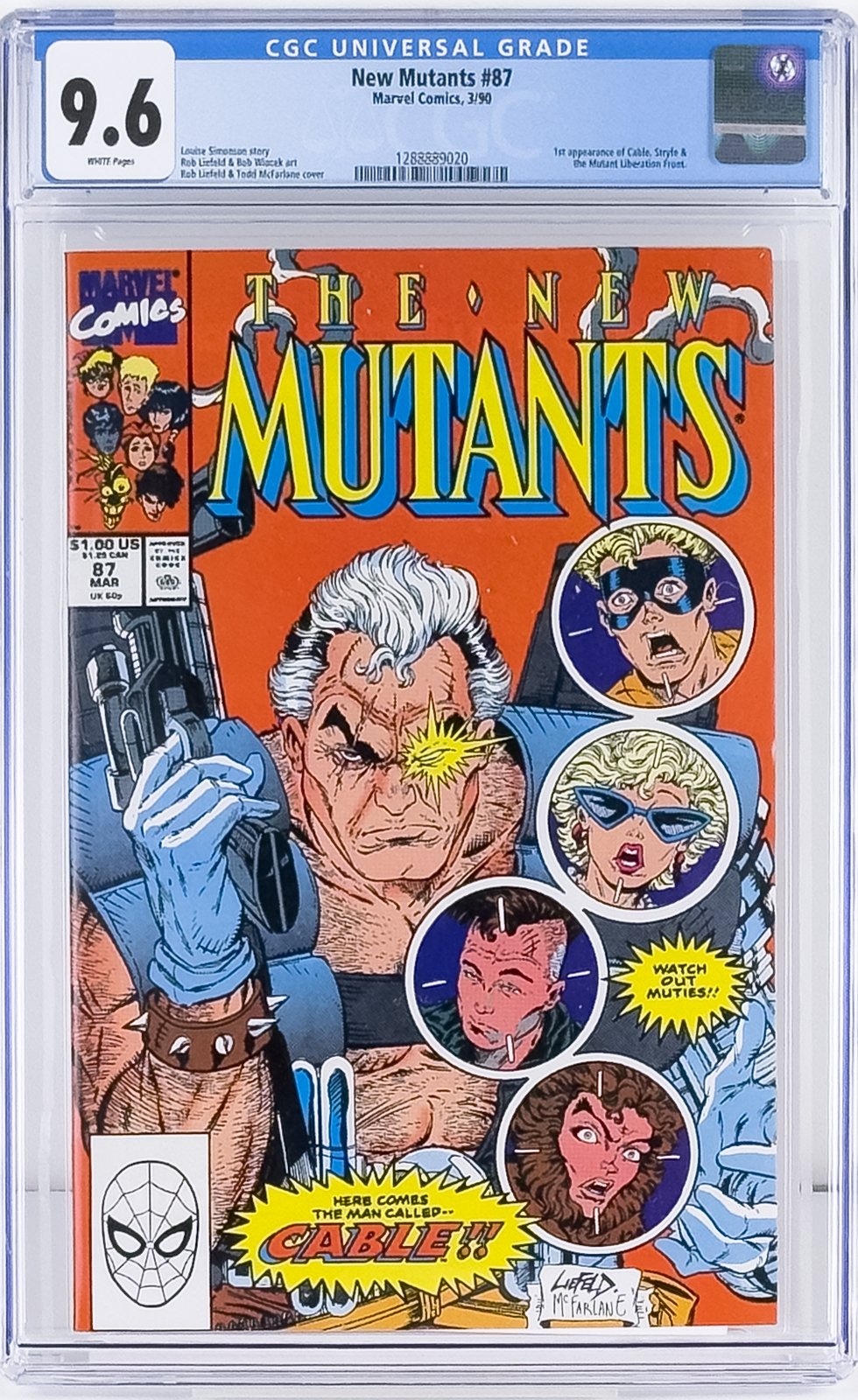

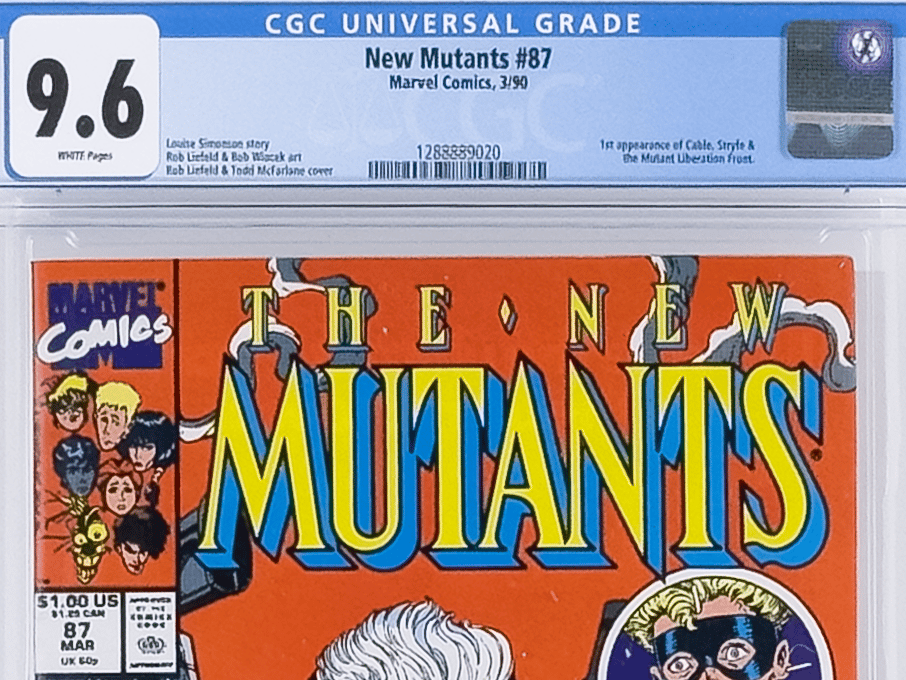
| Series Title | The New Mutants |
|---|---|
| Story Title | A Show of Power! |
| Issue Number | 87 |
| Volume | 1 |
| Cover Date | March 1990 |
| Cover Price | $1.00 |
| Printing | First Print |
| Variant Description | Direct |
| Page Count | 36 |
| Genre | Superhero |
| Age Era | Copper Age |
| Publisher | Marvel Comics |
| Writer | Louise Simonson |
| Artist | Rob Liefeld |
| Cover Artist | Rob Liefeld |
| Inker | Bob Wiacek |
| Letterer | Joe Rosen |
| Editor | Bob Harras |
| First Appearances | Cable (Nathan Christopher Charles Summers) |
| Character Appearances | Cable, Cannonball, Wolfsbane, Sunspot, Magma, Warlock, Rictor, Boom-Boom, Rusty Collins |
| Series Title | The New Mutants |
|---|---|
| Story Title | A Show of Power! |
| Issue Number | 87 |
| Volume | 1 |
| Cover Date | March 1990 |
| Cover Price | $1.00 |
| Printing | First Print |
| Variant Description | Direct |
| Page Count | 36 |
| Genre | Superhero |
| Age Era | Copper Age |
| Publisher | Marvel Comics |
| Writer | Louise Simonson |
| Artist | Rob Liefeld |
| Cover Artist | Rob Liefeld |
| Inker | Bob Wiacek |
| Letterer | Joe Rosen |
| Editor | Bob Harras |
| First Appearances | Cable (Nathan Christopher Charles Summers) |
| Character Appearances | Cable, Cannonball, Wolfsbane, Sunspot, Magma, Warlock, Rictor, Boom-Boom, Rusty Collins |
The New Mutants launched in March 1983 as Marvel's first X-Men spin-off series, created by writer Chris Claremont and artist Bob McLeod. The series originated from Marvel Graphic Novel #4 (1982), which introduced a new generation of teenage mutants studying at Xavier's School after the X-Men were believed dead. The initial team consisted of Cannonball (Sam Guthrie) from Kentucky, Wolfsbane (Rahne Sinclair) from Scotland, Psyche/Mirage (Danielle Moonstar) a Cheyenne Native American, Sunspot (Roberto da Costa) from Brazil, and Karma (Xi'an Coy Manh) from Vietnam. This internationally diverse roster reflected Claremont's vision of mutants as a global phenomenon and addressed Marvel's recognition that their readership had become increasingly international. The first issue sold approximately 250,000 copies, exceptional for a spin-off title, demonstrating the X-Men franchise's strength and reader appetite for mutant-related content.
The series differentiated itself from X-Men by focusing on teenage characters learning to control their powers while dealing with adolescent issues. Under Claremont's guidance (issues #1-54), the book explored themes of identity, belonging, and coming-of-age within the superhero framework. The young mutants faced self-doubt, romantic complications, and cultural conflicts alongside super-villains. Major storylines included the Demon Bear Saga (#18-20), illustrated by Bill Sienkiewicz, whose experimental art style transformed the book's visual approach and influenced comic art for decades. The introduction of Magik (Illyana Rasputin), Magma (Amara Aquilla), and Warlock expanded the roster and mythology. Sales remained strong throughout Claremont's run, averaging 180,000-200,000 copies monthly, making it one of Marvel's top ten titles. The series benefited from X-Men's popularity while establishing its own identity through younger characters and more experimental storytelling.
A dramatic shift occurred with issue #87 (March 1990) when writer Louise Simonson and artist Rob Liefeld transformed the book's direction. Liefeld introduced Cable, a mysterious military leader from the future, in issue #87, which sold over 500,000 copies and required multiple printings. This issue marked the beginning of the series' evolution from teen drama to paramilitary action. Liefeld's dynamic art style, featuring exaggerated anatomy and numerous weapons, appealed to the emerging 1990s aesthetic. New characters like Shatterstar, Feral, and Domino joined as the team became more aggressive and militant. Issue #98 introduced Deadpool, who would become one of Marvel's most popular characters. Issue #100 (April 1991) ended the series with sales exceeding 1 million copies, as the team transformed into X-Force under Cable's leadership, launching a new series that exemplified 1990s comic trends.
The New Mutants' cultural significance extends beyond sales figures to its representation of diversity and adolescent experiences in superhero comics. The series was among the first mainstream superhero books to feature a truly international cast where ethnic backgrounds weren't simply costume choices but integral to character development. Claremont incorporated real-world politics, from Roberto's experiences with Brazilian racism to Dani's connection to her Cheyenne heritage. The book tackled serious subjects including death (Warlock's murder), techno-organic infection, and child abuse through Illyana's backstory. Bill Sienkiewicz's artistic contributions (#18-31, 35-38) revolutionized mainstream comic art, introducing fine art techniques and experimental layouts that influenced countless artists. The series proved that teen superhero books could address complex themes while maintaining commercial viability.
The series' evolution from teenage mutant students to militant soldiers reflected broader changes in comic industry preferences during the late 1980s and early 1990s. While purists criticized the transformation, arguing it betrayed the original concept, commercial success validated the change for Marvel's management. The contrast between early issues' focus on character development and later issues' emphasis on action and weaponry demonstrates the comic market's shift toward Image-style artwork and anti-hero protagonists. Original New Mutants members experienced varied fates: some joined X-Force, others disappeared into comic limbo, while characters like Cannonball eventually became full X-Men members, fulfilling the series' promise of training future heroes.
The New Mutants' legacy encompasses both its groundbreaking diversity and its transformation into 1990s excess. The series launched careers of major creators, from Bill Sienkiewicz's artistic innovations to Rob Liefeld's industry-changing style. Characters introduced in its pages, particularly Cable and Deadpool, generate hundreds of millions in revenue across comics, films, and merchandise. The original team's influence appears in subsequent young X-Men series like Generation X and New X-Men. A 2009 revival by Zeb Wells returned to the original concept, while the 2020 film adaptation attempted to blend horror with superhero elements. Collected editions of the classic run remain in print, with the Sienkiewicz issues particularly valued. The series stands as a document of 1980s progressive ideals and 1990s commercial transformation, representing both the best intentions and market realities of superhero comics publishing.
October 15 - October 29, 2025
BidLots operates as a division of Mayberry Holdings Ltd t/a Mayberry Fine Art
Contact us below to preview this lot or to sell similar items.
212 McDermot Ave, Winnipeg MB
(204) 255-5690
[email protected]
|
Bidding Range
|
Increment
|
|---|---|
| $0.00 - $50.00 | $1.00 |
| $50.00 - $100.00 | $5.00 |
| $100.00 - $500.00 | $10.00 |
| $500.00 - $1,000.00 | $25.00 |
| $1,000.00 - $5,000.00 | $50.00 |
| $5,000.00 - $10,000.00 | $100.00 |
| $10,000.00 - $20,000.00 | $200.00 |
| $20,000.00 - $50,000.00 | $500.00 |
| $50,000.00 - $100,000.00 | $1,000.00 |
| $100,000.00+ | $5,000.00 |
All items are shipped fully insured by Canada Post or by courier depending on service availablity.
Records, Comics and Paper Items: Flat rate $25 shipping for single items anywhere in Canada. Contact us for a quote on multiple items, special requests or international shipping.
Manitoba orders: GST (5%) and PST (7%) will be added to all orders picked up or shipped within Manitoba.
Other Canadian provinces: GST or HST will be added based on your province's rate.
US & International orders: No Canadian taxes apply. You may be responsible for import duties or taxes in your country.
Login or register a BidLots.com account to participate in any auction. Track specific lots and artists with real-time notifications on all bidding activity.
Becoming an approved bidder takes three simple steps:
1. Create a BidLots account
2. Confirm your email address
3. Add a valid billing profile
Note: BidLots or the auctioneer reserves the right to revoke bidding privileges if your account is not in good standing or violates our terms and conditions of sale.
A buyer's premium is an additional fee charged to winning bidders, typically ranging from 10% to 20% of the winning bid amount. The specific premium for each auction is clearly displayed on lot listings and paddle registration forms.
Bidding starts at the reserve price and increases by predetermined increments based on the current bid range. These increments are clearly shown on each lot's detail page. All bids (including maximum and single bids) must follow these preset increments to prevent duplicate bids.
Single bid cancellations are at the auctioneer's discretion. For maximum bids:
You can increase your maximum bid amount
Decreases require auctioneer approval
Changes won't be permitted if the lot closes within 24 hours or has significant activity
To request bid changes, use the "Ask a question" button on the lot's detail page
You'll be notified of winning bids in three ways:
Email notification (or Text notification if enabled)
Listed on your "Bidding Results" page
Highlighted message on auction pages when logged in
Shipping options vary based on item size, weight, and location. You'll select shipping preferences during auction registration. The auctioneer will provide specific shipping quotes after auction close. For special shipping requirements, please contact the auctioneer before bidding.
After the auction closes, you'll receive a detailed invoice including shipping costs. Payment options include:
Credit card (online)
Electronic Fund Transfer (EFT)
Bank draft
International wire transfer
Registered credit cards will be automatically charged for any outstanding balance 5 days after the close of a sale unless alternative payment arrangements have been made.