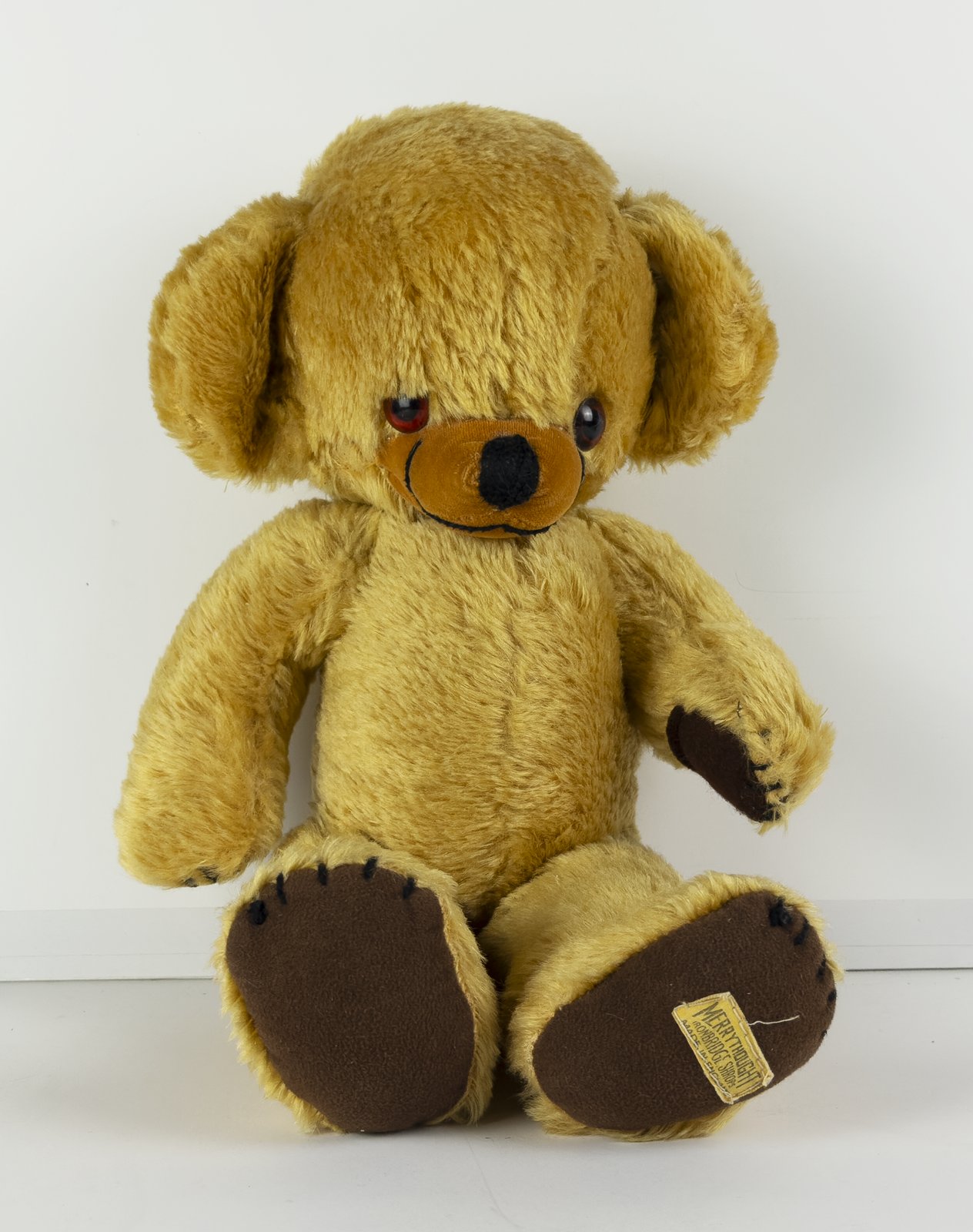
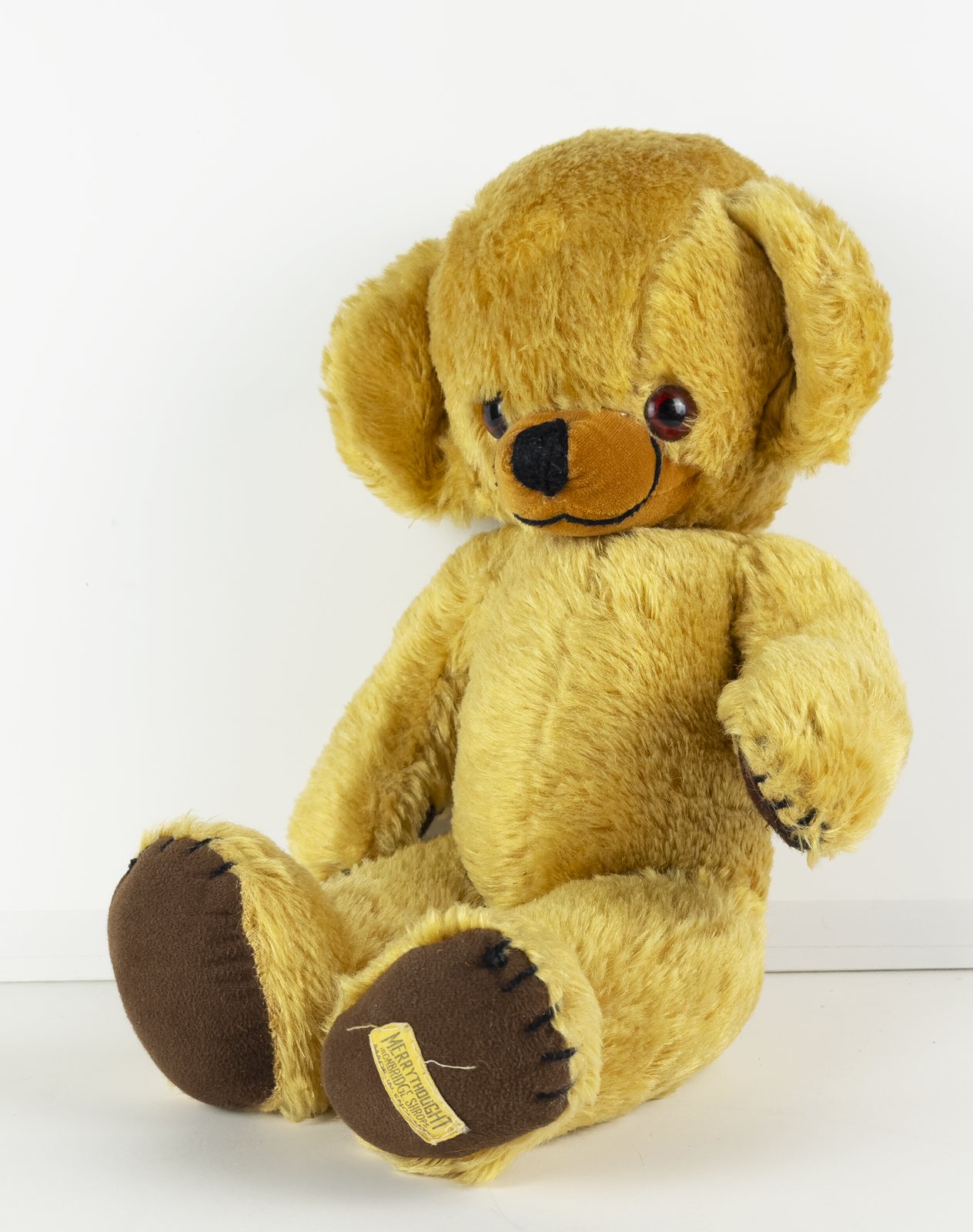
Lot Details
| Brand Line | Cheeky |
|---|---|
| Toy Subtype | plush |
| Scale Size | medium size |
| Manufacturer | Merrythought |
| Character Subject | Cheeky Teddy Bear |
| Cultural Significance | Revolutionary asymmetrical design that broke traditional teddy bear conventions and influenced plush toy design philosophy |
| Country Of Manufacture | Made in England |
Merrythought's Cheeky teddy bear, introduced in 1957, revolutionized teddy bear design with its asymmetrical face featuring one ear positioned higher than the other, breaking from the traditional symmetrical teddy bear aesthetic that had dominated since the early 1900s. This innovative design approach helped establish Merrythought as Britain's premier teddy bear manufacturer during the post-war toy boom and influenced plush toy design philosophy by demonstrating that deliberate asymmetry could create more expressive, personality-driven characters rather than the static, uniform designs of earlier generations.
(Includes Buyer's Premium)
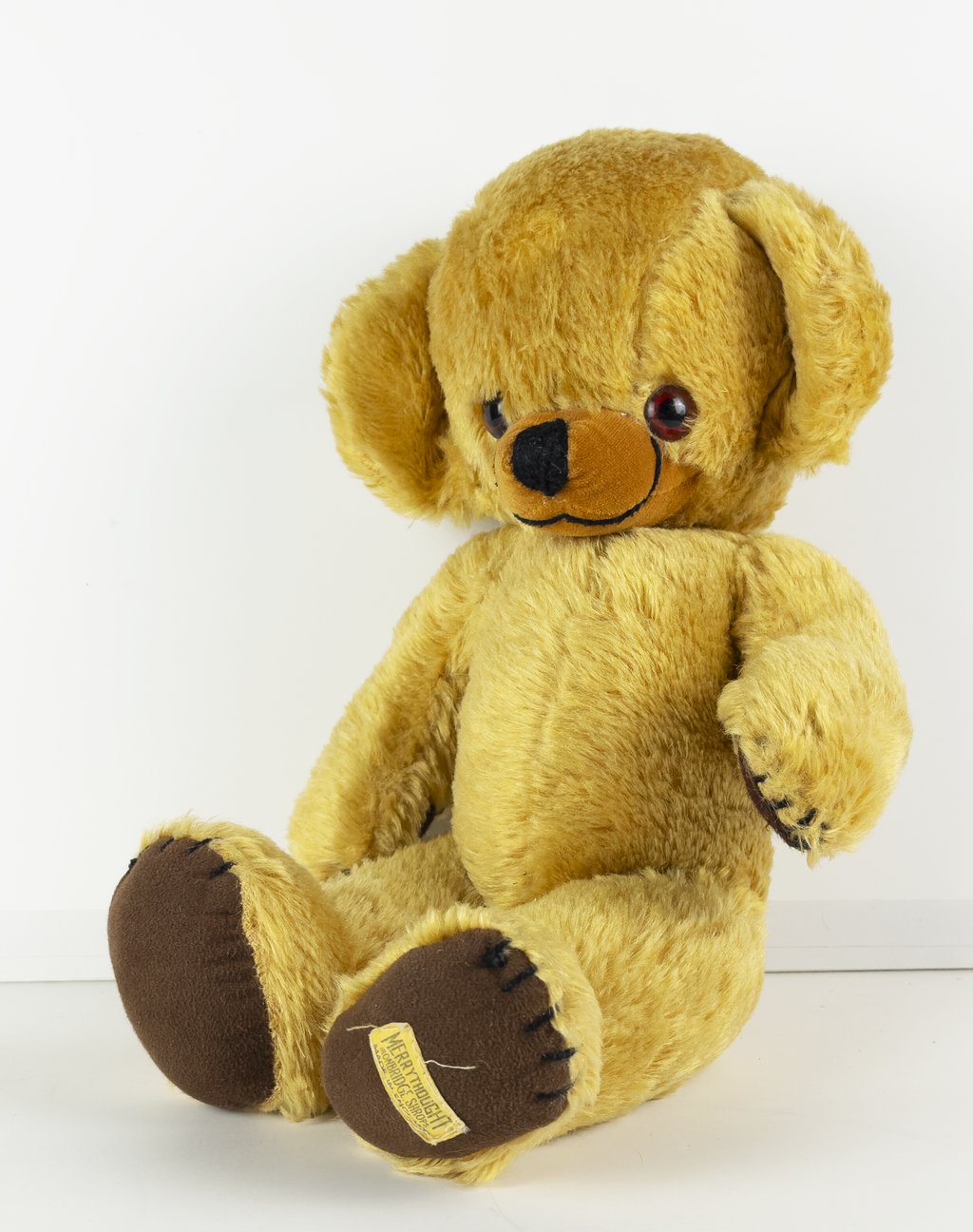
Lot Details
| Brand Line | Cheeky |
|---|---|
| Toy Subtype | plush |
| Scale Size | medium size |
| Manufacturer | Merrythought |
| Character Subject | Cheeky Teddy Bear |
| Cultural Significance | Revolutionary asymmetrical design that broke traditional teddy bear conventions and influenced plush toy design philosophy |
| Country Of Manufacture | Made in England |
Merrythought
Merrythought Ltd. was founded in 1930 in Ironbridge, Shropshire, England, during the Great Depression by Gordon Holmes and G.H. Laxton, with funding from C.J. Rendell, owner of a local mohair spinning mill. The company took its name from the archaic English word for wishbone, symbolizing good luck and happiness. Despite challenging economic conditions, the founders recognized growing demand for quality British-made soft toys following World War I's disruption of German toy imports. The company hired skilled workers from Chad Valley and J.K. Farnell (makers of the original Winnie-the-Pooh bear), including Florence Atwood, who became their chief designer. By 1931, Merrythought produced their first catalog featuring golden mohair teddy bears that would define British teddy bear craftsmanship for generations.
Merrythought quickly established distinctive design features that set their bears apart from competitors. Their bears featured the "Merrythought look" - a prominent forehead, closely set eyes, and a distinctive sewn nose that could be identified by collectors decades later. The company pioneered the use of kapok filling combined with wood wool, creating bears that maintained their shape better than contemporary alternatives. Their Magnet Line, introduced in 1930s, featured internal magnets allowing bears to hold metal objects. During the 1930s-1950s, Merrythought produced various innovative designs including the Bingie family (dressed bears with flexible wire frames), Cheeky bears with bell-in-ear features, and the revolutionary Punkinhead design with its unique rolled plush head construction. Production quality remained consistently high, with each bear hand-finished despite increasing mechanization elsewhere in the toy industry.
World War II challenged Merrythought as the factory converted to war work producing maps and textile items for the military. Post-war material shortages led to creative solutions, including bears made from sheepskin and cotton plush when mohair was unavailable. The 1950s-1970s saw Merrythought's golden age, with iconic designs like Mr. Whoppit (Donald Campbell's mascot), licensed productions including Sooty bears, and the establishment of Royal Warrant as suppliers to Princess Margaret. The company survived multiple challenges including fires in 1954 and 1986 that destroyed historical archives and patterns. The 1980s brought financial difficulties as Asian imports dominated the toy market, leading to brief closure in 2006 before being rescued by Sarah Holmes, great-granddaughter of founder Gordon Holmes, who continues family ownership today.
Merrythought bears became highly collectible for several compelling reasons. The company's consistent quality control meant even well-loved bears retained structural integrity decades later, unlike mass-produced alternatives that deteriorated. Limited edition releases, particularly anniversary bears and royal commemoratives, created scarcity that drives collector demand. The company's meticulous record-keeping (when archives survived) and distinctive labels - gold and black woven labels pre-1957, printed labels afterward - allow accurate dating and authentication. Certain designs achieved legendary status among collectors: 1930s Magnet bears can exceed £2,000, while rare Punkinhead examples command £3,000-5,000. Celebrity associations increase values dramatically - Mr. Whoppit bears connected to speed record holder Donald Campbell are virtually priceless. The combination of historical significance, craftsmanship quality, and emotional appeal created a robust collector market.
Merrythought's influence on teddy bear design and British toy manufacturing remains profound. As Britain's oldest surviving teddy bear manufacturer still producing in their original factory, they represent continuity in an industry decimated by globalization. The company's patterns and techniques influenced generations of bear makers worldwide. Their innovations - from jointed limb mechanisms to distinctive facial expressions - became industry standards. Modern Merrythought continues producing limited editions and custom bears while maintaining traditional hand-finishing techniques, with prices ranging from £150 for standard bears to thousands for limited editions. The collector market remains strong, supported by authentication services and detailed reference books documenting variations and dating.
Merrythought's story embodies British manufacturing resilience and the emotional power of traditional craftsmanship. Their bears populate museums worldwide, including the V&A Museum of Childhood and Bethnal Green Museum. Celebrity collectors and Royal patronage maintained the brand's prestige through economic challenges. The company's survival through war, fire, and financial crisis while maintaining family ownership and British production makes modern Merrythought bears both toys and investments. With annual production now limited to approximately 5,000 bears versus 200,000 in their peak years, even contemporary Merrythoughts are designed with future collectibility in mind. The combination of heritage, quality, and scarcity ensures Merrythought teddy bears remain among the most desirable collectible bears, representing not just toys but tangible connections to British social history and craftsmanship traditions spanning nearly a century.
Winnipeg Collectibles Auction
October 15 - October 29, 2025
BidLots operates as a division of Mayberry Holdings Ltd t/a Mayberry Fine Art
Contact us below to preview this lot or to sell similar items.
212 McDermot Ave, Winnipeg MB
(204) 255-5690
[email protected]
|
Bidding Range
|
Increment
|
|---|---|
| $0.00 - $50.00 | $1.00 |
| $50.00 - $100.00 | $5.00 |
| $100.00 - $500.00 | $10.00 |
| $500.00 - $1,000.00 | $25.00 |
| $1,000.00 - $5,000.00 | $50.00 |
| $5,000.00 - $10,000.00 | $100.00 |
| $10,000.00 - $20,000.00 | $200.00 |
| $20,000.00 - $50,000.00 | $500.00 |
| $50,000.00 - $100,000.00 | $1,000.00 |
| $100,000.00+ | $5,000.00 |
All items are shipped fully insured by Canada Post or by courier depending on service availablity.
Records, Comics and Paper Items: Flat rate $25 shipping for single items anywhere in Canada. Contact us for a quote on multiple items, special requests or international shipping.
Manitoba orders: GST (5%) and PST (7%) will be added to all orders picked up or shipped within Manitoba.
Other Canadian provinces: GST or HST will be added based on your province's rate.
US & International orders: No Canadian taxes apply. You may be responsible for import duties or taxes in your country.
Login or register a BidLots.com account to participate in any auction. Track specific lots and artists with real-time notifications on all bidding activity.
Becoming an approved bidder takes three simple steps:
1. Create a BidLots account
2. Confirm your email address
3. Add a valid billing profile
Note: BidLots or the auctioneer reserves the right to revoke bidding privileges if your account is not in good standing or violates our terms and conditions of sale.
A buyer's premium is an additional fee charged to winning bidders, typically ranging from 10% to 20% of the winning bid amount. The specific premium for each auction is clearly displayed on lot listings and paddle registration forms.
Bidding starts at the reserve price and increases by predetermined increments based on the current bid range. These increments are clearly shown on each lot's detail page. All bids (including maximum and single bids) must follow these preset increments to prevent duplicate bids.
Single bid cancellations are at the auctioneer's discretion. For maximum bids:
You can increase your maximum bid amount
Decreases require auctioneer approval
Changes won't be permitted if the lot closes within 24 hours or has significant activity
To request bid changes, use the "Ask a question" button on the lot's detail page
You'll be notified of winning bids in three ways:
Email notification (or Text notification if enabled)
Listed on your "Bidding Results" page
Highlighted message on auction pages when logged in
Shipping options vary based on item size, weight, and location. You'll select shipping preferences during auction registration. The auctioneer will provide specific shipping quotes after auction close. For special shipping requirements, please contact the auctioneer before bidding.
After the auction closes, you'll receive a detailed invoice including shipping costs. Payment options include:
Credit card (online)
Electronic Fund Transfer (EFT)
Bank draft
International wire transfer
Registered credit cards will be automatically charged for any outstanding balance 5 days after the close of a sale unless alternative payment arrangements have been made.