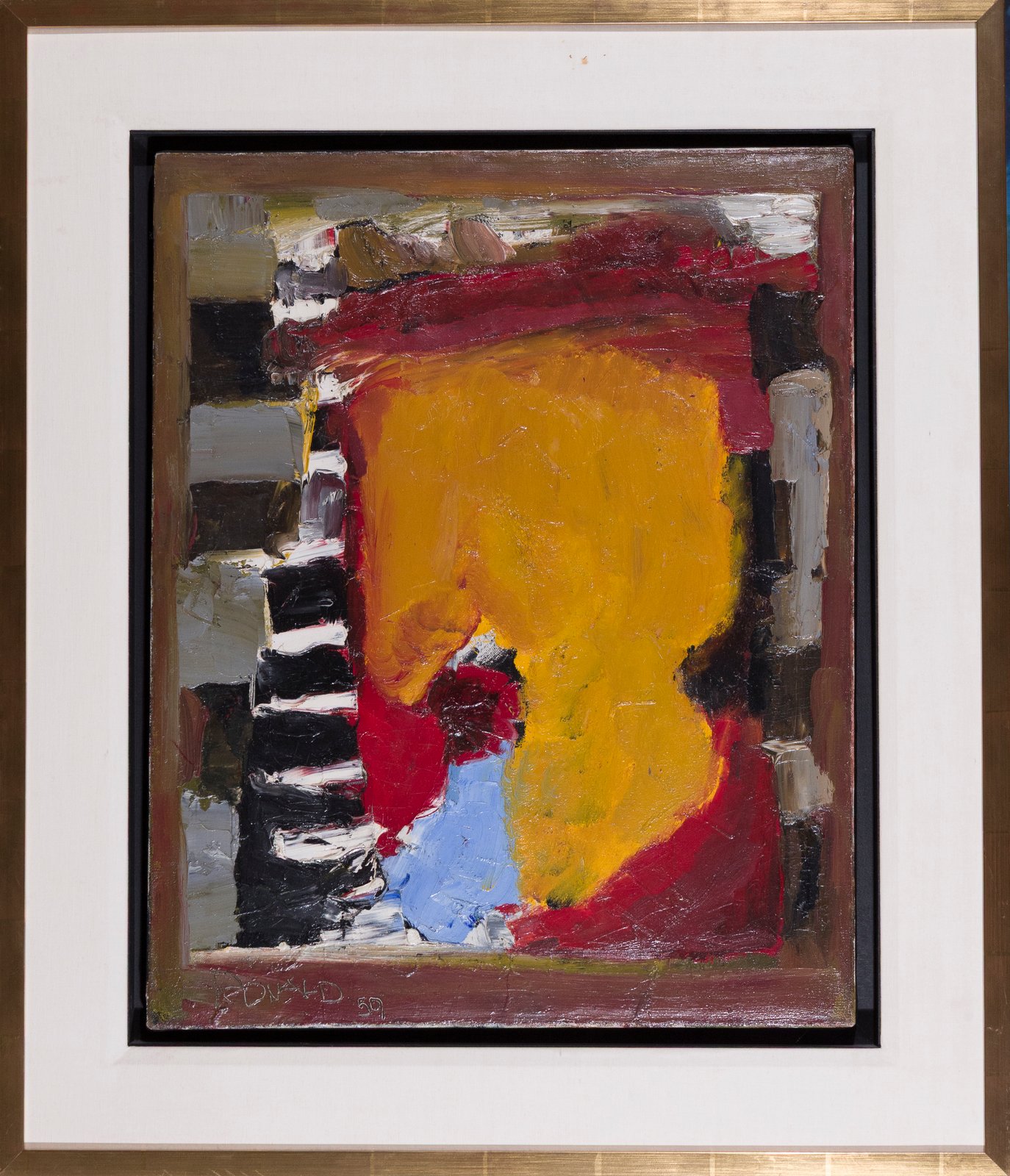
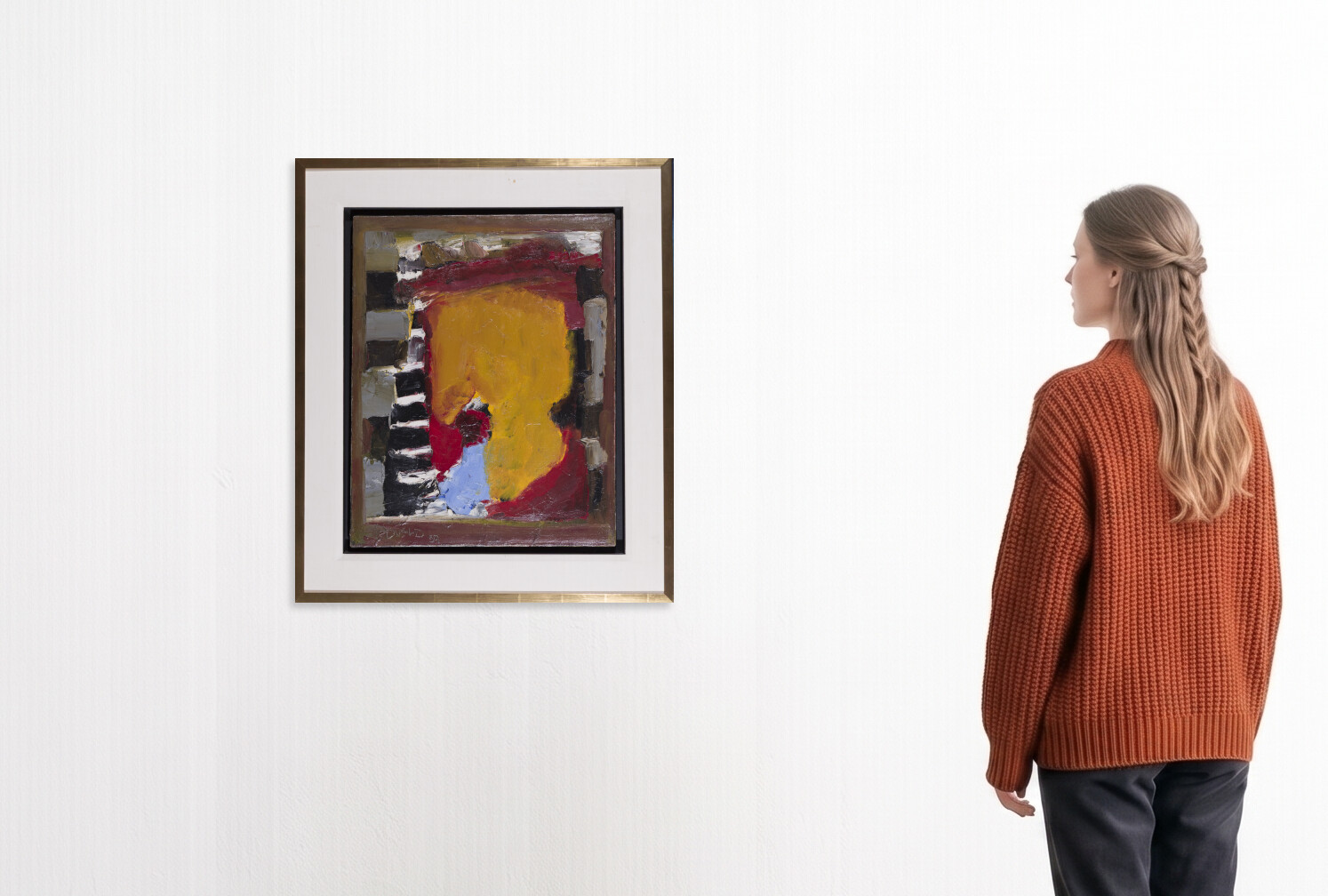
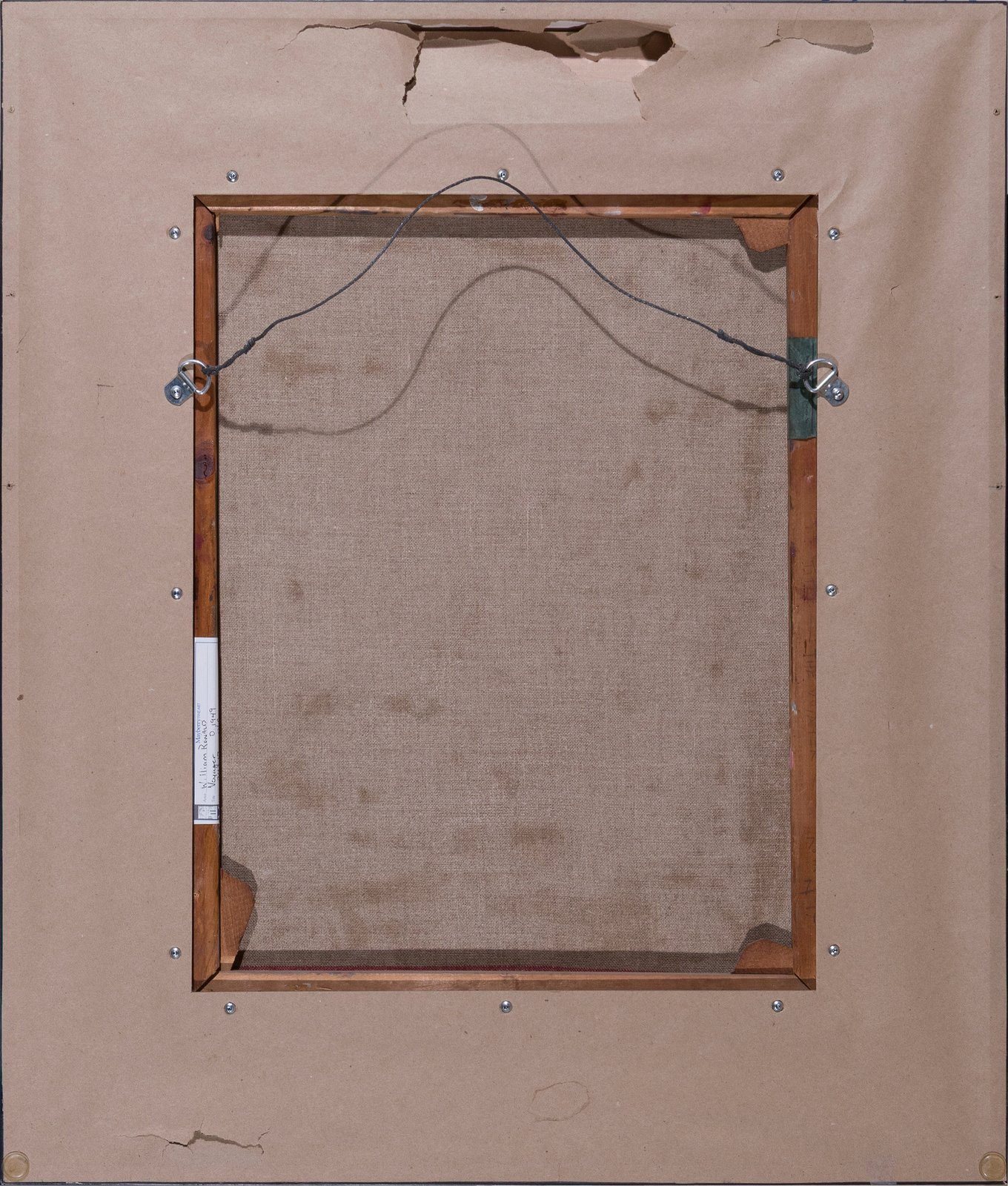
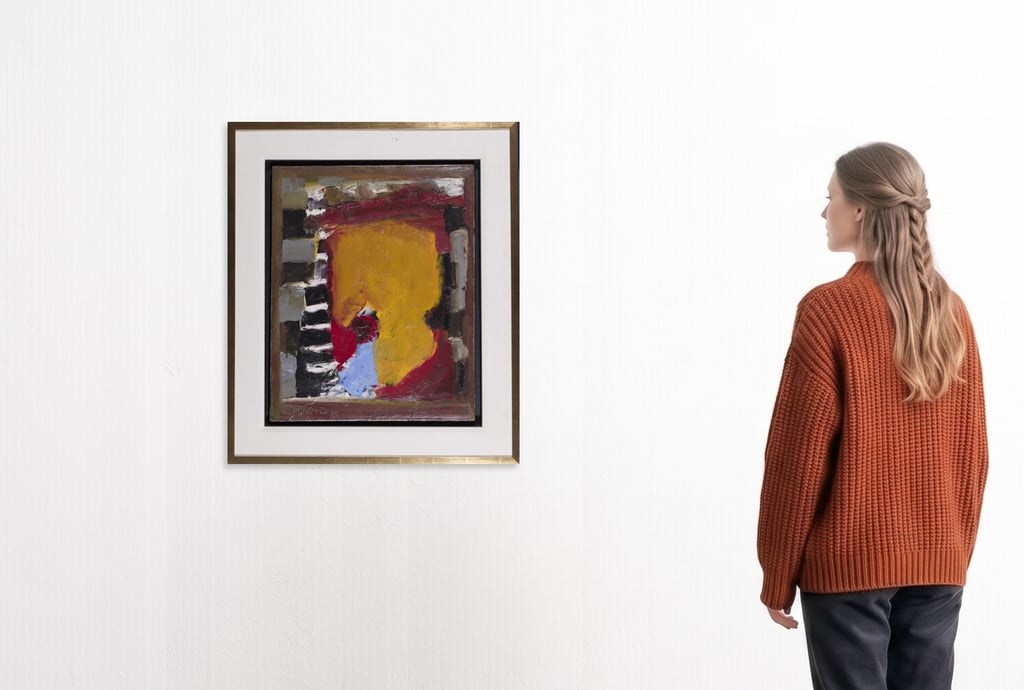
32.25 x 27.5 in (81.9 x 69.9 cm) including frame
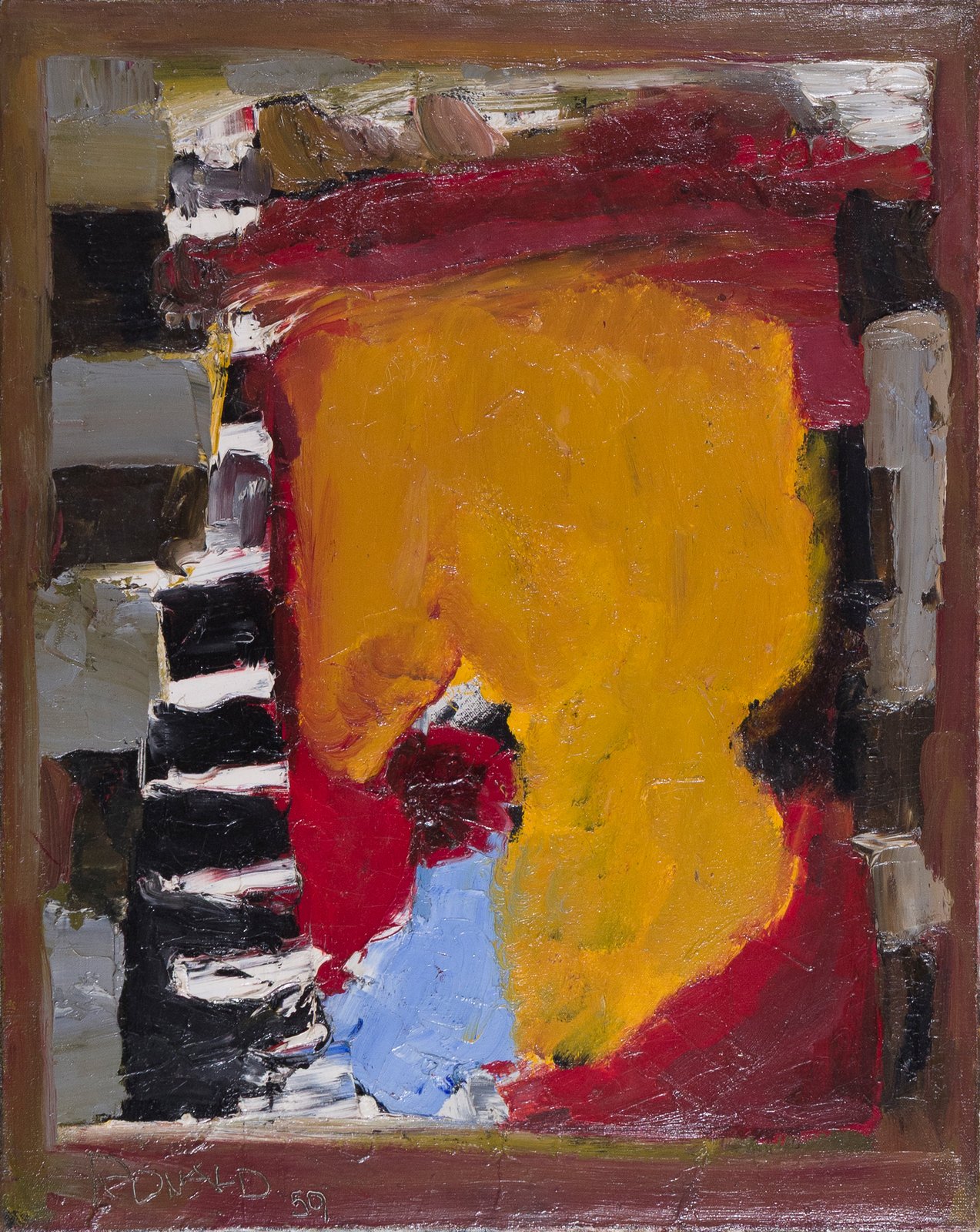
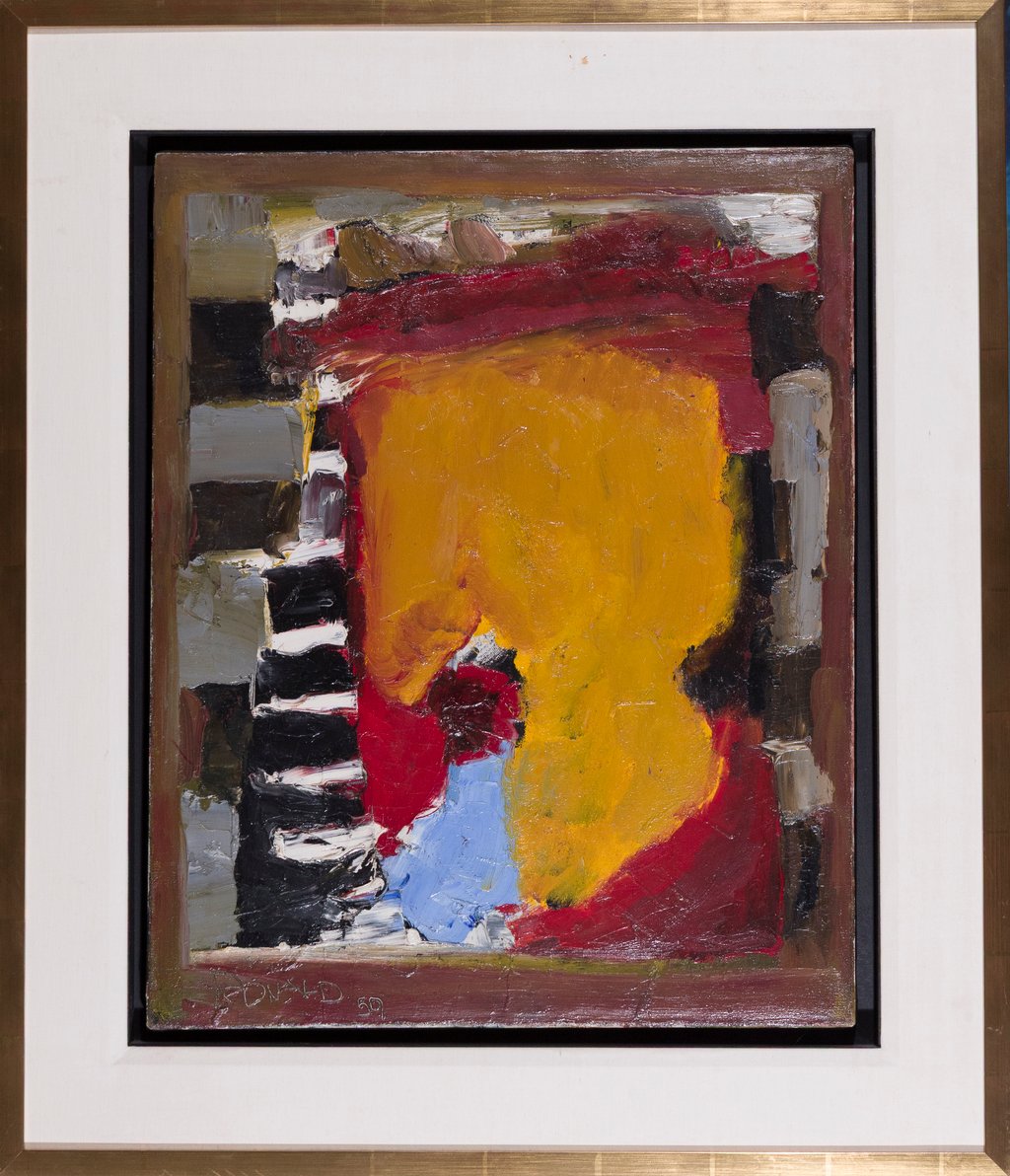
William Ronald was a founding member of the Toronto-based group Painters Eleven and achieved significant international recognition in the late 1950s. During this period, he was represented by the Kootz Gallery in New York, where he exhibited alongside prominent American Abstract Expressionists. Voyager (1959) is a representative example of his work from this decade, characterized by his development of the "centered image."
The composition is built around a central mass of saturated yellow and red paint, which appears to float within the frame. This central form is anchored by a small area of blue and flanked on the left by vertical, rhythmic bands of black and white. Ronald applied the oil paint with thick impasto and direct, visible brushstrokes, creating a textured and energetic surface.
This work reflects the shift in Canadian abstraction toward the more spontaneous and gestural style of the New York School. By isolating the primary activity in the middle of the canvas, Ronald avoided traditional landscape perspectives, focusing instead on the physical presence of the paint and the balance of the colored forms.
Ronald’s Studio, New York, N.Y
Quan Gallery, Toronto
Private Collection, Toronto
Canadian Art Group, Toronto
Mayberry Fine Art, Winnipeg
Private Collection, Winnipeg
“Ronald ’82, New Small Oils and Vintage Works” Gallery Quan, Toronto, April 3 - 22, 1982.
“William Ronald: Going against the grain” Lisa Balfour Bowen, Toronto Star, April 17, 1982, pF7.
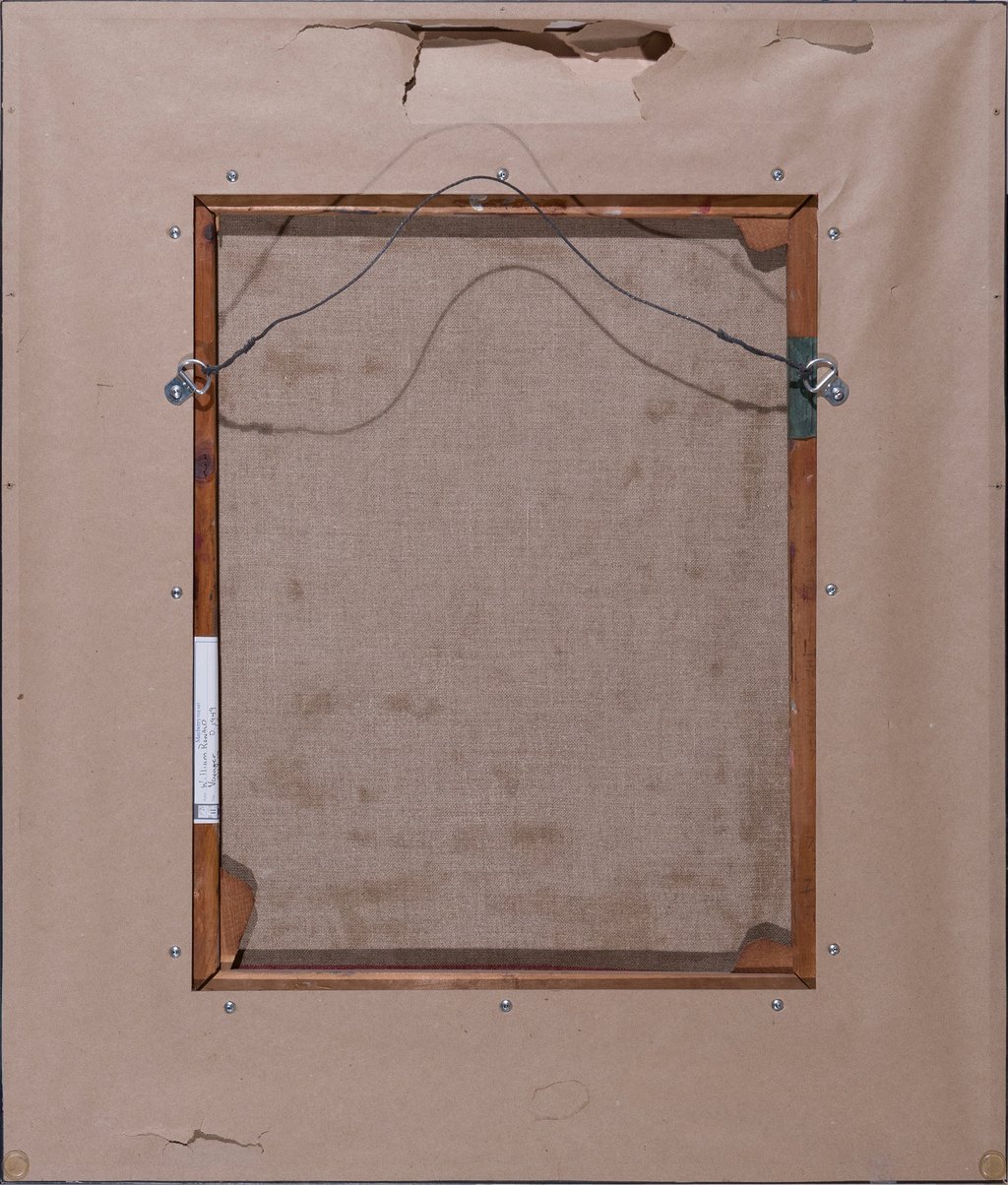
“The Theatre of the Self: The Life and Art of William Ronald” Robert Belton, 1999, p138.
(Includes Buyer's Premium)
William Ronald
William Ronald, born William Ronald Smith on August 13, 1926, in Stratford, Ontario, was a significant Canadian abstract expressionist painter who played a pivotal role in the development of modern Canadian art. After studying at the Ontario College of Art with Jock Macdonald, Ronald went to New York in 1952 where he briefly attended Hans Hofmann's School of Fine Arts. In 1953, frustrated by the lack of representation for abstract painting in Toronto, he organized the "Abstracts at Home" exhibition at the Robert Simpson department store where he worked as a display designer, pairing abstract paintings with furniture displays to introduce non-representational art to the public.
This initiative led to Ronald founding Painters Eleven in 1953, the first abstract painting group in English Canada. Finding Toronto's art scene too restrictive, Ronald moved to New York in 1957, where he joined the Kootz Gallery and developed his distinctive style characterized by large central images with dynamic, aggressive brushstrokes. His work was influenced by Willem de Kooning, though Ronald developed his own unique approach to abstract expressionism. During this period, he gained recognition from critics, collectors, and fellow artists such as Franz Kline.
Ronald returned to Canada in the mid-1960s and expanded his career beyond painting. He worked as a broadcaster for the CBC, hosting shows including "The Umbrella" (1966-67) and "As It Happens" (1969-72), and also wrote as a columnist for the Toronto Telegram. His painting style evolved in response to a 1967 mural commission for the National Arts Centre in Ottawa, incorporating more hard-edged elements while maintaining his interest in automatic painting and central imagery. In 1975, he was made a member of the Royal Canadian Academy of Arts.
In the 1980s, Ronald created a controversial series of abstract portraits of Canada's prime ministers, which was exhibited at the Art Gallery of Ontario in 1984 and toured Canada afterward. Known for his flamboyant personality, Ronald sometimes painted publicly, occasionally hiring performers to dance around him as he worked. He continued painting actively throughout his life, working in Montreal and later Barrie, Ontario. William Ronald died on February 9, 1998, shortly after suffering a heart attack while painting a work he named "Heart Attack."
Major Spring Fine Art Auction
May 7 - May 28, 2026

661 Wall St, Winnipeg MB
(204) 255-5690
mayberryfineart.com
[email protected]
Contact us to make an appointment to preview this item or to sell similar works.
|
Bidding Range
|
Increment
|
|---|---|
| $0.00 - $50.00 | $1.00 |
| $50.00 - $100.00 | $5.00 |
| $100.00 - $500.00 | $10.00 |
| $500.00 - $1,000.00 | $25.00 |
| $1,000.00 - $5,000.00 | $50.00 |
| $5,000.00 - $10,000.00 | $100.00 |
| $10,000.00 - $20,000.00 | $200.00 |
| $20,000.00 - $50,000.00 | $500.00 |
| $50,000.00 - $100,000.00 | $1,000.00 |
| $100,000.00+ | $5,000.00 |
Login or register a BidLots.com account to participate in any auction. Track specific lots and artists with real-time notifications on all bidding activity.
Bidding approval requires three simple steps:
1. Create a Bid Lots account
2. Confirm your email address
3. Create a valid billing profile
Bid Lots and/or the auctioneer may choose to revoke your bidding privileges if your account is not in good standing or your activity is in conflict with our standard terms and conditions of sale.
The buyer’s premium is an additional percentage charged to the winning bidder. The buyer’s premiums may vary from auction to auction, typically ranging from 10% to 20%. Buyer’s premiums will be displayed on detailed lot listings and paddle registration forms.
Bidding begins at the reserve price and advances at set increments based on the bidding range. The specific bidding increments may vary from auction to auction, however the next bid and subsequent increments will always be clearly defined on detailed lot listings. Maximum Bids and Single Bids can only be placed within the pre-defined bidding increments ensuring that no two bidders can place identical bids on an item. View individual lot detail pages to see a complete range of bidding increments for that item.
Requests to cancel a single bid are at the sole descretion of the auctioneer. Maximum bids can be increased but cannot be decreased unless premitted by the auctioneer. Requests to cancel a bid or to alter a maximum bid will be denied if the specific lot is scheduled to close in less than 24 hours or if the lot has significant interest or activity.
To request that a bid be cancelled or to change a maximum bid use the "Ask a question" button on the detailed lot listing.
You will receive an email notification when you have successfully won an auction. You will also see the item listed on your "Bidding Results" page and if you are logged into the site you will see a highlighted message on the auction catalogue pages and auction listings.
Shipping requirements may vary on different items depending on location and size or weight of an item. When registering for a specific auction you will be provided options to clarify your preferred shipping instructions. The auctioneer will also review and provide specific shipping quotes or options following the close of an auction. If you have specific shipping requirements or are unsure of the shipping constraints on a specific item please contact the auctioneer prior to bidding.
Following the close of an auction the auctioneer will provide a detailed invoice for all items you have won. They may contact you before a final invoice is prepared to confirm or review specific shipping instructions. Payment is due once a final invoice is provided and can be submitted online by credit card, or made by EFT (Electronic Fund Transfer), bank draft or international wire transfer. Any outstanding balance will be automatically charged to your registered credit card 5 days following the close of an auction.