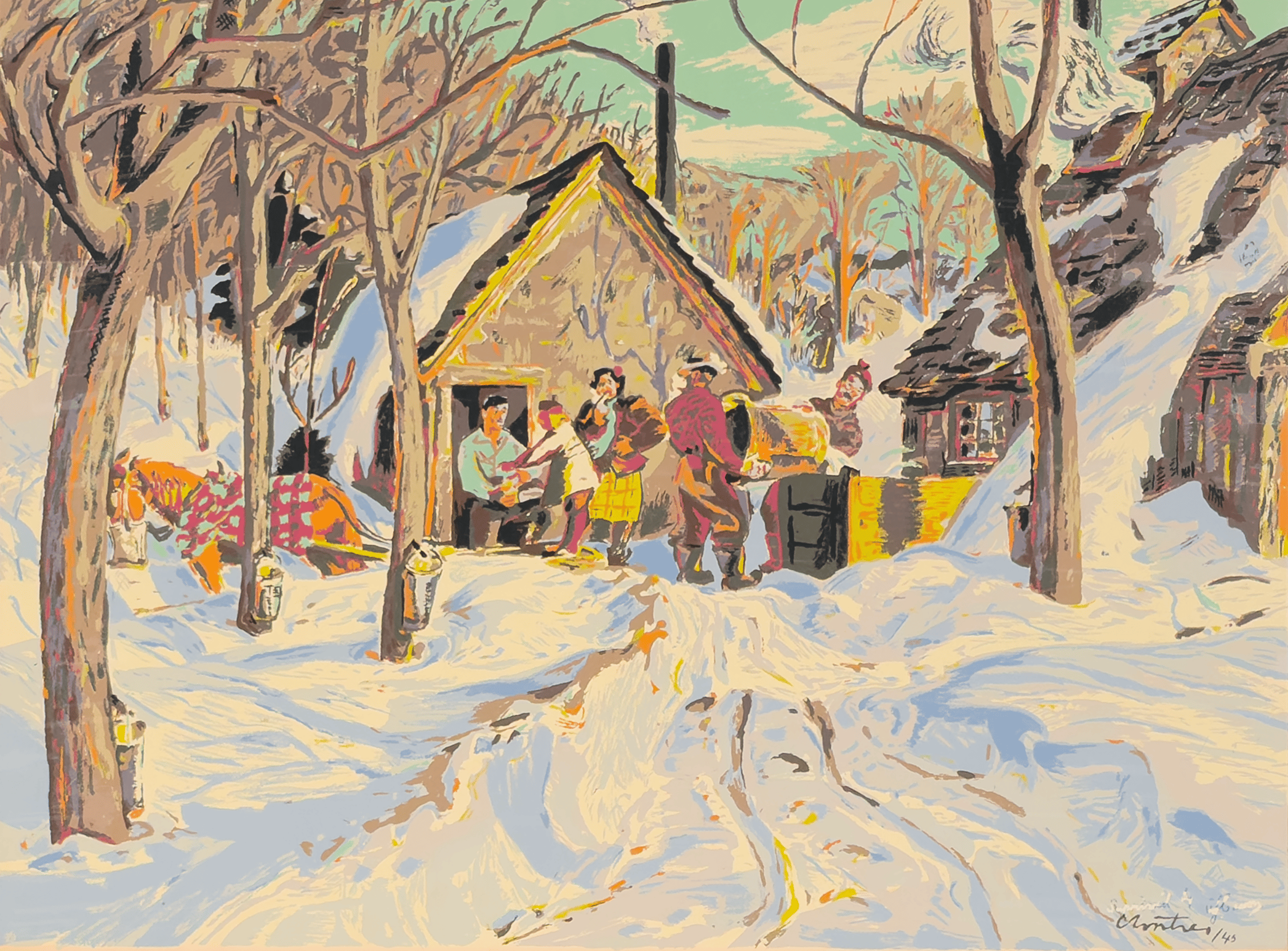
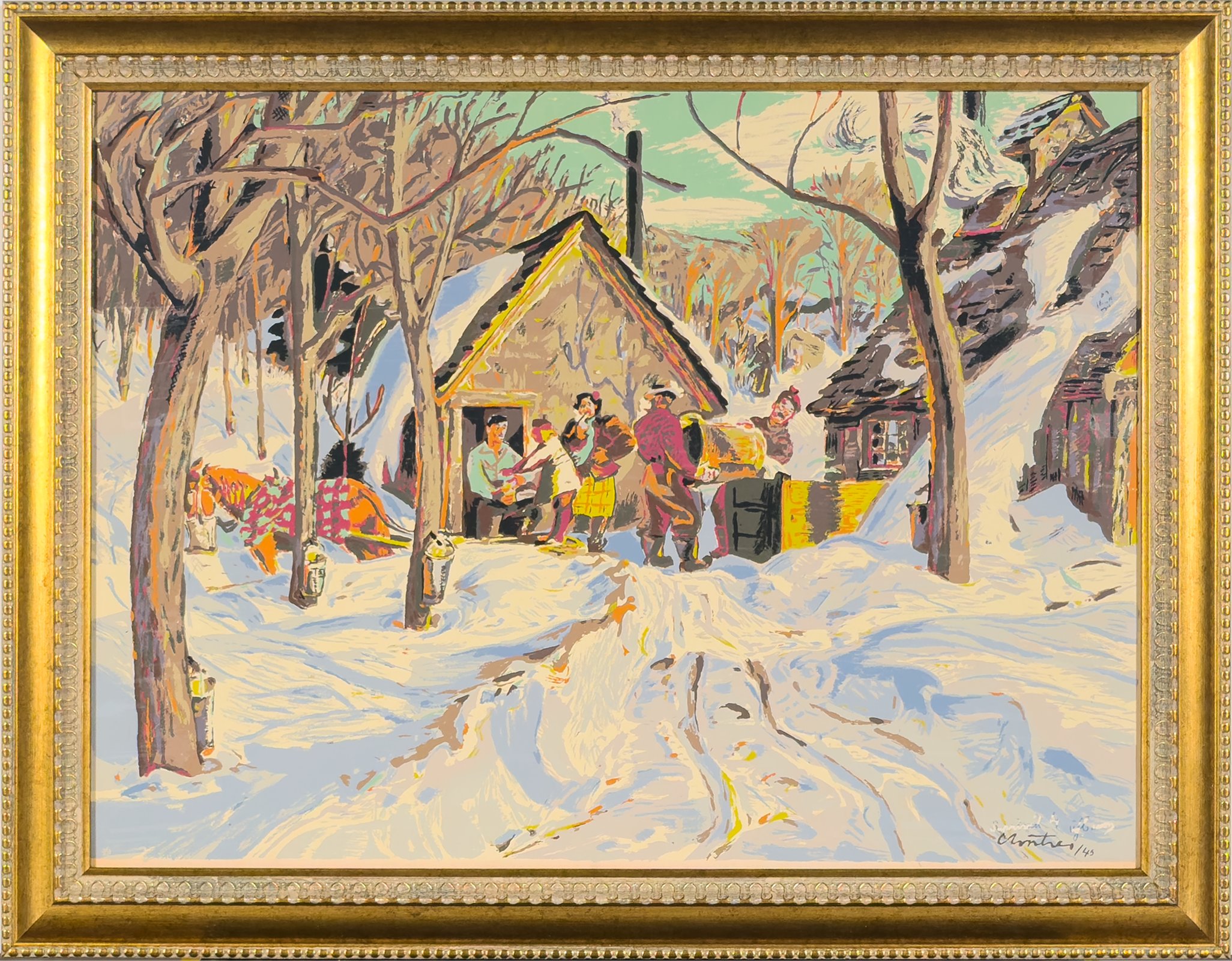
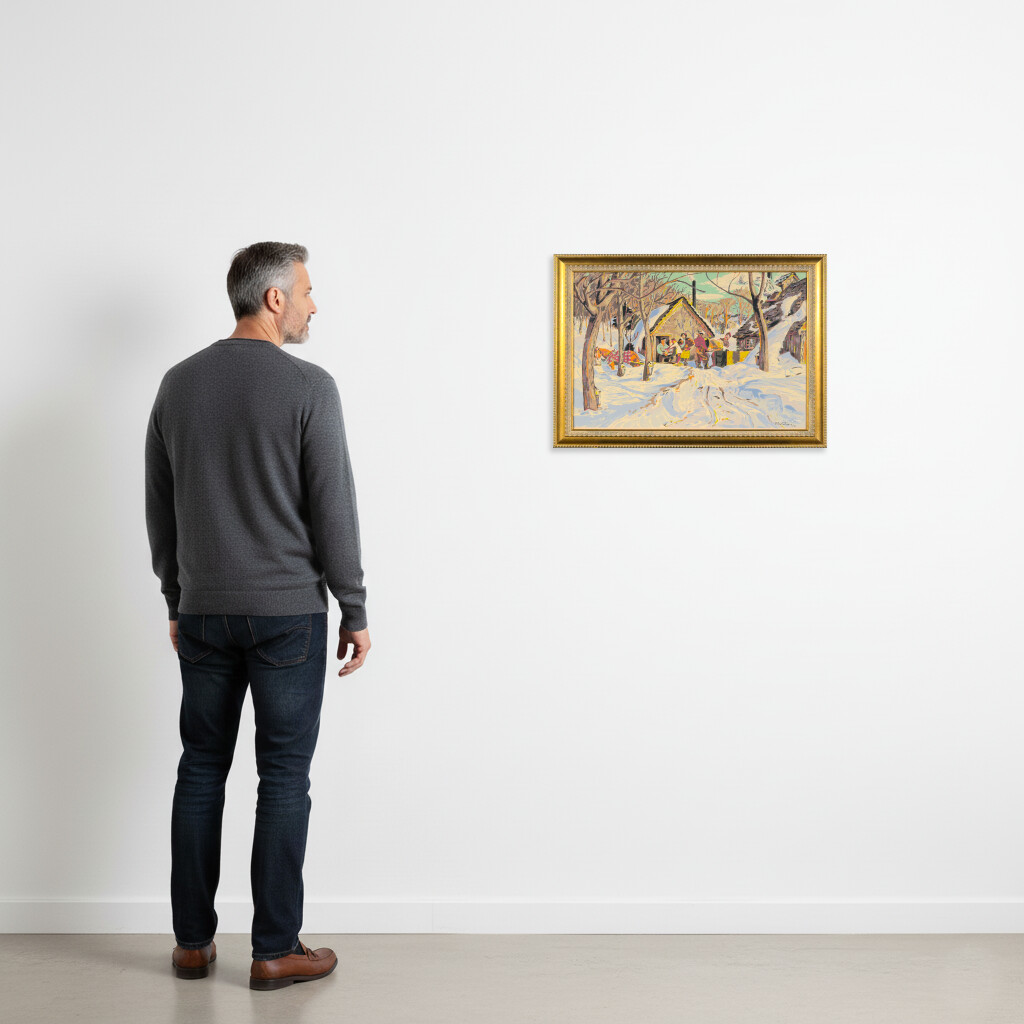
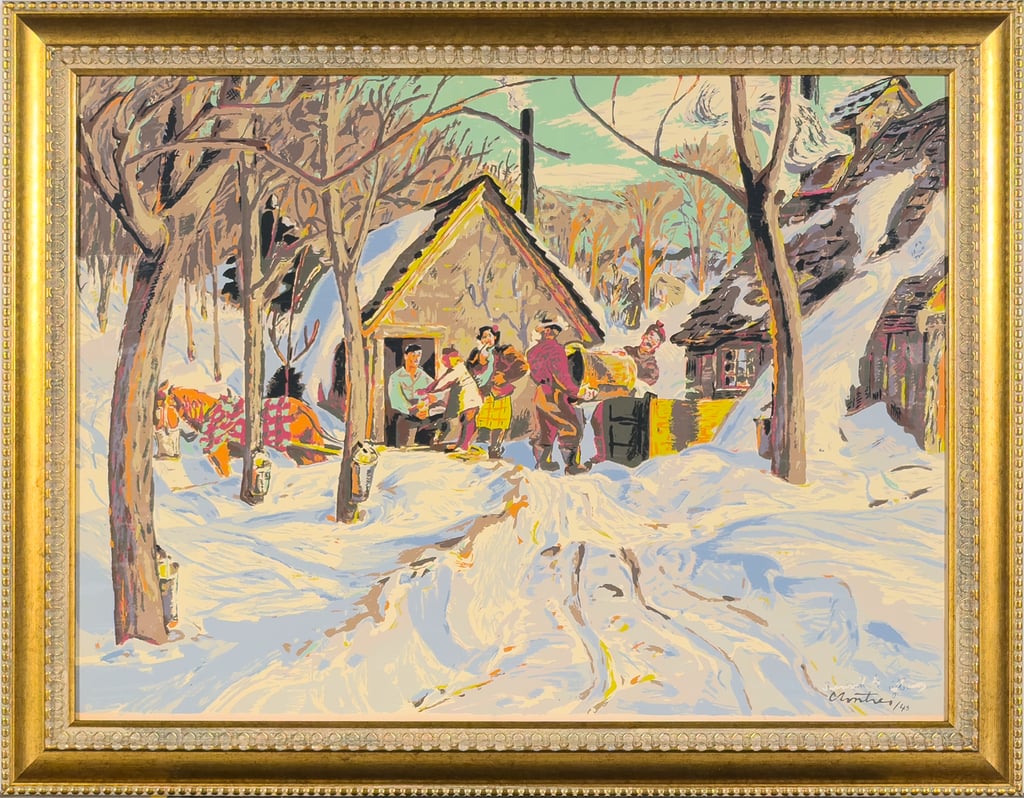
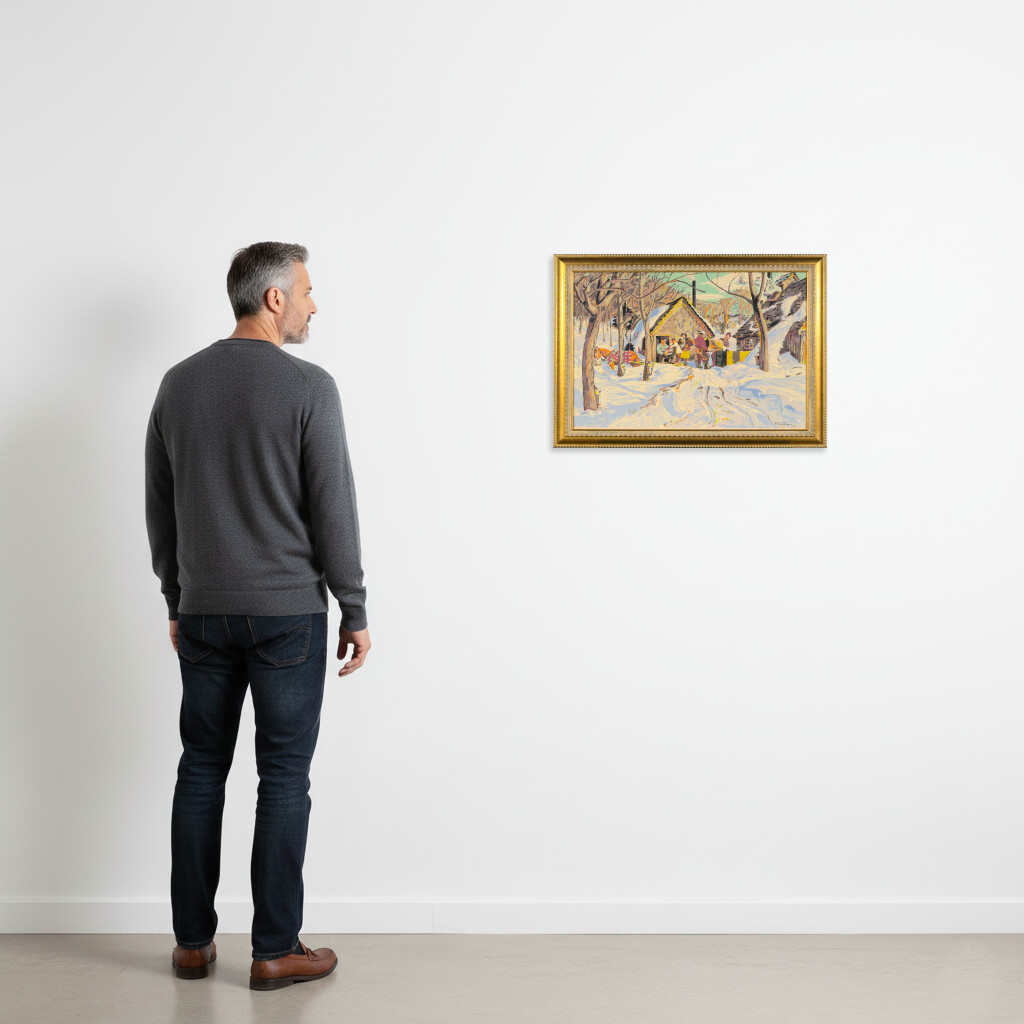
22 x 31 in (55.9 x 78.7 cm) including frame
This work was signed at a later date by A. J. Casson who was heavily involved in the Sampson-Matthews print making project. It contains his original signature.
The Sampson-Matthews print program was the largest public art project in Canadian history. Launched at the start of the Second World War, it lasted twenty-two years and cost tens of millions of dollars in today’s currency. At its height, it employed many of the country’s best commercial painters, designers and artists, working full-time to create masterpieces of serigraphy.
(Includes Buyer's Premium)
Albert Edward Cloutier
Albert Edward Cloutier was born in 1902 to Canadian parents in Leominster, Massachusetts. The family moved back to Canada in 1903, and as a child, Cloutier received encouragement in the arts from his parents, beginning to paint at the Monument National at age eleven. Largely self-taught, he went on painting trips with A.Y. Jackson and Edwin Holgate, associations that would prove significant throughout his career. From 1918 to 1921, Cloutier worked as an apprentice with Smeaton Bros in Montreal, followed by positions with Associated Engravers in Montreal (1922-1925) and Batten Ltd. in Montreal (1926-1929). From 1929 to 1940, he worked as a freelance graphic designer and illustrator in Montreal while developing his fine art practice.
Cloutier was part of the "Oxford Group" led by painters André Biéler and Edwin Holgate, which met in a below-ground room at the Oxford tavern at lunchtime. The group maintained roughly equal numbers of francophone and anglophone members, including Adrien Hébert, art critic Jean Chauvin, and editor Carrier. His early work showed the influence of French Impressionists, the Group of Seven, and Paul Cézanne, while his later style evolved into an intensified realism with increasingly abstract and plastic forms. Working in oils, watercolours, tempera, clay, wood, metals, and mosaics, Cloutier followed the French Canadian tradition of depicting settled farm landscapes and Canadian beauty.
In 1939, Cloutier collaborated with Edwin Holgate on a 450-square-foot frieze for the Canadian pavilion at the New York World's Fair, commissioned by the Canadian government. The mural showed a panorama of the country's industries, people, and products, centered on a hydroelectric dam with a white horse representing power, with transmission lines leading to pulp and paper, mining, and manufacturing industries, and a man with horse and plough in the foreground representing traditional agriculture. During World War II, Cloutier served as Art Director for the Wartime Information Board in 1941, where he was instrumental in launching the Sampson-Matthews print program. In 1941, he and Eric Aldwinckle created a poster of Canada's New Army featuring clean lines and simple, efficient design. From 1943 to 1946, Cloutier served as an Official War Artist with the Royal Canadian Air Force, holding the rank of flight lieutenant. He was the only francophone war artist, and his pictures included training aircraft and flying boats.
After the war, Cloutier worked as a freelance graphic designer and illustrator in Ottawa from 1946 to 1948, then returned to Montreal in 1948, where he remained for the rest of his career. He lectured at the École des beaux-arts de Montréal for more than two years and made silkscreens for Sampson Matthews Limited. His major commissions included a mural for one of the new Park cars on the Canadian Pacific Railway's Canadian passenger train and illustrations for "Kingdom of the Saguenay" (1936) by Marius Barbeau. In 1958, he was among the artists selected to decorate the interior of the Queen Elizabeth Hotel, owned by the Canadian National Railway. He contributed carved wooden panels and painted twelve panels for the main dining room of the Salle Bonaventure covering subjects of music, handicrafts, and culinary arts. He also created a mural for Le Carignan restaurant at Place Ville Marie in Montreal, painting soldiers from the Carignan-Salières Regiment in full battle dress using dyes on fabric. In 1959, he designed and illustrated "Pathway to Greatness" for the Canadian Pulp & Paper Association, describing the development of the Saint Lawrence Seaway.
Cloutier became a member of the Federation of Canadian Artists in 1941 and the Canadian Society of Painters in Water Colour in 1948. He was elected an Associate of the Royal Canadian Academy of Arts in 1951 and became a full member in 1956. He joined the Arts Club of Montreal in 1951 and served as its president from 1957 to 1959. He also became a member of the Canadian Society of Graphic Art (circa 1952), served as president of the Art Directors' Club of Montreal (1953), and was a member of the National Society of Art Directors in New York City. His work is held by the National Gallery of Canada in Ottawa. Albert Cloutier died in Mont-Saint-Hilaire, Quebec, in 1965 at age 63.
October Canadian Fine Art Auction
October 9 - October 23, 2025

661 Wall St, Winnipeg MB
(204) 255-5690
mayberryfineart.com
[email protected]
Contact us to make an appointment to preview this item or to sell similar works.
|
Bidding Range
|
Increment
|
|---|---|
| $0.00 - $50.00 | $1.00 |
| $50.00 - $100.00 | $5.00 |
| $100.00 - $500.00 | $10.00 |
| $500.00 - $1,000.00 | $25.00 |
| $1,000.00 - $5,000.00 | $50.00 |
| $5,000.00 - $10,000.00 | $100.00 |
| $10,000.00 - $20,000.00 | $200.00 |
| $20,000.00 - $50,000.00 | $500.00 |
| $50,000.00 - $100,000.00 | $1,000.00 |
| $100,000.00+ | $5,000.00 |
Login or register a BidLots.com account to participate in any auction. Track specific lots and artists with real-time notifications on all bidding activity.
Bidding approval requires three simple steps:
1. Create a Bid Lots account
2. Confirm your email address
3. Create a valid billing profile
Bid Lots and/or the auctioneer may choose to revoke your bidding privileges if your account is not in good standing or your activity is in conflict with our standard terms and conditions of sale.
The buyer’s premium is an additional percentage charged to the winning bidder. The buyer’s premiums may vary from auction to auction, typically ranging from 10% to 20%. Buyer’s premiums will be displayed on detailed lot listings and paddle registration forms.
Bidding begins at the reserve price and advances at set increments based on the bidding range. The specific bidding increments may vary from auction to auction, however the next bid and subsequent increments will always be clearly defined on detailed lot listings. Maximum Bids and Single Bids can only be placed within the pre-defined bidding increments ensuring that no two bidders can place identical bids on an item. View individual lot detail pages to see a complete range of bidding increments for that item.
Requests to cancel a single bid are at the sole descretion of the auctioneer. Maximum bids can be increased but cannot be decreased unless premitted by the auctioneer. Requests to cancel a bid or to alter a maximum bid will be denied if the specific lot is scheduled to close in less than 24 hours or if the lot has significant interest or activity.
To request that a bid be cancelled or to change a maximum bid use the "Ask a question" button on the detailed lot listing.
You will receive an email notification when you have successfully won an auction. You will also see the item listed on your "Bidding Results" page and if you are logged into the site you will see a highlighted message on the auction catalogue pages and auction listings.
Shipping requirements may vary on different items depending on location and size or weight of an item. When registering for a specific auction you will be provided options to clarify your preferred shipping instructions. The auctioneer will also review and provide specific shipping quotes or options following the close of an auction. If you have specific shipping requirements or are unsure of the shipping constraints on a specific item please contact the auctioneer prior to bidding.
Following the close of an auction the auctioneer will provide a detailed invoice for all items you have won. They may contact you before a final invoice is prepared to confirm or review specific shipping instructions. Payment is due once a final invoice is provided and can be submitted online by credit card, or made by EFT (Electronic Fund Transfer), bank draft or international wire transfer. Any outstanding balance will be automatically charged to your registered credit card 5 days following the close of an auction.