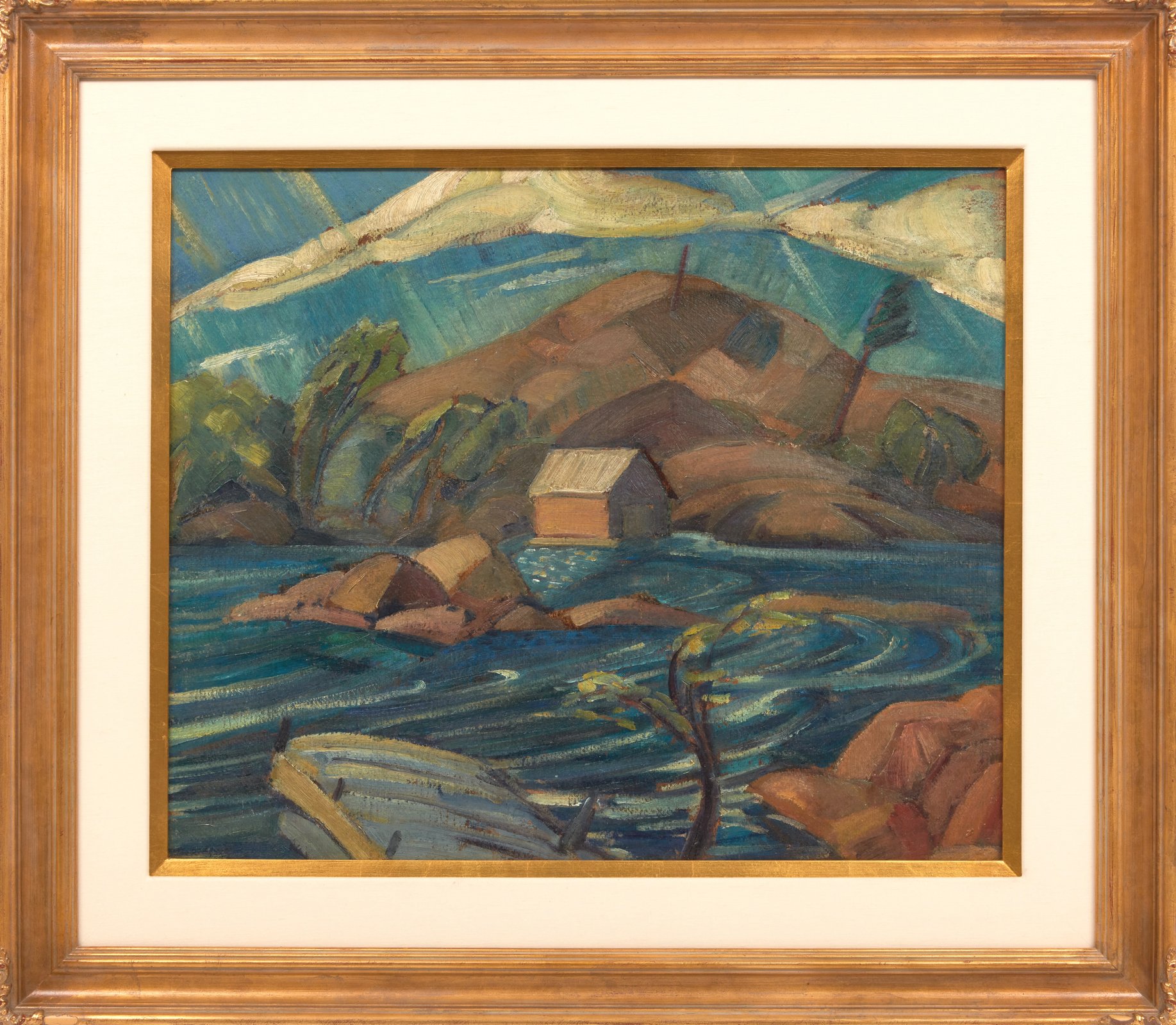
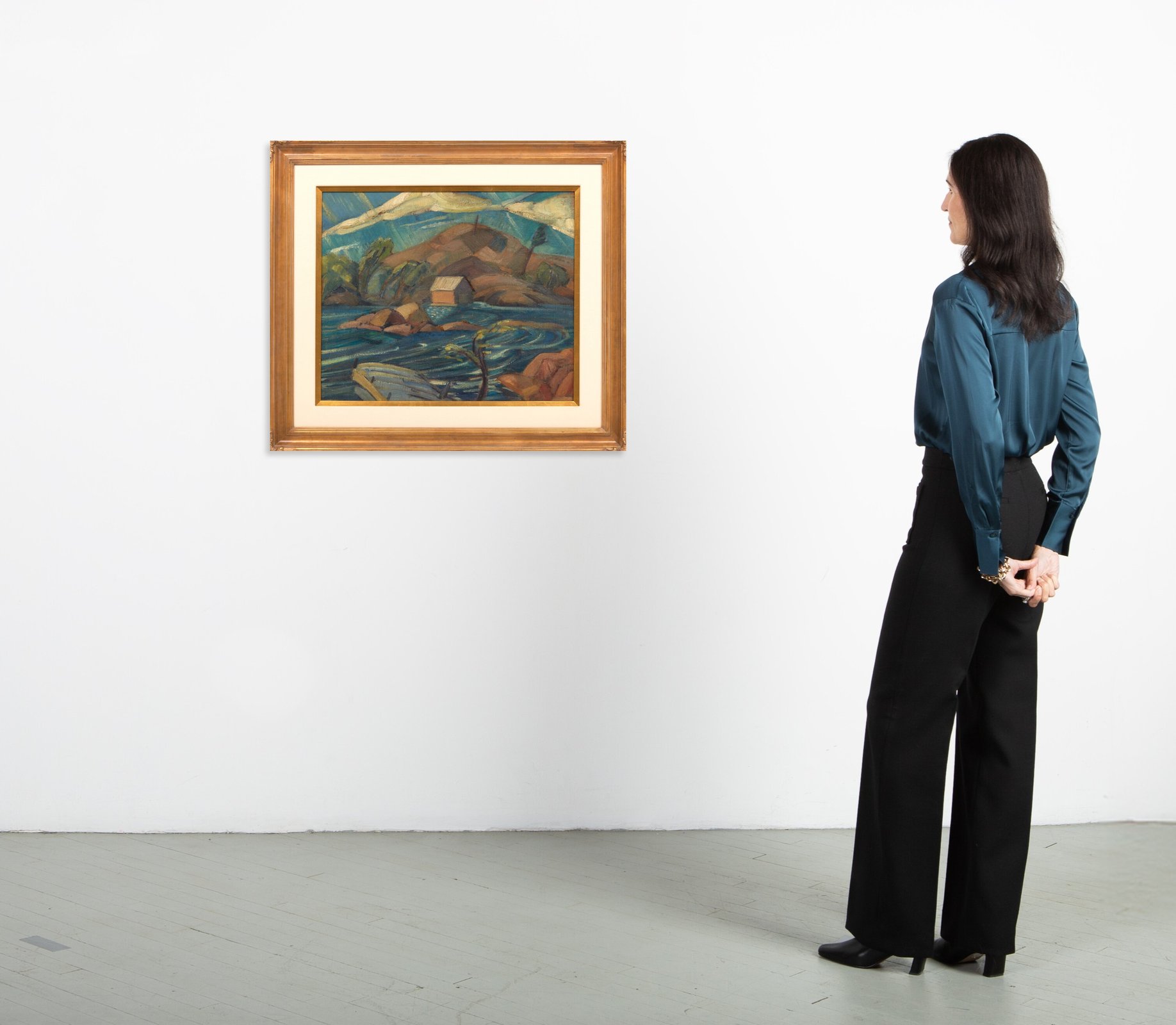
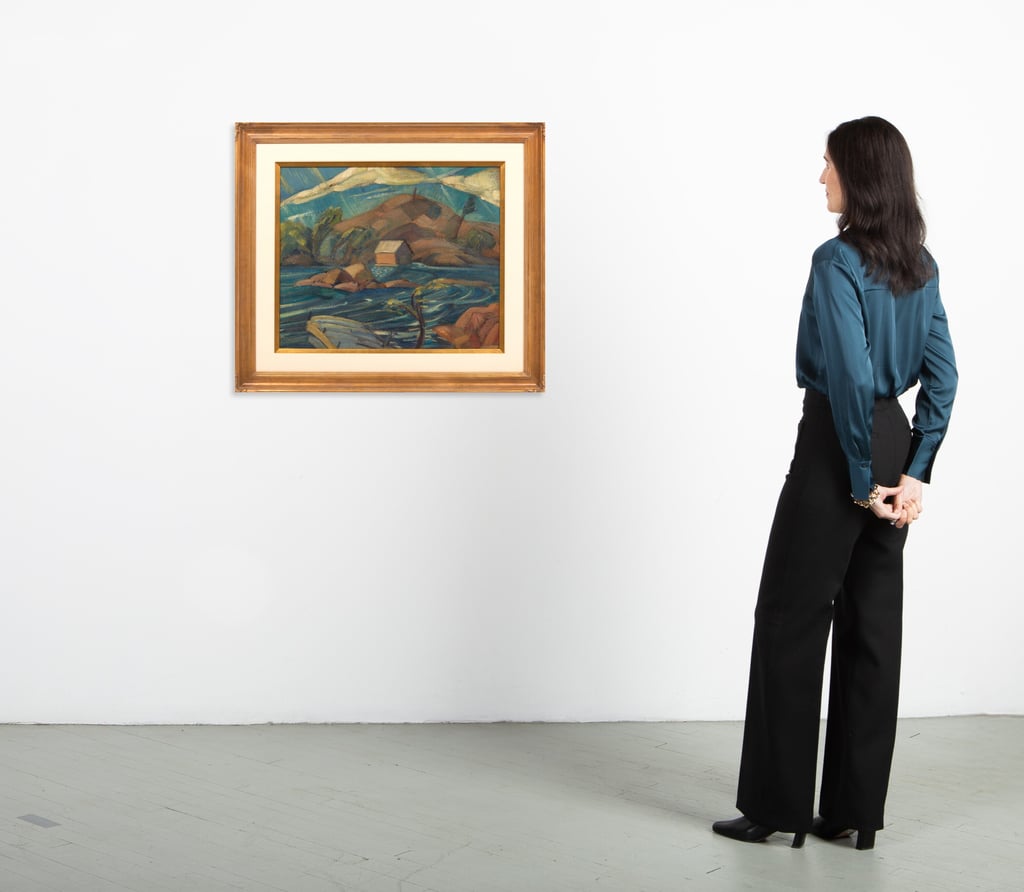
28.75 x 33 x 1.5 in (73 x 83.8 x 3.8 cm) including frame
Sir Frederick Grant Banting remains one of Canada’s most consequential historical figures. Internationally renowned as the co-discoverer of insulin alongside Charles Best and J.J.R. Macleod, Banting was awarded the Nobel Prize in Physiology or Medicine in 1923 at the age of thirty-two. Alongside his scientific career, Banting developed a dedicated, lifelong practice as a painter. After being introduced to the Arts and Letters Club of Toronto in the mid-1920s, he became a close companion of A.Y. Jackson. The two artists travelled and sketched together regularly throughout Quebec, Ontario, and the Arctic, with Jackson acting as an essential sounding board and painting partner. Banting was later elected an associate member of the Royal Canadian Academy of Arts.
During their travels, Jackson and Banting made several painting trips to the French River and Georgian Bay area of Ontario. Banting's lifelong friend and teacher, Dr. George William Ross, owned a cottage on Georgian Bay near the Key River, and the pair were known to have stayed with Dr. Ross while working in the region. The provenance of the work is directly tied to the site where it was produced. Dr. Ross acquired the work directly from Banting, either by purchase or as a gift. The painting remained hanging inside the Key River cottage for decades. When Dr. Ross eventually sold the property, the artwork passed down with the cottage to its new owners.
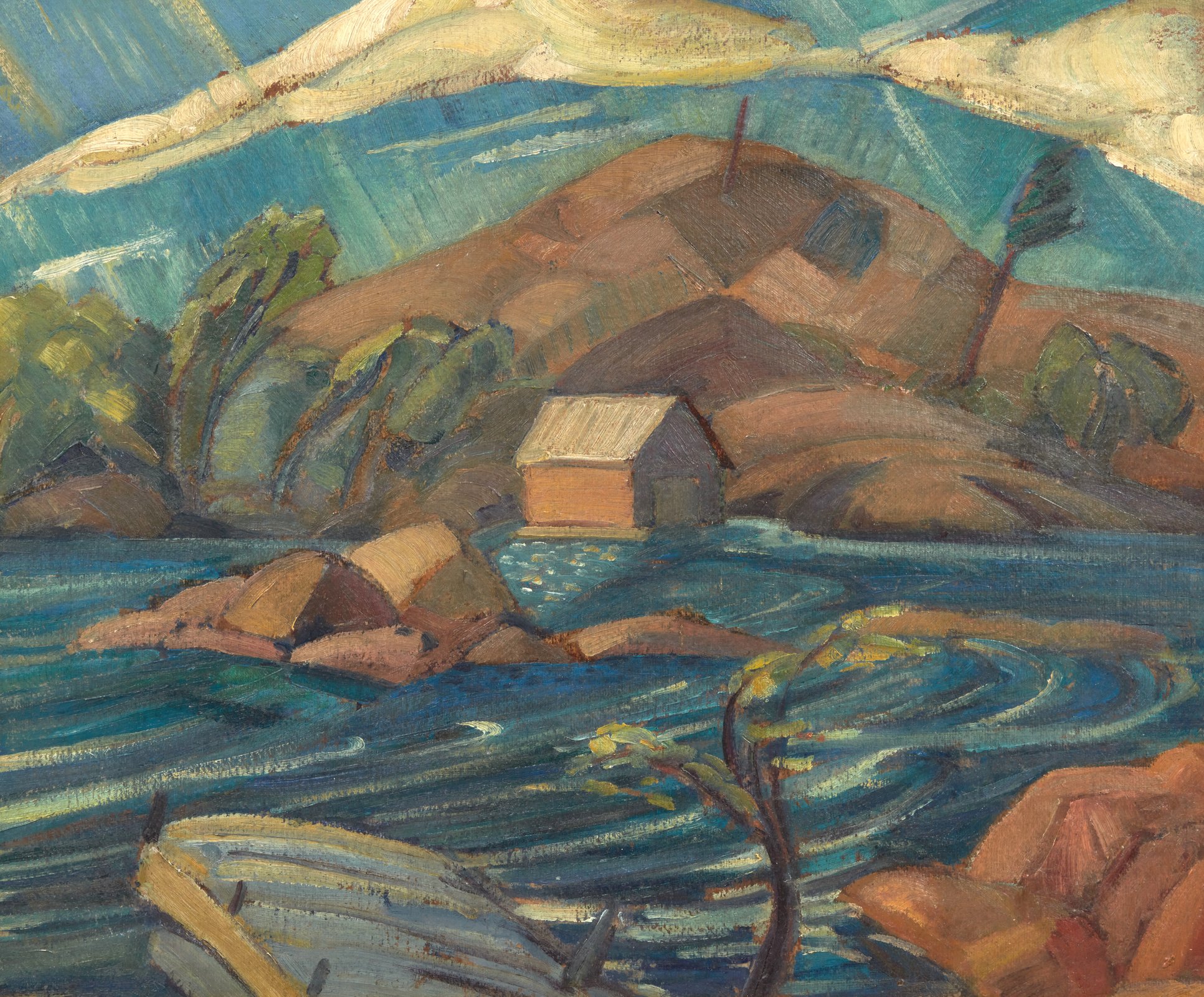
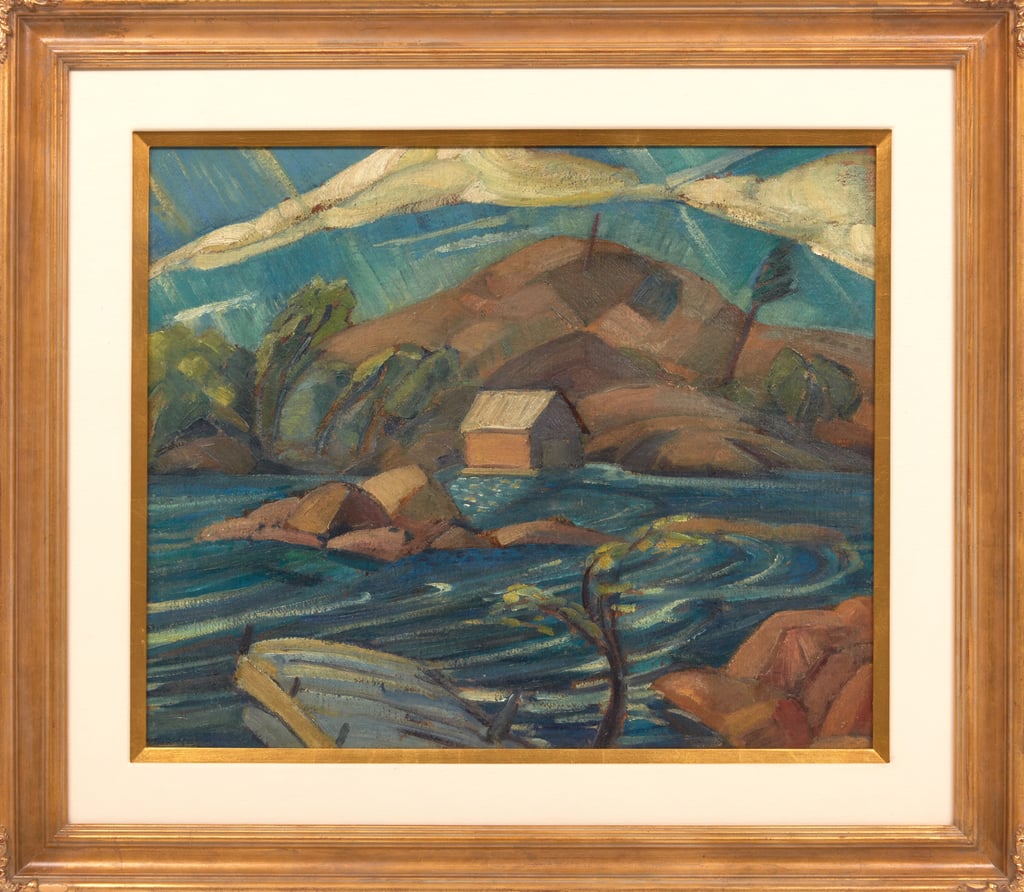
Measuring 20 by 23.75 inches, Mouth of the French River is an unusually large work in Banting’s oeuvre, where smaller sketching panels were the norm. Given the directness and structural immediacy of the brushwork, it was likely executed directly on site as a large plein air panel. The painting depicts the rocky shoreline of the Georgian Bay watershed, featuring a wooden skiff resting in the foreground and a solitary boathouse set against the rolling granite and sparse trees of the Canadian Shield.
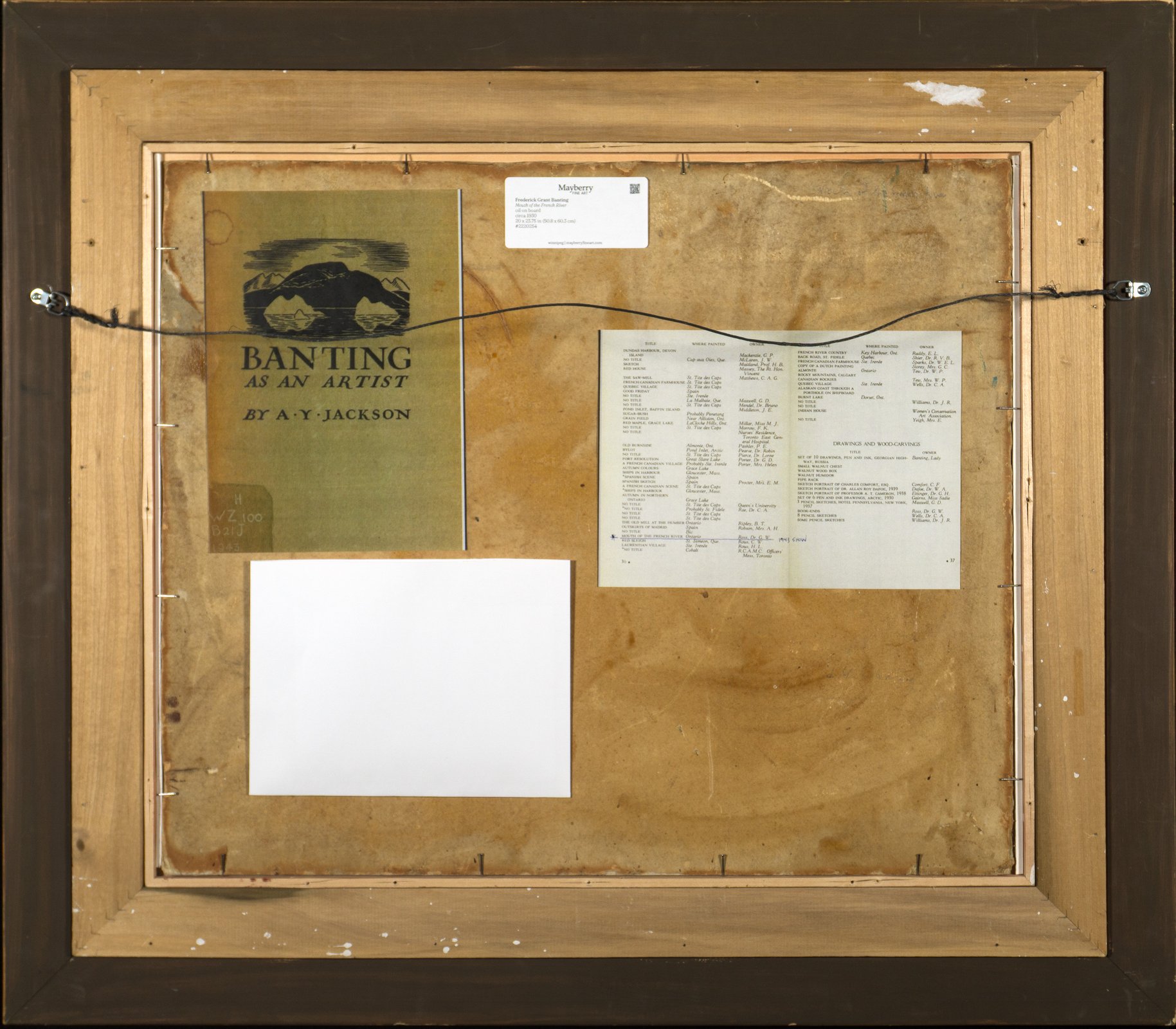
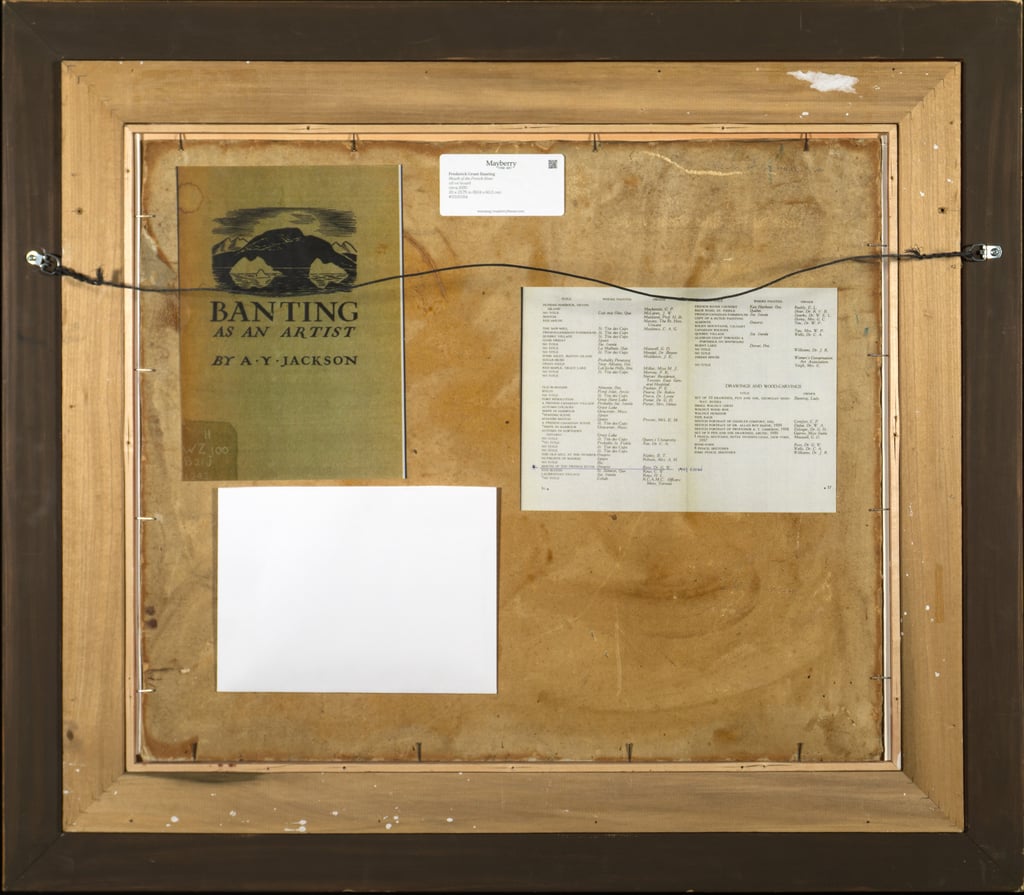
In 1943, following Banting’s death in a military aircraft crash in 1941, Jackson curated a memorial retrospective at Hart House at the University of Toronto. The exhibition checklist recorded two works titled Mouth of the French River: one loaned by Banting’s widow, Lady Henrietta Banting, and the present work, loaned by Dr. Ross. It remains unconfirmed whether the two artworks were related or distinct works painted carrying the same title.
Dr. George William Ross, Ontario
Mr. & Mrs. James H. Gairdner, Ontario
By Decent to William D. Gairdner, Ontario, 1996
Oeno Gallery, Ontario, 2016
Private Collection, Toronto
“Exhibition of Paintings by the Late Sir Frederick Banting”, Hart House, University of Toronto, February 13 - March 1, 1943
A.Y. Jackson, “Banting as an Artist”, The Ryerson Press, Toronto 1943, page 36, listed as “Mouth Of The French River” and loaned by Dr. GW Ross
Frederick Grant Banting
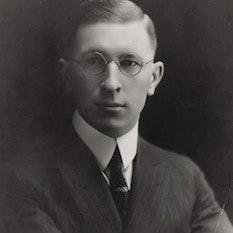
Born, 1891 in Allison, Ontario, Frederick Banting studied medicine at the University of Toronto. He received his MB degree in 1916 and immediately joined the Canadian Army Medical Corps and was sent overseas. He was wounded in France and awarded the Military Cross for bravery. Following the first World War, he continued his medical studies, receiving his M.D. degree in 1922. He had a particular interest in diabetes. Together with his assistant, Charles Best, Banting started the work which would lead to the lifesaving discovery of insulin. For this innovation, he was awarded the Nobel Prize for Medicine in 1923. After the war, he had briefly set up a practice in London, Ontario. The practice was slow in getting started, so with some time on his hands, he was gripped with an urge to paint. This came about one day, when he happened by a London shop, with a display of artist’s paints in the window. He went in, purchased them, and embarked on teaching himself to paint. As his medical career took off, he had little time to devote to this passion, but after winning the Nobel Prize, he was able to dedicate some time to art. He became a collector as well as a painter.
In 1927, he approached A.Y. Jackson, wishing to purchase one of his war sketches. This was the beginning of a long friendship. The same year, Jackson and Banting went on their first sketching excursion together. They traveled to St-Jean Port Jolie, on the south shore of the St. Lawrence. There, Banting received his first instruction in plein air landscape painting technique from Jackson. He had a natural aptitude, and his works were accepted at juried exhibitions, but he was always afraid that his work had been accepted because of his reputation as a scientist, rather than its own merit. After a time, he no longer submitted works for exhibition. He was also reluctant to sell his paintings. He had ingenious way of supporting the artists of his acquaintance. When a collector indicated a wish to purchase one of his paintings, he instructed them to purchase a work from another local artist, and he would then exchange it for one of his own works. In July of 1927, Banting traveled with Jackson to the Arctic. On a trip lasting 2 and a half months, they encountered a variety of weather and light conditions in the Arctic landscape. They returned with many sketches. The one Jackson painted of Bache Post was donated to the National Gallery of Canada by the Minister of the Interior. Over the years Banting accompanied Jackson on many sketching trips. At different times, they returned to the North shore of the St. Lawrence, traveled to the Great Slave Lake area, and visited the Group of Seven haunt, Georgian Bay. At times they were joined by other artists.
Banting thoroughly enjoyed the outdoor painting experience. He invented a system for getting his completed sketches home, without spoiling them, while they were still wet. He placed matchsticks between the panels as spacers, a trick that A.Y. Jackson continued to use for the rest of his career. Jackson spoke of Banting’s great determination and hard work on these sketching trips, often getting up to sketch long before breakfast. When the Second World War began, he began to devote himself exclusively to medical research, serving as a medical liaison officer between the British and North American medical services.
Major Fall Fine Art Auction
November 12 - December 3, 2026
661 Wall St, Winnipeg MB
(204) 255-5690
mayberryfineart.com
[email protected]
Contact us to make an appointment to preview this item or to sell similar works.
|
Bidding Range
|
Increment
|
|---|---|
| $0.00 - $50.00 | $1.00 |
| $50.00 - $100.00 | $5.00 |
| $100.00 - $500.00 | $10.00 |
| $500.00 - $1,000.00 | $25.00 |
| $1,000.00 - $2,500.00 | $50.00 |
| $2,500.00 - $10,000.00 | $100.00 |
| $10,000.00 - $20,000.00 | $200.00 |
| $20,000.00 - $50,000.00 | $500.00 |
| $50,000.00 - $100,000.00 | $1,000.00 |
| $100,000.00 - $300,000.00 | $5,000.00 |
| $300,000.00 - $1,000,000.00 | $10,000.00 |
| $1,000,000.00 - $2,000,000.00 | $25,000.00 |
| $2,000,000.00+ | $50,000.00 |
Login or register a BidLots.com account to participate in any auction. Track specific lots and artists with real-time notifications on all bidding activity.
Bidding approval requires three simple steps:
1. Create a Bid Lots account
2. Confirm your email address
3. Create a valid billing profile
Bid Lots and/or the auctioneer may choose to revoke your bidding privileges if your account is not in good standing or your activity is in conflict with our standard terms and conditions of sale.
The buyer’s premium is an additional percentage charged to the winning bidder. The buyer’s premiums may vary from auction to auction, typically ranging from 10% to 20%. Buyer’s premiums will be displayed on detailed lot listings and paddle registration forms.
Bidding begins at the reserve price and advances at set increments based on the bidding range. The specific bidding increments may vary from auction to auction, however the next bid and subsequent increments will always be clearly defined on detailed lot listings. Maximum Bids and Single Bids can only be placed within the pre-defined bidding increments ensuring that no two bidders can place identical bids on an item. View individual lot detail pages to see a complete range of bidding increments for that item.
Requests to cancel a single bid are at the sole descretion of the auctioneer. Maximum bids can be increased but cannot be decreased unless premitted by the auctioneer. Requests to cancel a bid or to alter a maximum bid will be denied if the specific lot is scheduled to close in less than 24 hours or if the lot has significant interest or activity.
To request that a bid be cancelled or to change a maximum bid use the "Ask a question" button on the detailed lot listing.
You will receive an email notification when you have successfully won an auction. You will also see the item listed on your "Bidding Results" page and if you are logged into the site you will see a highlighted message on the auction catalogue pages and auction listings.
Shipping requirements may vary on different items depending on location and size or weight of an item. When registering for a specific auction you will be provided options to clarify your preferred shipping instructions. The auctioneer will also review and provide specific shipping quotes or options following the close of an auction. If you have specific shipping requirements or are unsure of the shipping constraints on a specific item please contact the auctioneer prior to bidding.
Following the close of an auction the auctioneer will provide a detailed invoice for all items you have won. They may contact you before a final invoice is prepared to confirm or review specific shipping instructions. Payment is due once a final invoice is provided and can be submitted online by credit card, or made by EFT (Electronic Fund Transfer), bank draft or international wire transfer. Any outstanding balance will be automatically charged to your registered credit card 5 days following the close of an auction.