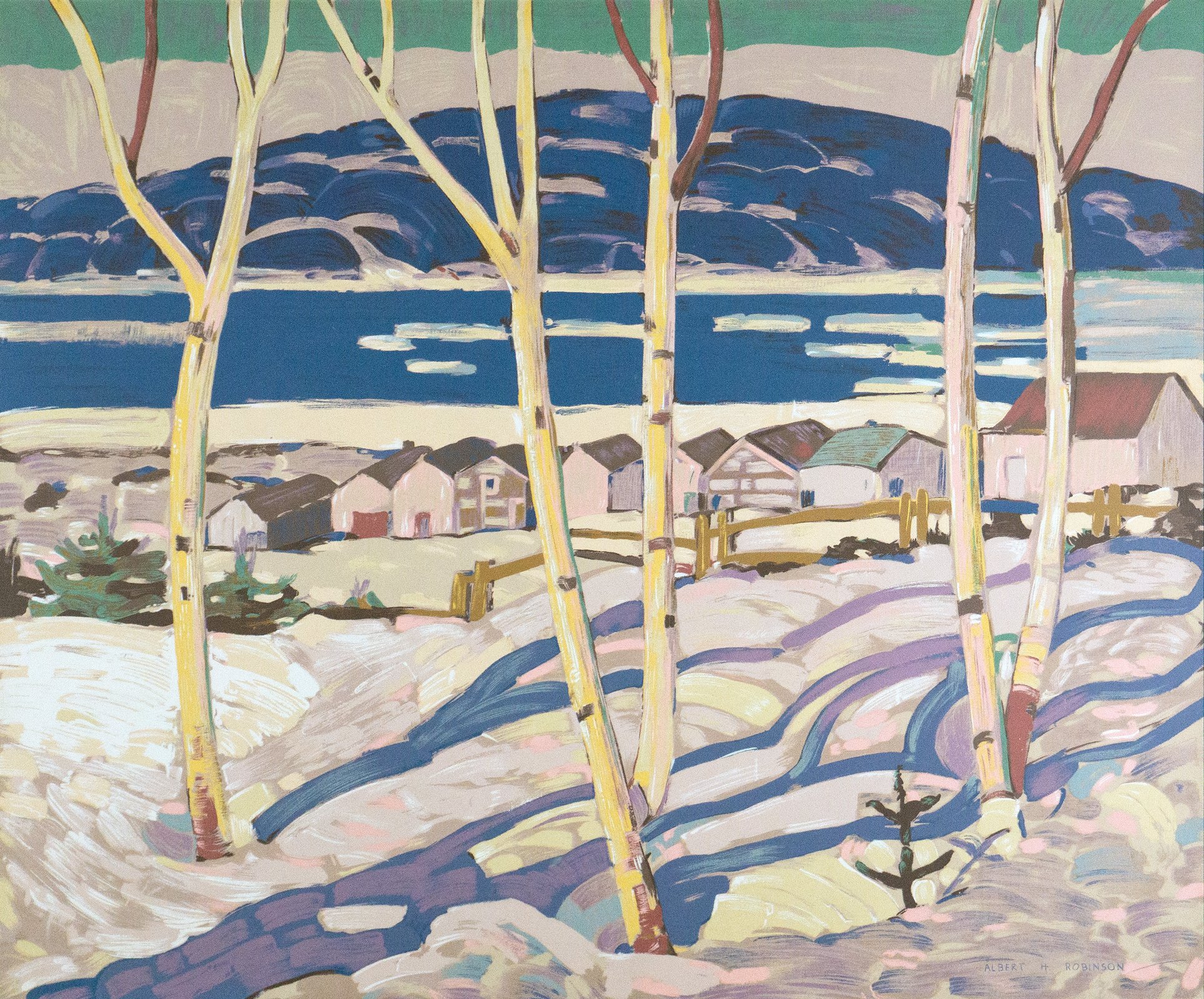
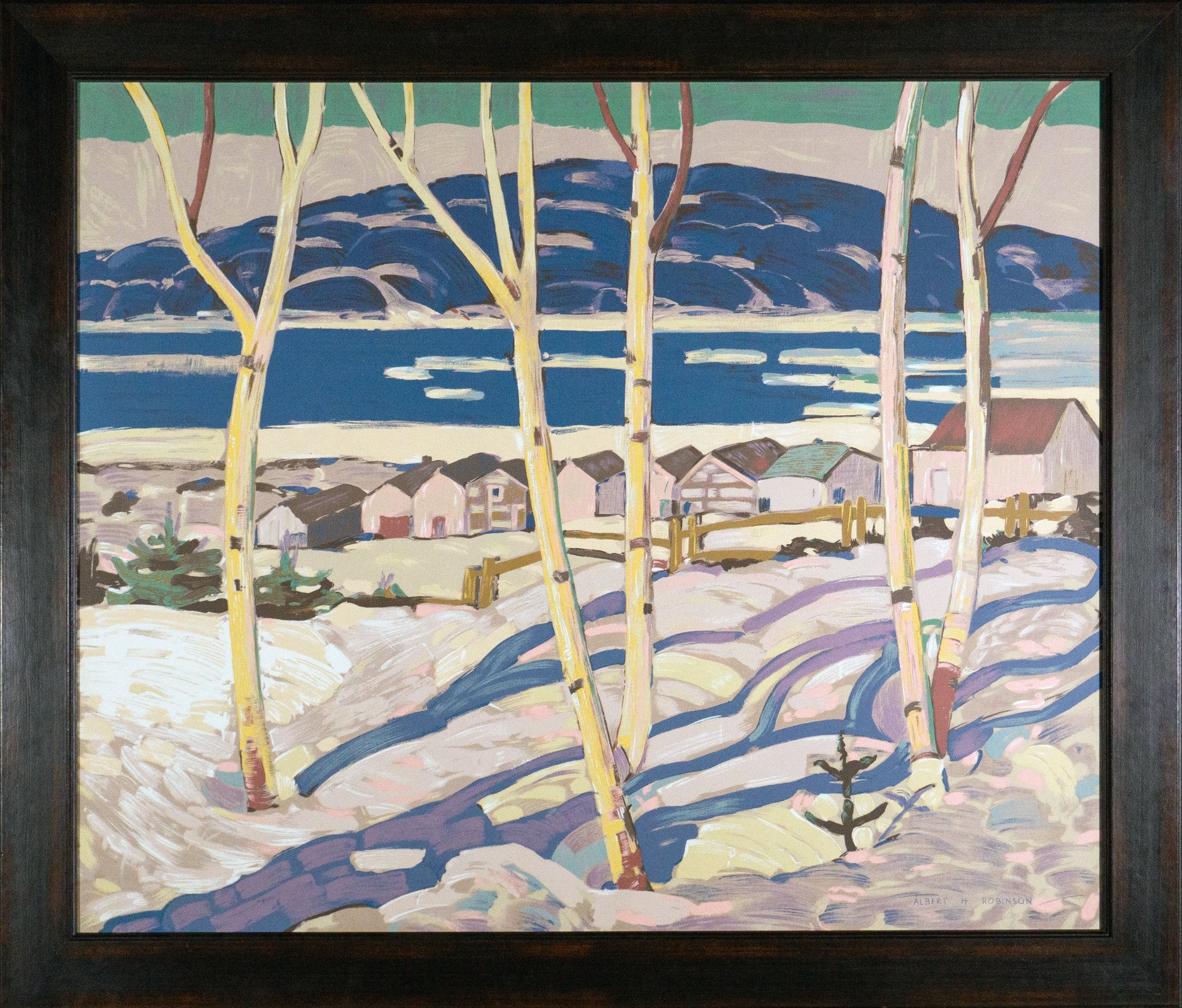
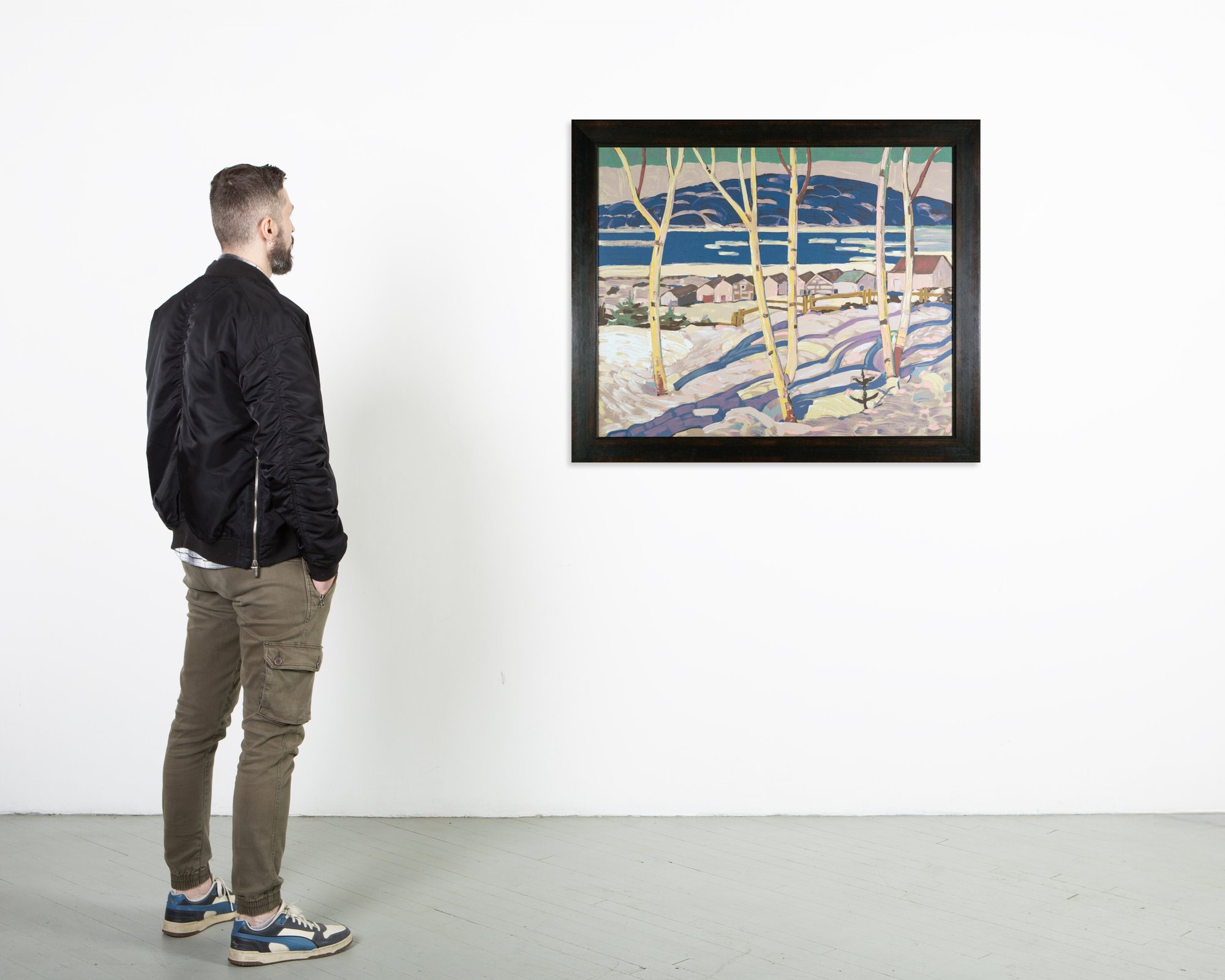
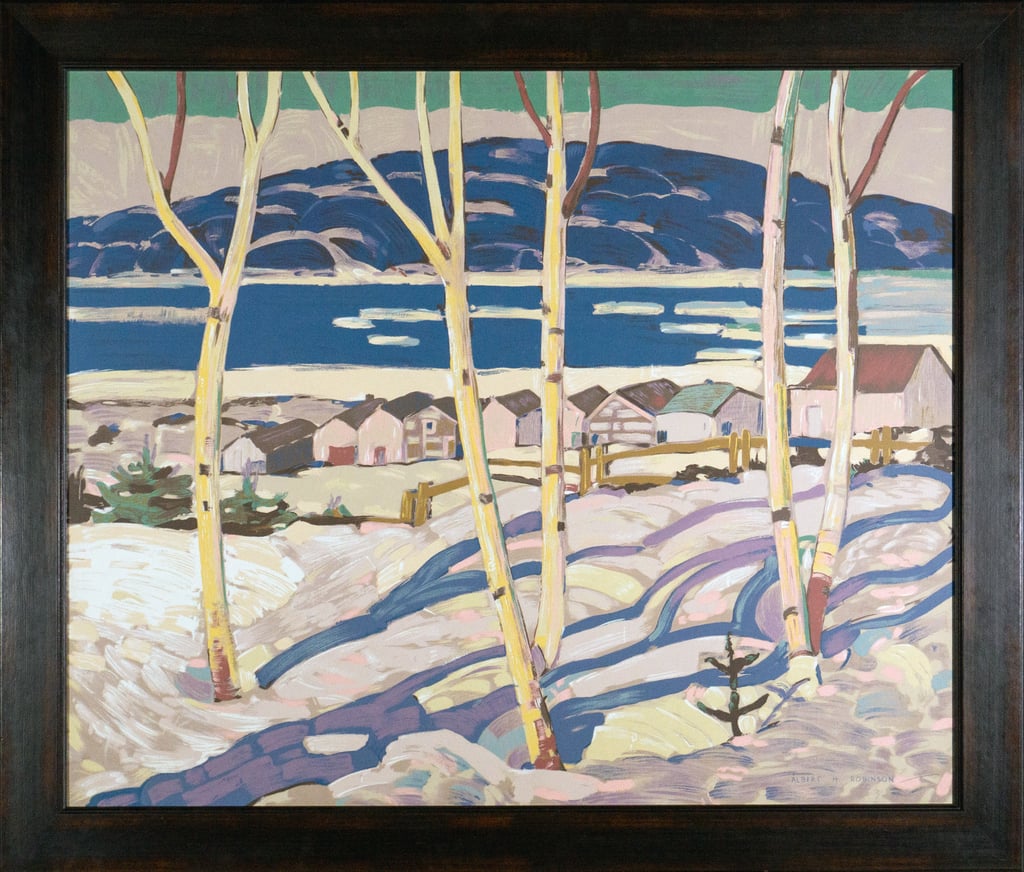
35 x 41.75 x 1 in (88.9 x 106 x 2.5 cm) including frame
The Sampson-Matthews print program was the largest public art project in Canadian history. Launched at the start of the Second World War, it lasted twenty-two years and cost tens of millions of dollars in today’s currency. At its height, it employed many of the country’s best commercial painters, designers and artists, working full-time to create masterpieces of serigraphy.
(Includes Buyer's Premium)
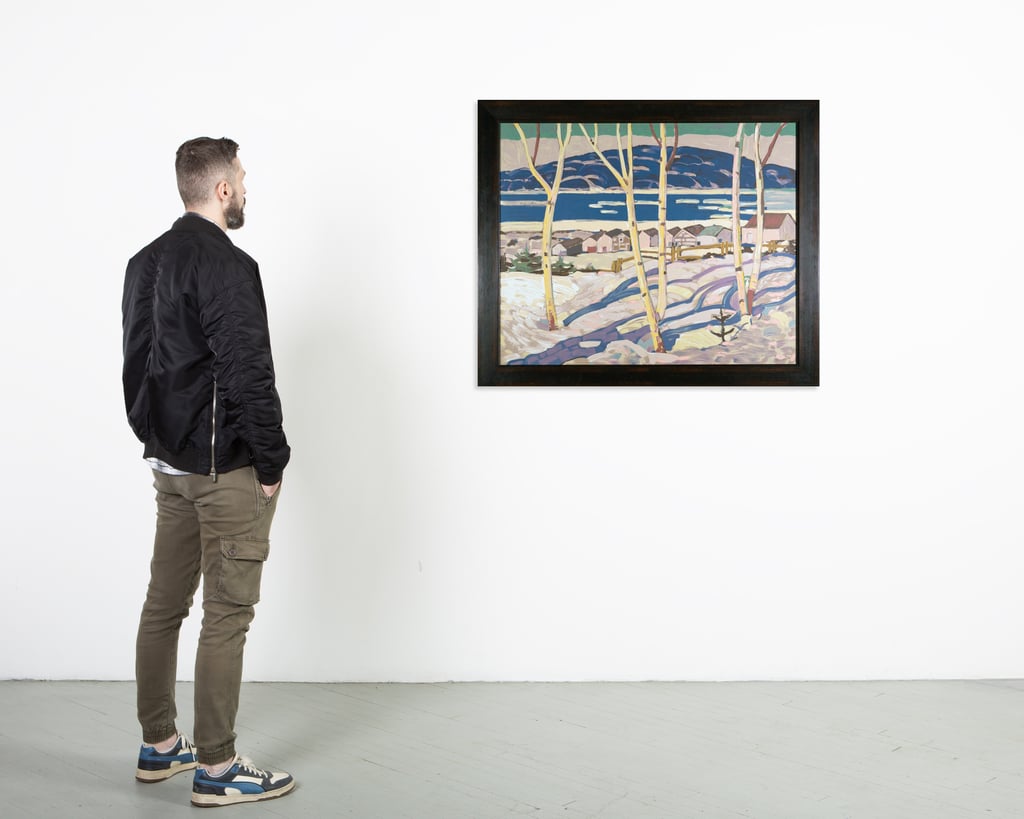
Albert Henry Robinson
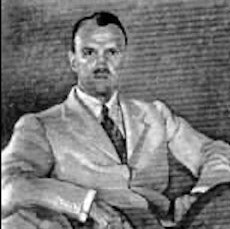
Albert Henry Robinson was born on January 2, 1881, in Hamilton, Ontario. He began drawing as a young student and after finishing high school, took a job at the Hamilton Times newspaper as an illustrator, drawing murders, accidents, and other news events for $5 a week from 1901 to 1903. During this time, he studied at the Hamilton Art School under John S. Gordon, who later married artist Hortense Mattice Gordon, a member of Painters Eleven.
After several years at the newspaper, Robinson had saved enough to travel to Paris in 1903. He studied at the Académie Julian under William Bouguereau and Bashet, producing work of sufficient quality to gain entry into the École des Beaux-Arts, where he studied with Gabriel Ferrier. He also studied with artist Thomas William Marshall. For two summers in 1904 and 1905, Robinson traveled and painted in Normandy and Corsica. After a bout with typhoid, he returned to Hamilton in 1905, where John Gordon hired him as a studio assistant. He also began teaching life classes at the Hamilton Art School.
In 1906, Robinson exhibited his paintings for the first time and sold his first oil painting to Ontario Lieutenant-Governor J.M. Gibson. Around 1907, he began painting Canadian landscapes in oil. About 1908, Robinson met William Davis and his wife, who sponsored him to paint out of a studio in Montreal. Through the Davises, he met other artists and became friends with three important painters: Maurice Cullen, William Brymner, and Edmund Dyonnet. He began painting Montreal harbor scenes and Quebec landscapes.
In 1910, Robinson met A.Y. Jackson and they became good friends. In 1911, the two artists sailed to Europe together to paint, visiting St. Malo and Carhaix in Brittany, where Robinson sketched along the French coast. After four months, Robinson became homesick and short of money and returned to Montreal. Robinson was elected an Associate of the Royal Canadian Academy of Arts in 1911.
When World War I was declared, Jackson went into the army while Robinson worked in the war industry as inspector of munitions at Longue-Pointe, Quebec from 1914 to 1918. In 1918, Robinson was commissioned by Canadian War Memorials to paint the Vickers Shipbuilding plant in Montreal. Many of his canvases from this period are now in Canadian war collections. He became an Academician of the Royal Canadian Academy in 1920.
After the war, from about 1918 to 1933, Robinson painted rural Quebec on sketching trips along the St. Lawrence River and in the Laurentians with Jackson, Clarence Gagnon, Edwin Holgate, and Randolph Hewton. In 1921, he painted with Jackson at Cacouna where he made studies for "Returning from Easter Mass" (1922), now in the Art Gallery of Ontario collection. This painting was later selected for reproduction in the Sampson-Matthews silkscreen project. Despite traveling to the south shore of the Saint Lawrence River with Jackson in 1921, Robinson preferred to paint the north shore, making annual trips throughout the 1920s and into the early 1930s to Beaupré and Charlevoix counties, including Baie-Saint-Paul, Murray Bay, Saint-Fidèle, and Saint-Tite-des-Caps.
Robinson exhibited "The Open Stream" (1923) at the British Empire Exhibition at Wembley in 1925. This painting was then shown in Paris where it was purchased in 1932 by the French Government. In 1920, Robinson was invited to participate as a guest exhibitor at the inaugural exhibition of the Group of Seven in Toronto.
Robinson's work was characterized by a high-keyed palette with crisp, square-edged brushstrokes. He used the rolling rhythm of landscape parallel to the picture plane similar to A.Y. Jackson, but endowed his work with unusual colors including corals, pinks, and dark blue. He sought simplified, powerful form. His vision of Quebec was idyllic, depicting rural landscapes caught in prisms of snow banks and snowflakes. His personal vision and technique represented a spontaneous and lifelong method barely modified from his earliest Impressionist studies done in France.
Robinson began to battle ill health in the late 1920s. He had a successful solo show in 1926 but could not produce enough new works for another show the following year due to his health. Due to a heart attack followed by arthritis, he was forced to retire from painting by 1936, more than a decade before his death. The Art Gallery of Hamilton and National Gallery of Canada held a retrospective show in 1955. Robinson died on September 7, 1956, in Montreal.
Robinson was a member of the Pen and Pencil Club of Montreal and the Arts Club of Montreal. His work is held in collections including the National Gallery of Canada, Art Gallery of Ontario, Art Gallery of Hamilton, McMichael Canadian Art Collection, Montreal Museum of Fine Arts, Musée national des beaux-arts du Québec, and Musée National d'Art Moderne in Paris.
March Fine Art Auction
March 12 - March 26, 2026

661 Wall St, Winnipeg MB
(204) 255-5690
mayberryfineart.com
[email protected]
Contact us to make an appointment to preview this item or to sell similar works.
|
Bidding Range
|
Increment
|
|---|---|
| $0.00 - $50.00 | $1.00 |
| $50.00 - $100.00 | $5.00 |
| $100.00 - $500.00 | $10.00 |
| $500.00 - $1,000.00 | $25.00 |
| $1,000.00 - $5,000.00 | $50.00 |
| $5,000.00 - $10,000.00 | $100.00 |
| $10,000.00 - $20,000.00 | $200.00 |
| $20,000.00 - $50,000.00 | $500.00 |
| $50,000.00 - $100,000.00 | $1,000.00 |
| $100,000.00+ | $5,000.00 |
Login or register a BidLots.com account to participate in any auction. Track specific lots and artists with real-time notifications on all bidding activity.
Bidding approval requires three simple steps:
1. Create a Bid Lots account
2. Confirm your email address
3. Create a valid billing profile
Bid Lots and/or the auctioneer may choose to revoke your bidding privileges if your account is not in good standing or your activity is in conflict with our standard terms and conditions of sale.
The buyer’s premium is an additional percentage charged to the winning bidder. The buyer’s premiums may vary from auction to auction, typically ranging from 10% to 20%. Buyer’s premiums will be displayed on detailed lot listings and paddle registration forms.
Bidding begins at the reserve price and advances at set increments based on the bidding range. The specific bidding increments may vary from auction to auction, however the next bid and subsequent increments will always be clearly defined on detailed lot listings. Maximum Bids and Single Bids can only be placed within the pre-defined bidding increments ensuring that no two bidders can place identical bids on an item. View individual lot detail pages to see a complete range of bidding increments for that item.
Requests to cancel a single bid are at the sole descretion of the auctioneer. Maximum bids can be increased but cannot be decreased unless premitted by the auctioneer. Requests to cancel a bid or to alter a maximum bid will be denied if the specific lot is scheduled to close in less than 24 hours or if the lot has significant interest or activity.
To request that a bid be cancelled or to change a maximum bid use the "Ask a question" button on the detailed lot listing.
You will receive an email notification when you have successfully won an auction. You will also see the item listed on your "Bidding Results" page and if you are logged into the site you will see a highlighted message on the auction catalogue pages and auction listings.
Shipping requirements may vary on different items depending on location and size or weight of an item. When registering for a specific auction you will be provided options to clarify your preferred shipping instructions. The auctioneer will also review and provide specific shipping quotes or options following the close of an auction. If you have specific shipping requirements or are unsure of the shipping constraints on a specific item please contact the auctioneer prior to bidding.
Following the close of an auction the auctioneer will provide a detailed invoice for all items you have won. They may contact you before a final invoice is prepared to confirm or review specific shipping instructions. Payment is due once a final invoice is provided and can be submitted online by credit card, or made by EFT (Electronic Fund Transfer), bank draft or international wire transfer. Any outstanding balance will be automatically charged to your registered credit card 5 days following the close of an auction.