The New Teen Titans
Comic Series, 1980
Items in The New Teen Titans
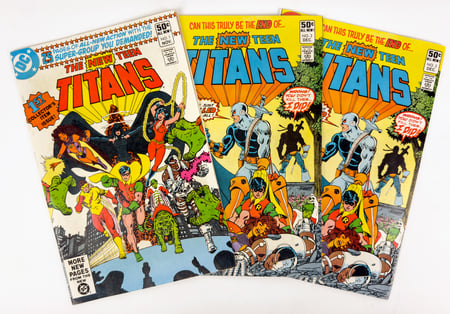
The New Teen Titans
Debuting in DC Comics Presents #26 in October 1980 before launching its own title the following month, The New Teen Titans was a revitalization of the silver age team concept by writer Marv Wolfman and artist George Pérez. The series was designed to compete with the character driven success of Marvel’s X-Men, moving away from the "junior Justice League" dynamic of the 1960s. Wolfman and Pérez retained original members Robin, Wonder Girl, and Kid Flash while introducing three entirely new characters: Starfire, an alien princess; Cyborg, a technologically enhanced athlete; and Raven, a half demon empath. This roster was rounded out by Changeling, formerly Beast Boy of the Doom Patrol, creating a diverse ensemble that balanced superhero action with soap opera style interpersonal drama.
The series is historically significant for its consistent creative vision and its role in introducing several of the most enduring antagonists in the DC Universe. Issue #2 featured the first appearance of Deathstroke the Terminator, a mercenary who would become the team’s primary foil and a major figure in the broader DC continuity. Other key milestones included the introduction of the demonic entity Trigon and the exploration of the fictional Middle Eastern nation of Qurac. Technically, the series benefited from the detailed, ensemble oriented pencils of George Pérez, whose ability to render large casts and complex mechanical designs, such as Cyborg’s components or the Titans Tower, set a new visual standard for group titles in the early 1980s.
The cultural impact of The New Teen Titans lies in its successful transition of legacy sidekicks into independent, adult protagonists, a shift that redefined the "teen hero" subgenre for the modern era. Its blend of high stakes cosmic conflict and grounded emotional conflict made it one of DC's most popular titles of the decade, often outselling the publisher's flagship Superman and Batman books. The series established the core mythology that has served as the foundation for multiple animated television shows, feature films, and live action series. As a collectible, it is recognized for its role in the 1980s direct market expansion and its status as the definitive starting point for the modern Titans franchise.