Daniel Inukpuk
Works by Daniel Inukpuk
Daniel Inukpuk
Daniel Inukpuk, born in 1942 in Sarollie Weetaluktuk's camp near Inukjuak, Nunavik, Quebec, is a prominent Inuit sculptor, printmaker, and draftsman. As the son of carver Johnny Inukpuk, he comes from a family of artists that includes his brothers Charlie and Johnny Jr. Daniel began his artistic career around 1960 after his family settled in Inukjuak in the 1950s. He later expanded his practice to include printmaking, learning techniques from Thomassie and Lucassie Echalook, and divided his time between both mediums until the Inukjuak print shop closed in 1976.
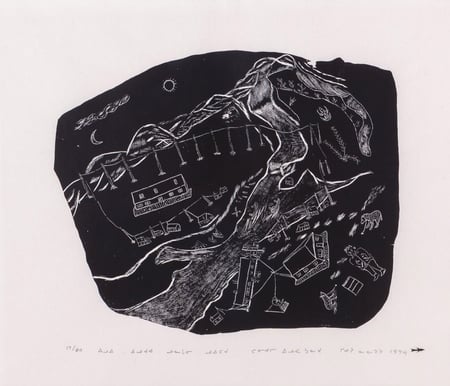
Inukpuk's artwork is characterized by its dynamic energy and sense of movement. His prints, in particular, showcase figures in motion – running, fighting, flying, playing, swimming, and hunting. In the early 1970s, he contributed to several Nunavik print collections, establishing himself as a multi-talented artist. His sculptures and prints have gained international recognition, with his work held in prestigious permanent collections including the National Gallery of Canada, the Canadian Museum of History, the Art Gallery of Ontario, the Winnipeg Art Gallery, and the Smithsonian's National Museum of the American Indian.
Beyond his artistic practice, Inukpuk is deeply committed to cultural preservation and community engagement. As a board member of the Unaaq's Men's Association, founded in Inukjuak in 2001, he organizes workshops to teach younger generations traditional skills such as making fish-nets, igloos, kayaks, and traditional tools. He is also involved with the Inukjuak co-operative, which he views as a social entity where carvers can gather, collaborate, and support each other. In 2021, his cultural standing was further recognized when he designed the medal for Quebec's first 'Inuit First Peoples Medal' awarded by the lieutenant-governor of Quebec.
Despite his continued artistic output, Inukpuk has spoken candidly about the challenges facing contemporary Inuit carvers, particularly the increasing difficulty in accessing quality stone and the shifting interests of younger generations away from traditional carving. His concern for cultural preservation is evident in his statement: "I think carving is an important part of our culture, but the generation today have more interests other than carving, so it seems inevitable that we will start to lose that part of our culture." Nonetheless, Inukpuk remains an active carver, often working alongside his longtime friend Lucassie Echalook, and continues to create artwork that documents and celebrates Inuit traditions and experiences.