Simiuni Sivuarapik
Inuit Artists
Works by Simiuni Sivuarapik
Simiuni Sivuarapik
1926 - 1983
Simiuni Sivuarapik was an Inuit sculptor, printmaker, and community leader born near Puvirnituq (Povungnituk) in Nunavik, northern Quebec. Raised in a traditional semi-nomadic lifestyle, he spent his youth hunting, trapping, and traveling along the eastern coast of Hudson Bay. During the early 1950s, as the local economy shifted toward stone carving, Sivuarapik emerged as a central figure in the development of the contemporary Inuit art movement in Arctic Quebec.
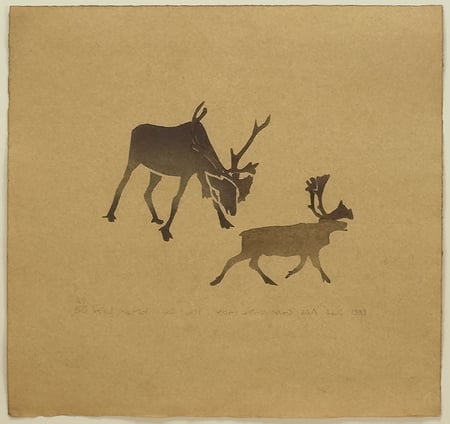
Working predominantly in local dark soapstone, Sivuarapik became known for his detailed, naturalistic depictions of traditional Inuit life, wildlife, and hunter-prey dynamics. His sculptures frequently portrayed Arctic fauna, such as walruses, polar bears, and seals, as well as scenes of daily survival and camp life. Beyond his individual studio work, he played a foundational role in establishing the Povungnituk Sculptors' Association in 1958, which later evolved into the Co-operative Association of Povungnituk, an organization created to support indigenous artists and secure economic independence for the community.
Over the course of his career, Sivuarapik contributed to the broader recognition of Inuit visual culture across Canada and internationally. His works were featured in early landmark survey exhibitions organized by public institutions, including the National Gallery of Canada and the Winnipeg Art Gallery. Today, his sculptures are preserved in major public museum collections, including the National Gallery of Canada, the Montreal Museum of Fine Arts, and the Canadian Museum of History. He lived and worked in Puvirnituq until his death in 1983.