James Stuart Park
European Artists
Works by James Stuart Park
James Stuart Park
1862 - 1933
James Stuart Park was a Scottish painter known for his floral still lifes and figure studies. Born in Kidderminster, Worcestershire, to Scottish parents, he spent his youth in Ayrshire, Scotland. Before committing fully to art, he was apprenticed as an engineer. He began his artistic education through evening classes at the Glasgow School of Art in the mid-1880s. He continued his studies in Paris, attending the Académie Julian under Gustave Boulanger and Jules-Joseph Lefebvre, and the École des Beaux-Arts under Fernand Cormon.
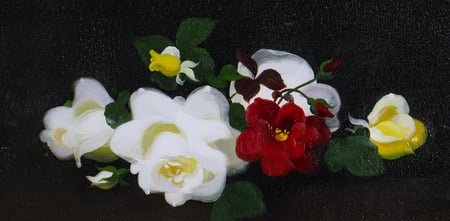
Upon returning to Scotland, Park established a professional studio in Glasgow by 1888 and became associated with the Glasgow Boys movement. During this period, he shared studio space with artists David Gauld and James Kay. While initially attempting portraiture, he shifted his focus to floral still life compositions. His technique relied on rapid, fluid brushwork to depict flowers against dark, contrasting backgrounds.
In 1896, Park relocated to Kilmarnock, where he continued his studio practice for the remainder of his career. He maintained a focus on capturing floral subjects, particularly roses, lilies, orchids, and hydrangeas. His work was featured in exhibitions at the Royal Scottish Academy and the Royal Glasgow Institute.
Park's works are held in public museum collections across Scotland, including the Kelvingrove Art Gallery and Museum, the Hunterian Museum and Art Gallery in Glasgow, the Dundee City Art Galleries, and the Dick Institute in Kilmarnock. He died in Kilmarnock in 1933.