Judas Ullulaq
Inuit Artists
Works by Judas Ullulaq
Judas Ullulaq, RCA
1937 - 1999
Judas Ullulaq, RCA (1937–1999), was a Netsilik Inuit sculptor born in the Taloyoak region (formerly Spence Bay) on the Boothia Peninsula in Nunavut. He spent his early life following a traditional nomadic lifestyle on the land with his family before settling in the community of Taloyoak during the 1960s. He was the nephew of renowned artist Karoo Ashevak and the brother of sculptor Charlie Ugyuk, emerging from a family deeply involved in carving traditions.
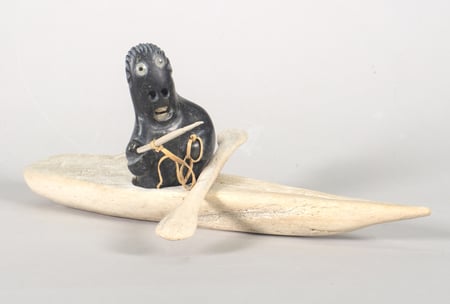
Ullulaq began carving stone and organic materials in the early 1970s. Working primarily in the distinctive local dark green and grey soapstone, caribou antler, whalebone, and muskox horn, his work focused on figurative forms, shamanic transformations, maternal subjects, and camp scenes. In 1974, he attended the Toronto print and carving workshop organized by the Canadian Eskimo Arts Council, an experience that broadened his exposure to studio methods and contemporary Indigenous art practices across Canada.
Throughout the 1980s and 1990s, his work was acquired by major Canadian public galleries and presented in institutional museum exhibitions. In 1988, his sculptures were featured in the landmark exhibition In the Shadow of the Sun: Contemporary Canadian Indian and Inuit Art, organized by the Canadian Museum of Civilization (now the Canadian Museum of History) in Gatineau, Quebec. The exhibition traveled internationally, including presentations in Germany and the United States. His work was also showcased in the 1990 exhibition The First Passionate Dawn: Canadian Inuit Art at the Winnipeg Art Gallery.
Ullulaq was elected to the Royal Canadian Academy of Arts (RCA) in 1993 in recognition of his contributions to Canadian sculpture. He maintained an active studio practice in Taloyoak until his death on January 29, 1999. His sculptures are preserved in the permanent collections of major public art museums, including the National Gallery of Canada in Ottawa, the Winnipeg Art Gallery, the Montreal Museum of Fine Arts, the Art Gallery of Ontario in Toronto, and the Canadian Museum of History.