Alfred de Breanski Sr.
European Artists
Works by Alfred de Breanski Sr.
Alfred de Breanski Sr., RSBAS
1852 - 1928
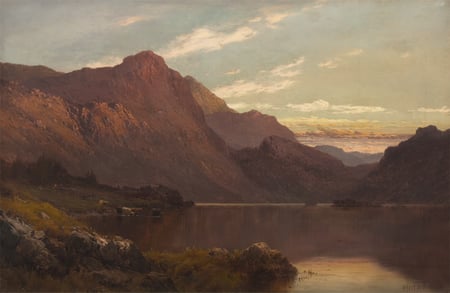
Alfred de Breanski Sr. (1852–1928) was a prominent British landscape painter of the Victorian era, recognized for his naturalistic and luminous depictions of the mountainous regions of Scotland and Wales. Born in Greenwich, England, he was the eldest son of Leopold de Breanski. He received early recognition for his technical proficiency, winning awards for drawing at the Greenwich Proprietary School before making his debut at the Royal Academy in 1872 with the work "Evening: Softly falls the even light". This initial success established his reputation, and he continued to exhibit at the Royal Academy regularly until 1918.
Throughout his career, Breanski focused on capturing the atmospheric conditions of the British wilderness, frequently traveling to the Scottish Highlands and North Wales. His style was characterized by a meticulous attention to the textures of foliage, rock, and earth, often set against the backdrop of a sunset or "golden hour" light. Common motifs in his work included lochs, rugged mountain peaks, and the inclusion of highland cattle or sheep. His approach to light and sky suggests the influence of earlier British masters such as John Constable and J.M.W. Turner, though he maintained a signature realism that appealed to contemporary collectors.
Breanski was an active member of several professional organizations, including the Royal Society of British Artists and the Royal Cambrian Academy. In 1880, he was honored as a Freeman of the City of London. His familial life was closely tied to the arts; his brother Gustave and sister Julie were painters, and in 1873 he married the Welsh artist Annie Roberts. Two of their sons, Alfred Fontville de Breanski and Arthur Breanski, followed their father into the profession, with the elder Breanski often using an accent on the "é" in his signature to distinguish his work from that of his son.
His work is represented in numerous public institutional collections globally. In the United Kingdom, his paintings are held by the Southampton City Art Gallery, the Laing Art Gallery in Newcastle upon Tyne, the Glasgow Museum, and the Brighton & Hove Museums. His legacy remains defined by his role in documenting the British landscape during a period of transition toward modernism, maintaining a consistent dedication to the traditions of 19th-century naturalism until his death in London in 1928.