Paraskeva Clark
Historical Canadian Artists
Works by Paraskeva Clark
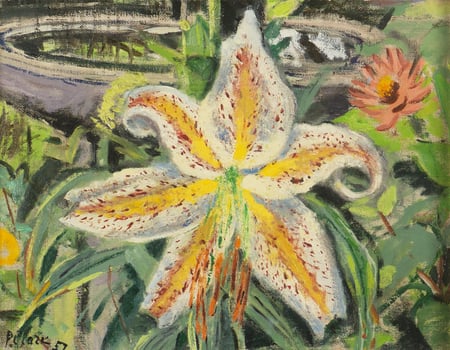
Paraskeva Clark, RCA, OSA
1896 - 1986
Paraskeva Clark was a Russian-born Canadian painter known for her contributions to modernism and her dedication to social and political subject matter. Born Paraskeva Avdeyevna Plistik in Saint Petersburg, she received her formal art education at the Petrograd Academy of Fine Arts between 1916 and 1918 under Savely Seidenberg. Following the Russian Revolution, she continued her studies at the Free Art Studios from 1918 to 1921, where she was mentored by Vasily Shukhaev and Kuzma Petrov-Vodkin. Her early training focused on formalist-realist techniques and the structural principles of Paul Cézanne, which remained foundational to her practice.
After spending several years in Paris, where she worked in an interior design shop and became familiar with European post-impressionism, she immigrated to Toronto in 1931 with her second husband, Philip Clark. Upon her arrival, she joined a community of younger artists who sought to move beyond the traditional wilderness landscapes popularized by the Group of Seven. Clark advocated for art that reflected human experiences and social realities, often incorporating themes of class struggle and international politics into her work. In 1933, she became an early member of the Canadian Group of Painters and later served as president of the Canadian Society of Painters in Water Colour in 1949.
During the Second World War, Clark’s work shifted toward the war effort and international relations. In 1944, the National Gallery of Canada commissioned her to document the activities of the Women's Divisions of the Armed Forces. This appointment resulted in significant works such as Parachute Riggers (1947), which depicted the labor of the Royal Canadian Air Force Women's Division. Throughout her career, she also maintained a focus on self-portraiture, still life, and urban landscapes, characterized by a distinctive use of tilted verticals and structured compositions.
Clark’s professional standing was solidified through her involvement with several prominent institutions, including the Ontario Society of Artists and the Royal Canadian Academy, to which she was elected as a full member in 1966. Her work was featured in numerous major exhibitions, such as Canadian Painting in the Thirties at the National Gallery of Canada in 1975. Today, her paintings are held in the permanent collections of the National Gallery of Canada, the Art Gallery of Ontario, the Winnipeg Art Gallery, and the Canadian War Museum.