Jean-Louis Forain
European Artists
Works by Jean-Louis Forain
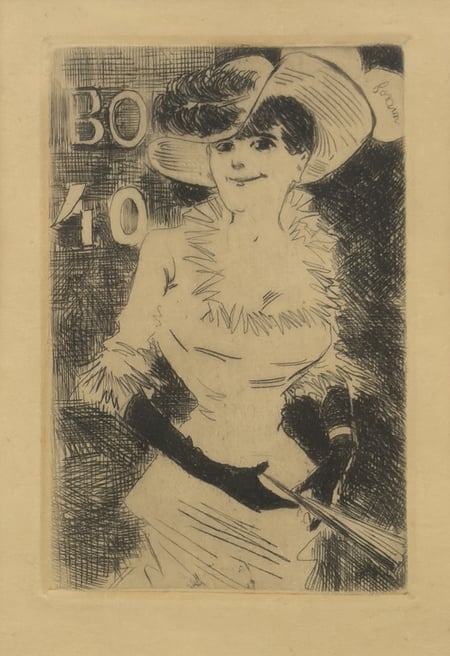
Jean-Louis Forain
1852 - 1931
Jean-Louis Forain was a French painter, printmaker, watercolorist, and caricaturist. Born Louis Henri Forain in Reims, France, he moved with his family to Paris around 1860. His early artistic training included copying Old Masters at the Musée du Louvre, private drawing instruction under Louis-Henri Jacquesson de la Chevreuse, and brief study at the École des Beaux-Arts under Jean-Léon Gérôme, as well as time in the studio of sculptor Jean-Baptiste Carpeaux.
During the late 1870s, Forain established close connections with the Parisian avant-garde, forming friendships with figures such as Edgar Degas and Édouard Manet. At the invitation of Degas, he joined the Impressionist group and participated in four of their independent exhibitions in Paris between 1879 and 1886. His work from this period focused on scenes of contemporary urban life, including the ballet, racetracks, cafés, and the theater.
Simultaneously, Forain developed a prolific career as a graphic illustrator and political satirist. Beginning in the 1880s, his illustrations appeared in prominent French publications, including Le Figaro, Le Courrier français, and Le Rire. In the early 20th century, his thematic focus expanded to include series centered on the French judicial system, courtroom proceedings, and social commentary. During World War I, he served in the Section de Camouflage and produced military drawings.
Forain received significant institutional recognition late in his career. He was elected to the Académie des Beaux-Arts in 1923 and served as president of the Société Nationale des Beaux-Arts from 1925 until his death in 1931. In 1931, he was elected an Honorary Member of the Royal Academy of Arts (Hon. RA) in London.
His works are preserved in the permanent public collections of major international institutions, including the National Gallery of Canada in Ottawa, the Musée d'Orsay in Paris, the National Gallery of Art in Washington, D.C., the Tate in London, and the Art Institute of Chicago.